
WHOLESALE SOURCING GUIDES
What is MAP Pricing and Why It Matters for Amazon FBA Wholesale Sellers
By Brandhunterz Ltd | Company No: 15342697 | 11 minute read
Affiliate Disclosure: This article contains affiliate links. If you purchase through our links we may earn a commission at no extra cost to you. We only recommend tools we genuinely use and believe in. Read our full disclaimer.
If you have been researching Amazon FBA wholesale sourcing for any length of time you will have come across the term MAP pricing. Understanding MAP pricing is not optional for serious wholesale sellers — it is one of the most important concepts you need to master before approaching any brand for a wholesale account.
We are Brandhunterz Ltd — a UK registered wholesale sourcing company (Company No: 15342697) — and MAP pricing compliance is something we take extremely seriously in every supplier relationship we build. In this guide we explain exactly what MAP pricing is, why brands enforce it, how it affects your margins and most importantly how to use it to your advantage as a wholesale seller.
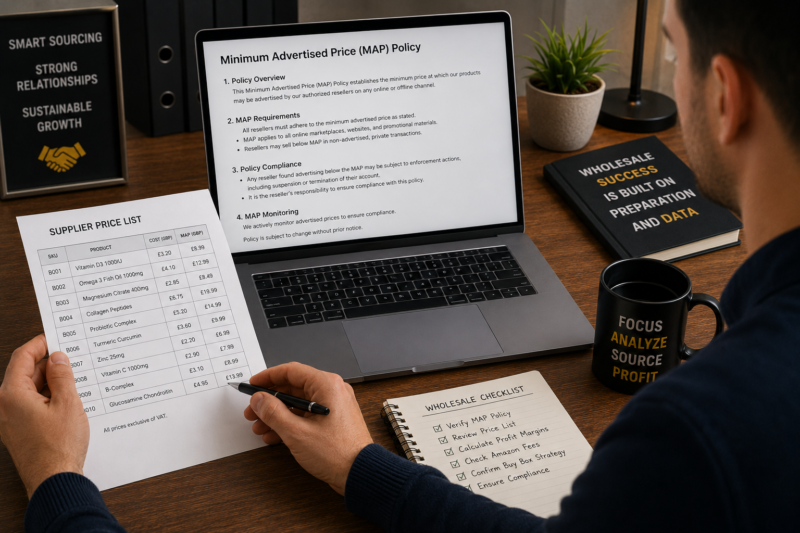
💡 Quick Summary
MAP stands for Minimum Advertised Price. It is the lowest price a wholesale reseller is allowed to advertise a product for. Brands set MAP policies to protect their brand value and prevent price wars. Respecting MAP is essential for maintaining wholesale accounts and avoiding termination.
What is MAP Pricing?
MAP stands for Minimum Advertised Price. It is a policy set by a brand or manufacturer that specifies the lowest price at which their authorised resellers are permitted to advertise their products publicly. On Amazon this means the lowest price you can display on your product listing.
MAP pricing is not the same as a fixed retail price. You are technically allowed to sell a product below MAP in certain circumstances — for example in a private sale or with a coupon — but you cannot publicly advertise a price below MAP on your Amazon listing or anywhere else publicly visible.
| Term | What it Means | Example |
|---|---|---|
| MAP Price | Minimum price you can advertise publicly | £14.99 — cannot list below this |
| RRP / MSRP | Recommended retail price — suggested not enforced | £17.99 — suggested selling price |
| Wholesale Price | What you pay the brand per unit | £6.50 — your buy price |
| Your Selling Price | What you list on Amazon — must be at or above MAP | £14.99 to £17.99 |
Why Do Brands Set MAP Policies?
Understanding why brands set MAP policies helps you appreciate why respecting them is so important for building long-term wholesale relationships. Brands set MAP policies for several key reasons:
Reason 1 — Protecting Brand Value
When resellers compete aggressively on price it creates a race to the bottom that damages how customers perceive the brand. A premium skincare brand that retails for £25 loses its premium positioning if resellers start advertising it for £8. MAP pricing prevents this by ensuring all resellers maintain a minimum price floor that preserves the brand’s perceived value.
Reason 2 — Protecting Retail Partners
Many brands sell through multiple channels — their own website, high street retailers and Amazon resellers. If Amazon resellers undercut the brand’s own website price or high street retail partners it creates serious commercial tensions. MAP policies level the playing field across all channels.
Reason 3 — Ensuring Reseller Profitability
Brands actually want their resellers to be profitable. An unprofitable reseller cannot continue buying stock, grow their orders or invest in marketing the brand’s products. MAP pricing protects reseller margins — including yours — which benefits the entire supply chain.
Reason 4 — Preventing Price Wars
Without MAP policies multiple resellers on the same Amazon listing will inevitably undercut each other in an attempt to win the Buy Box. This destroys margins for all sellers and ultimately harms the brand. MAP policies eliminate this destructive competition by establishing a price floor that all resellers must respect.
How MAP Pricing Affects Your Amazon FBA Business
MAP pricing has both positive and negative implications for Amazon FBA wholesale sellers. Understanding both sides helps you make better sourcing decisions:
Positive Impact of MAP on Your Business
| Benefit | Why It Helps You |
|---|---|
| Price stability | Your margins are protected — no race to the bottom with other sellers |
| Predictable profit | You can accurately forecast your margins before placing any order |
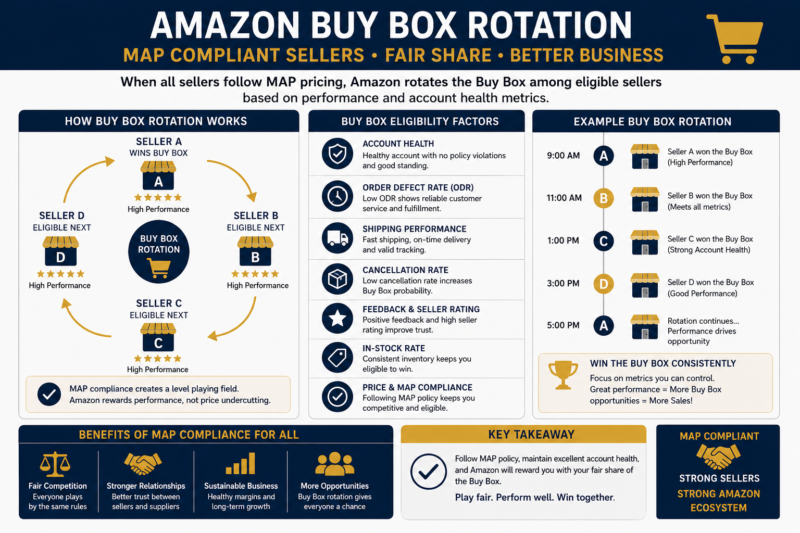
| Buy Box rotation | When all sellers price the same Amazon rotates the Buy Box fairly |
| Brand protection | Brand value is maintained making the product easier to sell long term |
Negative Impact of MAP on Your Business
| Challenge | How to Handle It |
|---|---|
| Cannot use price to win Buy Box | Focus on account health metrics and FBA fulfilment to win rotation |
| Fixed ceiling on selling price | Negotiate better wholesale buy price to improve margins instead |
| MAP violations by other sellers | Report violations to brand — they want to know and will act |
How to Calculate Profit Margins With MAP Pricing
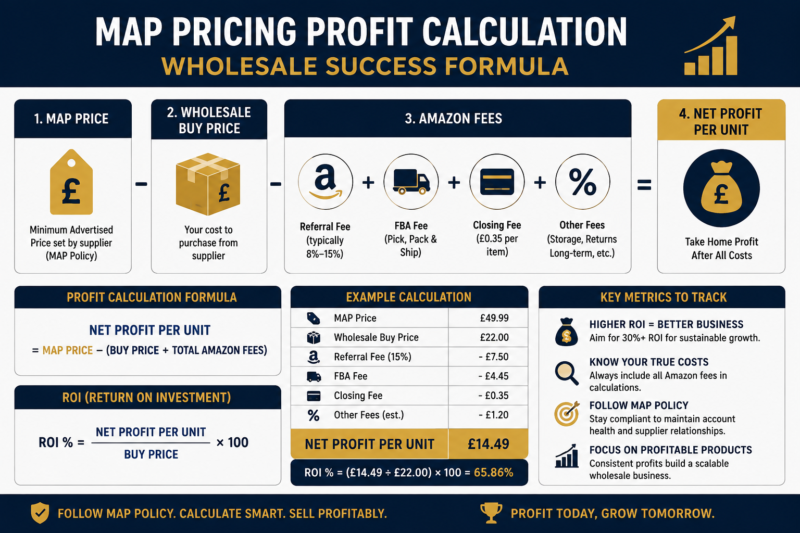
When you receive a wholesale price list from a brand you need to calculate your profit margin using the MAP price as your selling price — not the RRP. Here is the exact formula Brandhunterz Ltd uses for every product we research:
MAP PROFIT CALCULATION FORMULA
| MAP Selling Price | £14.99 |
| Minus Wholesale Buy Price | – £5.50 |
| Minus Amazon Referral Fee 15% | – £2.25 |
| Minus FBA Fulfilment Fee | – £2.50 |
| Minus Storage and Shipping | – £0.80 |
| NET PROFIT PER UNIT | £3.94 |
| ROI Percentage | 71.6% — EXCELLENT |
💡 Pro Tip
Always use the MAP price as your selling price in profit calculations — never the RRP. If your margins are not viable at MAP price do not order the product regardless of how attractive the RRP margin looks. You must be able to sell profitably at or above MAP at all times.
What Happens if You Violate MAP Pricing?
MAP violations are taken extremely seriously by brands. The consequences can be severe and fast-acting. Here is what typically happens when a reseller violates MAP:
| Violation Severity | Typical Consequence |
|---|---|
| First violation — minor | Written warning from brand — asked to correct price immediately |
| Second violation | Suspension of wholesale account — no further orders until resolved |
| Repeated violations | Permanent termination of wholesale account — no reinstatement |
| Severe violation | Brand files Amazon complaint — potential listing removal or account action |
How to Check if a Product Has MAP Pricing
Before approaching any brand for a wholesale account it is worth checking whether they have a MAP policy and what that price is. Here are the best ways to find out:
Check Amazon Price History with Keepa
Open Keepa and look at the price history for the product. If all sellers consistently price at exactly the same level this is a strong indicator of MAP enforcement — sellers are all hitting the same floor price.
Check the Brand Website
Many brands mention their MAP policy on their wholesale or trade pages. Look for language like minimum advertised price policy, retailer standards or brand compliance requirements.
Ask the Brand Directly
When you request their wholesale price list ask specifically: do you have a MAP policy and what is the MAP price for each product? Brands appreciate this question because it shows you understand professional reselling.
Use Helium 10 to Check Seller Prices
Helium 10 allows you to analyse competitor pricing history on any Amazon listing. If all sellers cluster at the same price point MAP is almost certainly being enforced on that product.
MAP Pricing and the Amazon Buy Box
Understanding the relationship between MAP pricing and the Amazon Buy Box is crucial for wholesale sellers. When multiple sellers on the same listing all price at MAP, Amazon cannot use price as the primary Buy Box factor — instead it rotates the Buy Box based on other metrics.
| Buy Box Factor | How to Optimise |
|---|---|
| Fulfilment method | Always use FBA — Amazon prioritises FBA over FBM sellers |
| Account health | Keep all metrics green — ODR under 1 percent |
| Stock availability | Never run out of stock — maintain healthy inventory levels |
| Seller feedback | Maintain above 95 percent positive feedback rating |
| Shipping time | FBA handles this automatically — advantage over FBM sellers |
How to Use MAP Pricing as a Competitive Advantage
Most sellers see MAP pricing as a restriction. Smart wholesale sellers see it as a competitive advantage. Here is how to use MAP pricing to your benefit:
Strategy 1 — Target MAP-Enforced Products
Products with strong MAP enforcement have stable prices and predictable margins. When researching wholesale products with Keepa look for listings where the price line is consistently stable — this indicates MAP enforcement and protects your margins long term. You can also use AMZScout to estimate monthly sales volume on any MAP-stable listing before committing to a wholesale order.
Strategy 2 — Report MAP Violators
When you spot a seller violating MAP on a product you carry report it directly to the brand. Most brands have a compliance team that monitors and enforces MAP. Reporting violations builds a strong relationship with the brand and helps eliminate competition that is unfairly undercutting your pricing.
Strategy 3 — Use MAP Compliance as a Selling Point
When applying for new wholesale accounts explicitly mention your commitment to MAP compliance in your application email. Brands approve MAP-compliant sellers faster and give them preferential treatment — better payment terms, priority supply and sometimes exclusive arrangements.
Conclusion — MAP Pricing is Your Friend Not Your Enemy
MAP pricing protects your margins, prevents destructive price wars and ensures the products you sell retain their brand value over time. Far from being a restriction MAP pricing is one of the features that makes Amazon FBA wholesale such a reliable and sustainable business model compared to retail arbitrage or dropshipping.
Always commit to MAP compliance in every supplier relationship. Always calculate your margins using MAP as your ceiling selling price. And always report MAP violations when you see them — it protects your business and builds invaluable goodwill with your wholesale suppliers.
Want help finding wholesale products with strong MAP enforcement and healthy margins? Browse our Brands Directory or use our professional product research service to find verified profitable wholesale opportunities.
FIND MAP-PROTECTED WHOLESALE PRODUCTS
Browse Verified Wholesale Brands Today
Our Brands Directory includes verified wholesale brands with stable MAP-protected pricing — giving you predictable margins and long-term business stability.
About the Author
This article is written by the team at Brandhunterz Ltd — a UK registered Amazon FBA wholesale sourcing company (Company No: 15342697) registered in England and Wales since 2023. Visit brandhunterz.com to learn more.