
AMAZON FBA WHOLESALE TIPS
Amazon PPC for Wholesale Sellers — Do You Really Need It?
By Brandhunterz Ltd | Company No: 15342697 | 12 minute read
Affiliate Disclosure: This article contains affiliate links. If you purchase through our links we may earn a commission at no extra cost to you. We only recommend tools we genuinely use and believe in. Read our full disclaimer.
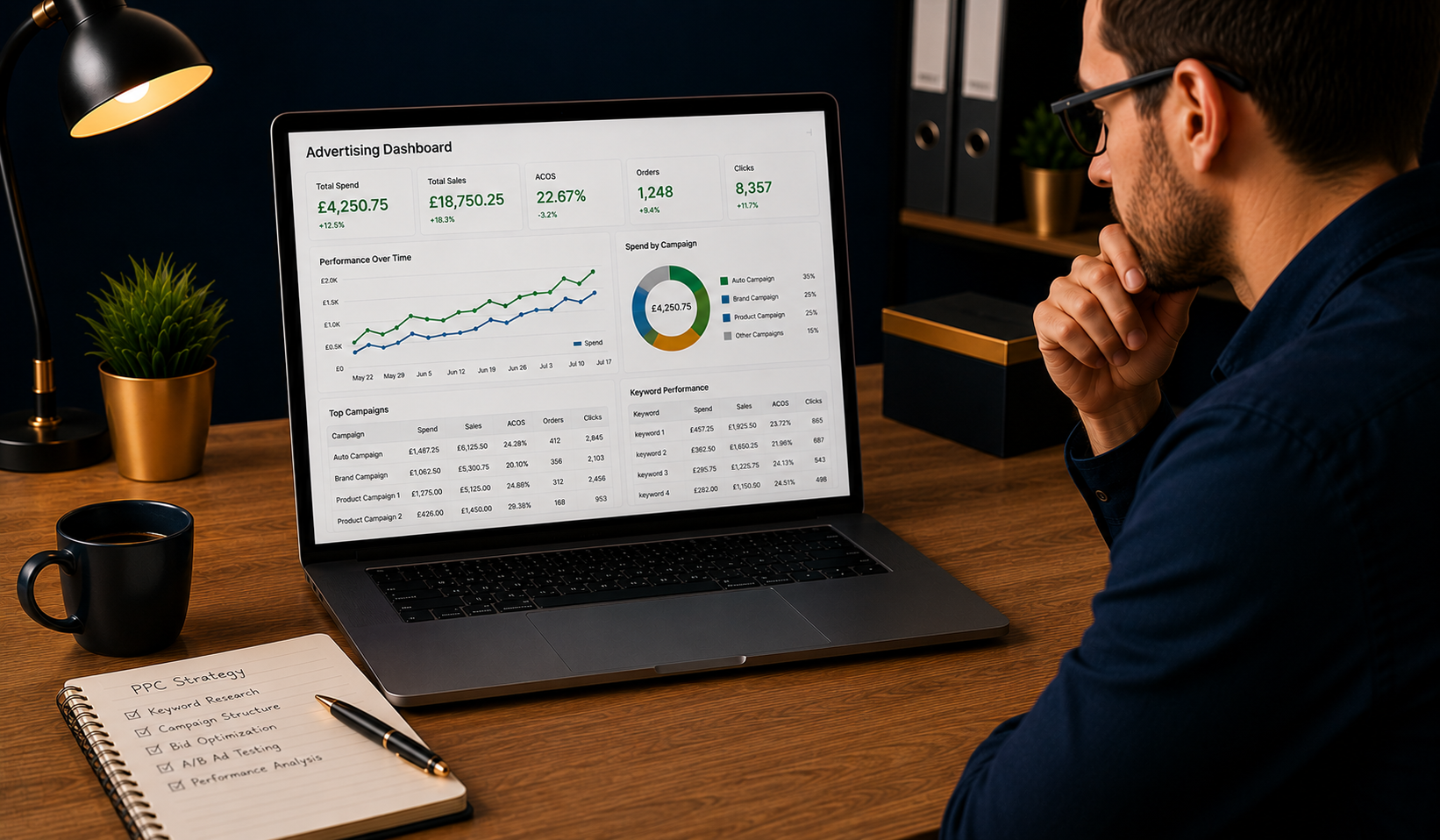
Amazon PPC — Pay Per Click advertising — is one of the most debated topics among Amazon FBA wholesale sellers. Private label sellers depend on PPC to launch new products and rank for keywords. But wholesale sellers operate a fundamentally different business model — you are selling on existing established listings, not launching new ones. So does PPC actually make sense for wholesale? And if so when and how should you use it?
We are Brandhunterz Ltd — a UK registered wholesale sourcing company (Company No: 15342697) — and in this complete guide we answer this question honestly. We explain what PPC does and does not do for wholesale sellers, the specific situations where it genuinely helps and the situations where it is an unnecessary cost that drains your margins.
💡 Quick Summary
Most wholesale sellers do not need PPC to be profitable. Wholesale success is built on sourcing the right products, winning the Buy Box through FBA and strong account health and maintaining consistent stock levels. PPC is useful in specific situations — defending your position on a listing you dominate, boosting velocity on slow-moving stock or testing a new product category. It is never a substitute for good sourcing.
What is Amazon PPC and How Does it Work?
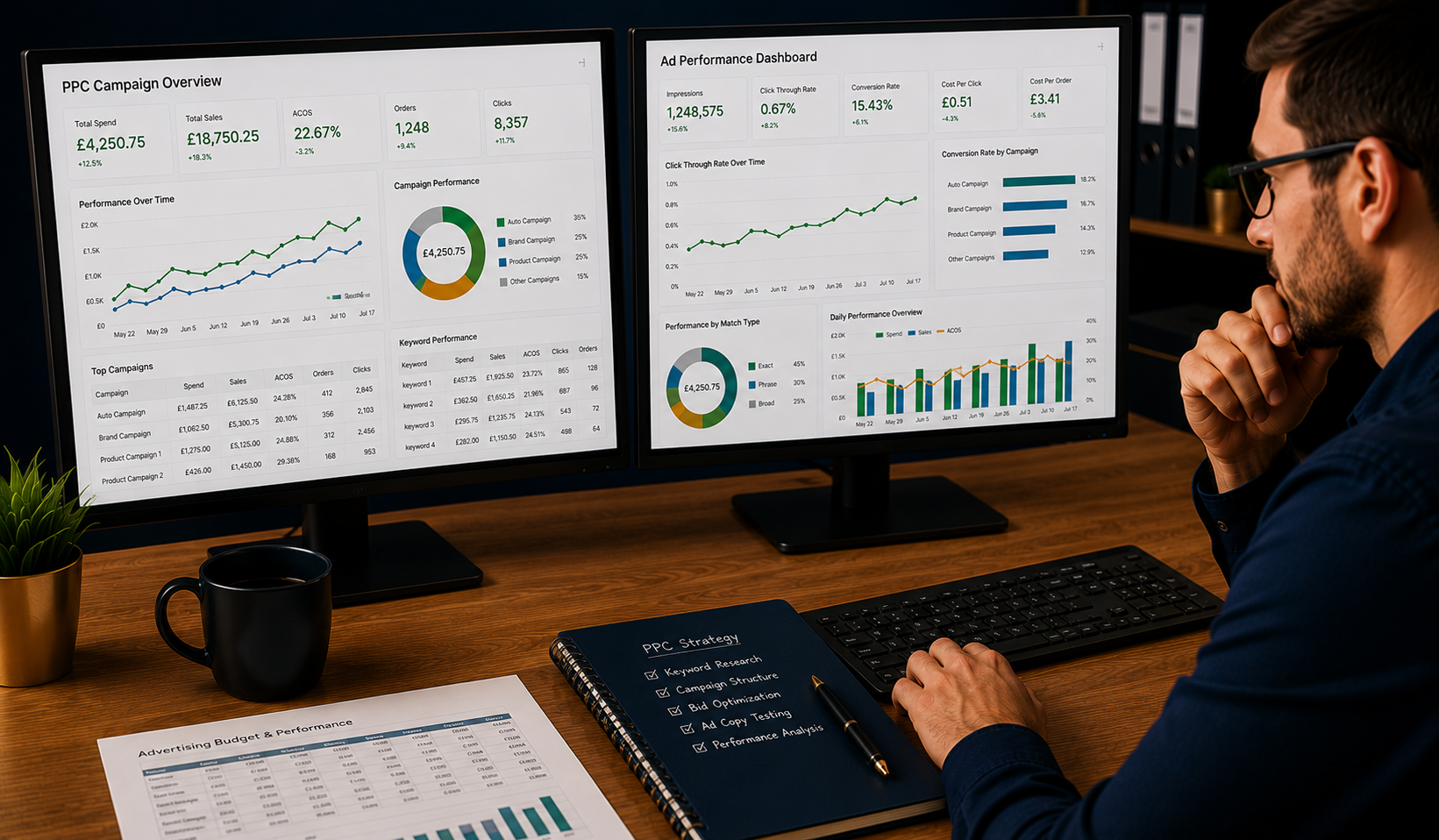
Amazon PPC is an advertising system where you bid on keywords and pay Amazon a fee each time a shopper clicks your ad. Your ad appears in prominent positions — at the top of search results, in the middle of search pages or on competitor product pages — driving additional traffic to your listing beyond the organic search results.
Amazon offers three main PPC campaign types:
| Campaign Type | How it Works | Best Use for Wholesale |
|---|---|---|
| Sponsored Products | Ads appear in search results and product pages | Most relevant for wholesale sellers |
| Sponsored Brands | Banner ads featuring your brand at top of search | Not relevant — requires Brand Registry |
| Sponsored Display | Ads shown on and off Amazon to relevant audiences | Occasionally useful for high-margin products |
Why PPC Works Differently for Wholesale vs Private Label
To understand whether PPC makes sense for wholesale sellers you first need to understand the fundamental difference between why private label sellers use PPC and what wholesale sellers actually need.
| Factor | Private Label | Wholesale |
|---|---|---|
| Listing maturity | New — needs PPC to rank | Existing — already ranked |
| Reviews | Zero — needs traffic to build | Existing reviews on listing |
| Keyword ranking | Must build from scratch | Already established |
| Sales history | None — algorithm blind spot | Strong existing sales history |
| Buy Box competition | No competitors on listing | Multiple sellers competing |
| PPC necessity | Essential — cannot launch without it | Optional — situational use only |
The core reason private label sellers cannot survive without PPC is that they are launching brand new listings with zero sales history, zero reviews and zero organic rank. PPC provides the initial sales velocity needed to build ranking and social proof. Wholesale sellers enter established listings that already have all of these things. The fundamental driver of wholesale success is not advertising — it is winning the Buy Box through FBA, competitive pricing and strong account health.
The Critical Problem With PPC for Wholesale Sellers
Before deciding whether to use PPC as a wholesale seller you must understand one critical structural problem — when you run PPC on a shared listing you are paying to drive traffic to a listing that your competitors also benefit from.
Imagine you run a Sponsored Products campaign and pay £50 to drive 100 additional clicks to a listing you share with two other FBA sellers. Those 100 clicks land on the product listing and Amazon allocates the resulting orders through Buy Box rotation. If you hold 33 percent of the Buy Box you receive approximately 33 of those 100 sales — but you paid for all 100 clicks. The other two sellers each receive approximately 33 sales that your advertising budget paid to generate.
THE SHARED LISTING PPC PROBLEM
| Your PPC spend to drive 100 clicks | £50.00 |
| Sales YOU receive (33% Buy Box share) | ~33 orders |
| Sales competitors receive from YOUR ads | ~67 orders — free for them |
| Your effective cost per sale from PPC | £1.52 per sale vs £0.50 if sole seller |
This problem is not absolute — it depends heavily on your Buy Box share percentage. If you consistently hold 80 to 90 percent Buy Box share on a listing PPC becomes significantly more efficient because most of the traffic you drive converts into your sales rather than your competitors. The higher your Buy Box share the more viable PPC becomes for wholesale.
When PPC Does Make Sense for Wholesale Sellers
Despite the shared listing problem there are specific situations where PPC generates a genuine positive return for wholesale sellers:
Situation 1 — You Are the Dominant or Sole FBA Seller
When you hold 70 percent or more of the Buy Box share on a listing — or are the only FBA seller — PPC becomes significantly more efficient. Most of the clicks you pay for convert into your sales rather than your competitors. If you are the sole FBA seller on a listing with FBM competitors PPC is particularly powerful because your FBA listing wins virtually every sale that clicks through. Use Keepa to verify how many active FBA sellers are on any listing before committing PPC budget to it.
Situation 2 — You Have Excess Stock to Clear
If you are approaching long-term storage fee thresholds or have over-ordered a particular product PPC can accelerate sell-through velocity significantly. Even with the shared listing cost the additional sales generated by PPC can be cheaper than the long-term storage fees you would otherwise pay. Calculate whether your PPC cost per sale is lower than your ongoing storage cost before running a clearance campaign.
Situation 3 — Testing a New Product Category
When you enter a new wholesale product category where your account has limited sales history PPC can provide the initial velocity boost that helps establish your seller profile on that listing faster. Run a short campaign with a controlled budget for the first 30 days on any new product to accelerate your Buy Box history on that ASIN — then evaluate whether organic performance alone sustains your target sales velocity.
Situation 4 — Seasonal Peak Periods
During Q4 peak season — October through December — overall Amazon conversion rates rise significantly and PPC costs often deliver better returns than at other times of year because the same click is more likely to result in a purchase. If you carry seasonal products with strong Q4 demand a targeted PPC campaign during peak weeks can generate meaningful additional revenue that justifies the advertising cost even with shared listing inefficiency.
When PPC Does NOT Make Sense for Wholesale Sellers
| Situation | Why PPC Wastes Money Here |
|---|---|
| 3 or more active FBA sellers on listing | You fund traffic that competitors convert — negative ROI |
| Amazon is on the listing | Amazon holds Buy Box — your PPC traffic converts for Amazon |
| Your margin is already thin | PPC cost erodes what little margin remains — loss-making |
| Product already sells well organically | PPC adds cost without meaningful sales uplift |
| You have account health issues | Fix account health first — PPC cannot compensate for poor metrics |
| You are out of stock or nearly out | Driving traffic to a low-stock listing wastes budget entirely |
How to Set Up a Basic Sponsored Products Campaign for Wholesale
If you have evaluated your situation and determined PPC is appropriate for one or more of your wholesale products here is the correct setup process:
Start With Automatic Targeting
Launch your first campaign with automatic targeting — Amazon selects the keywords based on your product listing. Set a conservative daily budget of £5 to £10 and run for 14 days. This gives you real keyword data showing which search terms actually convert for your product without requiring you to guess keywords upfront.
Review Search Term Report After 14 Days
Download the Search Term Report from Campaign Manager. Identify which keywords generated clicks and which generated actual sales. Keywords with sales and an ACoS — Advertising Cost of Sales — below 30 percent are profitable terms worth keeping. Keywords with clicks but zero sales are wasting your budget and should be added as negative keywords immediately.
Launch a Manual Campaign With Winning Keywords
Take the converting keywords from your automatic campaign and launch a manual Sponsored Products campaign targeting them directly. Use exact match for your highest-converting terms to control spend precisely. Set bids based on your maximum ACoS target — if your product profit margin is 40 percent your maximum viable ACoS is approximately 30 to 35 percent before PPC turns unprofitable.
Review and Optimise Weekly
Review your campaign performance every week. Pause keywords with high spend and zero sales. Increase bids on keywords generating profitable sales. Add new negative keywords to eliminate wasted spend. Use Helium 10 Adtomic or AMZScout to cross-validate which keywords are worth targeting for your specific product category.
Understanding ACoS — Your PPC Profitability Benchmark
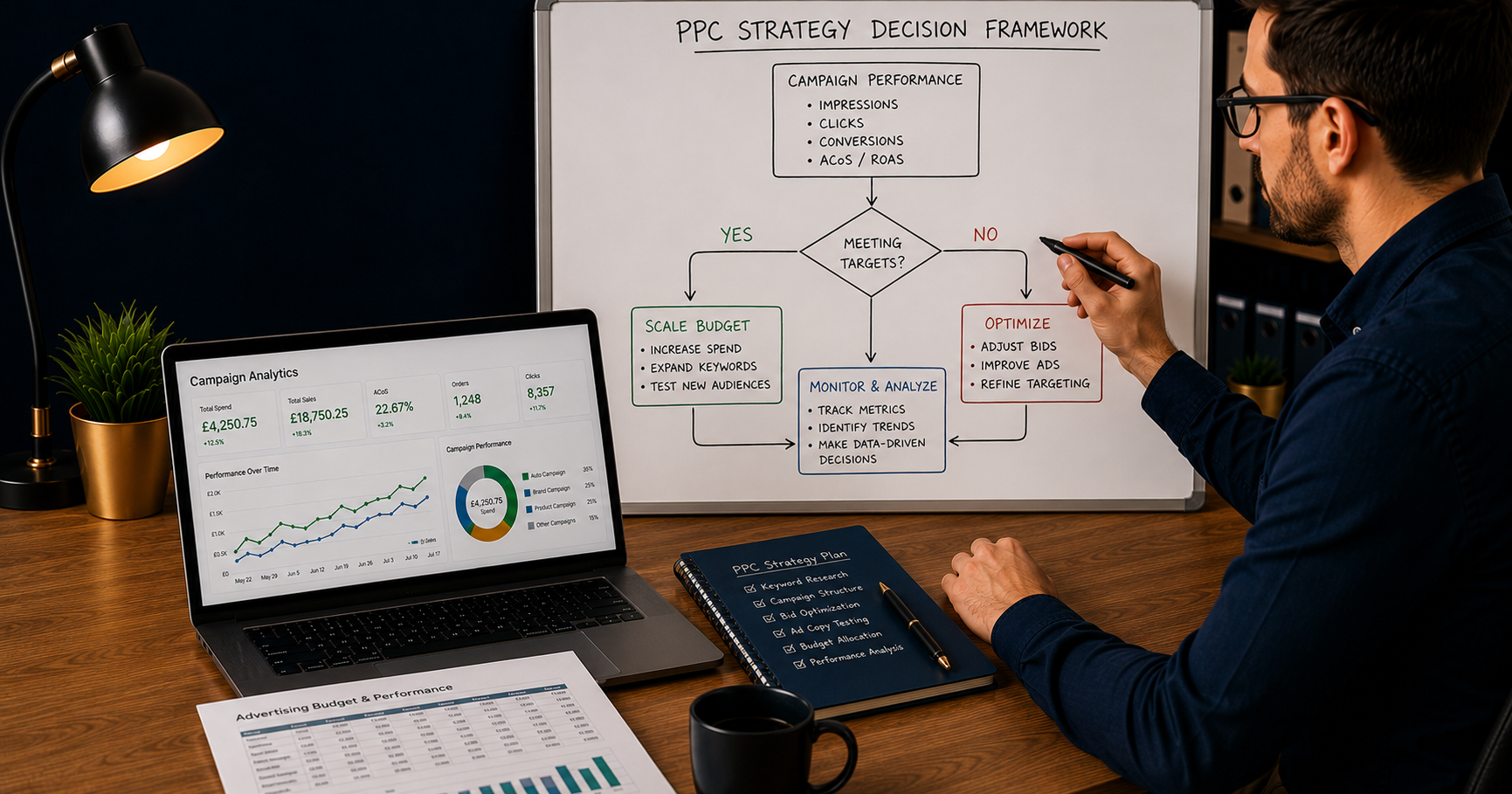
ACoS — Advertising Cost of Sales — is the percentage of your sale revenue that your PPC spend represents. It is the primary metric for measuring whether your PPC campaigns are profitable:
ACOS CALCULATION AND TARGET
| ACoS Formula | Ad Spend ÷ Sales Revenue × 100 |
| Example — £10 spend generates £50 sale | ACoS = 20% |
| Your product profit margin | 40% |
| Maximum viable ACoS (break even on PPC) | Under 40% |
| Target ACoS for profitable PPC | Under 25% — leaves margin after ad cost |
| ACoS above your margin percentage | LOSS MAKING — pause campaign immediately |
The Wholesale Priority Order — PPC Comes Last
If you are a wholesale seller trying to decide where to invest your time and money the correct priority order is always:
| Priority | Action | Impact on Revenue |
|---|---|---|
| 1 | Find and source the right wholesale products | Highest — determines everything |
| 2 | Win and maintain the Buy Box via FBA | Very high — drives 80%+ of sales |
| 3 | Maintain healthy stock levels — never stock out | High — stockouts kill revenue instantly |
| 4 | Keep account health metrics all green | High — protects existing revenue |
| 5 | Add new wholesale products to your catalogue | High — compounds growth |
| 6 | Consider PPC in specific situations | Situational — only when conditions are right |
Conclusion — PPC is a Tool Not a Strategy
Amazon PPC is a tool that can add value in specific situations for wholesale sellers — but it is never the foundation of a profitable wholesale business. The wholesale sellers who build the most sustainable and scalable businesses do so by sourcing the right products, winning the Buy Box consistently and maintaining healthy stock levels — not by spending on advertising to compensate for weak sourcing decisions.
Always research your products thoroughly using Keepa before ordering. Validate your margins with AMZScout or Helium 10. And find verified wholesale brands through our Brands Directory — products that sell organically without needing advertising support are the foundation of a profitable wholesale business.
For sellers also running eBay alongside Amazon Zik Analytics provides the research tools to identify which of your wholesale products perform best on eBay — a channel where PPC is not required and organic visibility is far easier to achieve than on Amazon.
BUILD A WHOLESALE BUSINESS THAT SELLS WITHOUT ADS
Browse 5,000+ Verified Wholesale Brands Free
The right wholesale products sell organically through Buy Box rotation without advertising support. Find them in our verified Brands Directory — all MAP-protected and Amazon-compatible.
About the Author
This article is written by the team at Brandhunterz Ltd — a UK registered Amazon FBA wholesale sourcing company (Company No: 15342697) registered in England and Wales since 2023. Visit brandhunterz.com to learn more.