
AMAZON FBA PRODUCT RESEARCH
How to Build a Profitable Amazon FBA Product Research System From Scratch
By Brandhunterz Ltd | Company No: 15342697 | 15 minute read
Affiliate Disclosure: This article contains affiliate links. If you purchase through our links we may earn a commission at no extra cost to you. We only recommend tools we genuinely use and believe in. Read our full disclaimer.
The difference between an Amazon FBA wholesale seller who consistently finds profitable products every week and one who spends hours researching with nothing to show for it is almost never intelligence or experience — it is system. The seller who finds good products consistently has a repeatable structured research process they follow every single session without deviation. They know which tools to open first what data to check in which sequence what thresholds disqualify a product at each stage and exactly how to move from a confirmed product opportunity to a supplier contact within the same research session. The seller who struggles has none of this — they research differently each time and make decisions based on incomplete data or the wrong signals.
We are Brandhunterz Ltd — a UK registered wholesale sourcing company (Company No: 15342697) — and in this complete guide we show you how to build a fully structured Amazon FBA product research system from scratch — covering your tool stack your research tracker your weekly research schedule your validation sequence and the decision framework that turns raw data into a confirmed sourcing pipeline every single week.
💡 Quick Summary
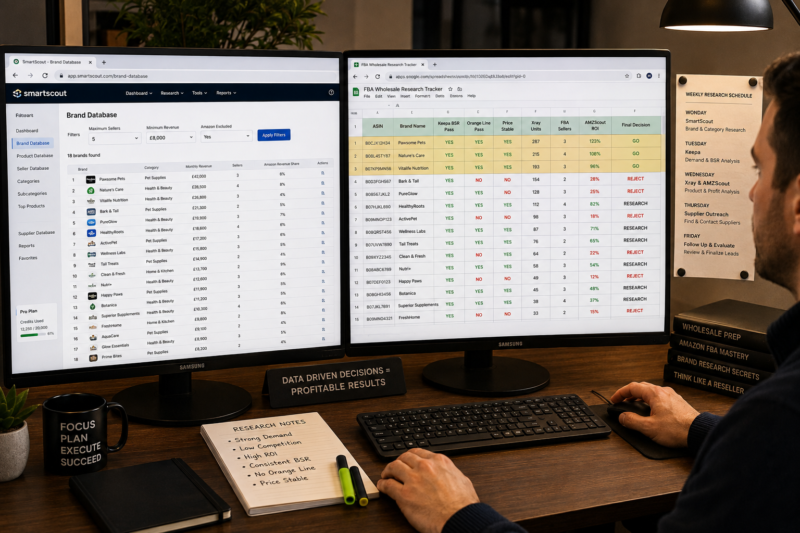
A profitable Amazon FBA product research system has four components — a core tool stack of Keepa SmartScout Helium 10 and AMZScout a research tracker spreadsheet that records every product through every validation stage a fixed weekly research schedule of 3 to 5 hours and a non-negotiable validation sequence that every product must pass before supplier outreach begins. Build the system once follow it every week and the sourcing pipeline fills itself consistently regardless of how new you are to wholesale FBA.
Component 1 — Your Core Research Tool Stack
Every product research system needs a defined tool stack — the specific tools you use for each stage of the research process. Using too many tools creates confusion and inconsistency. Using too few leaves critical data gaps. The wholesale FBA research system we recommend uses four core tools — each serving a specific non-overlapping function in the research sequence:
| Tool | Function in Research System | Used at Stage |
|---|---|---|
| SmartScout | Brand discovery — category analysis — competitor seller research — bulk candidate identification | Stage 1 — Discovery |
| Keepa | 12-month BSR history — Amazon presence check — price stability validation — seller count history | Stage 2 — Validation |
| Helium 10 Xray | Monthly units sold estimate — current revenue — seller count confirmation — demand volume cross-check | Stage 2 — Validation |
| AMZScout | Full FBA margin calculation — referral fee — fulfilment fee — storage — ROI confirmation | Stage 3 — Margin |
💡 Total Monthly Tool Stack Cost
Keepa approximately £17 per month — SmartScout from $49 per month — Helium 10 from $29 per month — AMZScout from $29 per month. Total approximately £100 to £120 per month for the full tool stack. A single confirmed profitable wholesale product generating £400 per month net profit more than covers the entire tool stack cost — making the investment in research tools one of the highest ROI decisions a wholesale seller makes.
Component 2 — Your Product Research Tracker Spreadsheet
A research tracker spreadsheet is the operational backbone of your product research system. Every product you investigate passes through the same columns in the same order — from initial discovery through every validation stage to the final go or no-go decision and then to supplier outreach status. Without a tracker your research is scattered — you forget which products you checked your validation notes are inconsistent and you cannot measure how many products you need to research each week to produce a consistent number of supplier applications.
Here is the exact column structure for your product research tracker — build this in Google Sheets or Excel before your first research session:
| Column | What to Record |
|---|---|
| A — ASIN | Amazon Standard Identification Number — unique product identifier |
| B — Brand Name | Brand on the Amazon listing — the company you will approach for wholesale |
| C — Product Name | Short product description — enough to identify it without clicking the link |
| D — Current Selling Price | Today’s Buy Box price — used as starting reference only |
| E — Keepa 12m Avg Price | 12-month average Buy Box price from Keepa — used for margin calculation |
| F — Keepa BSR Pass | YES or NO — consistent drops minimum every 6 to 10 days across 12 months |
| G — Orange Line Pass | YES or NO — orange line completely absent for all 12 months |
| H — Price Stable Pass | YES or NO — blue line flat or rising — less than 10% decline over 12 months |
| I — Xray Monthly Units | Estimated monthly units sold from Helium 10 Xray — minimum 30 to proceed |
| J — Active FBA Sellers | Current number of active FBA sellers on the listing — maximum 6 to proceed |
| K — Estimated Buy Price | Estimated or actual wholesale buy price — 40 to 60% below retail before account opened |
| L — AMZScout ROI | Calculated ROI percentage after all fees — minimum 30% to proceed |
| M — Net Profit Per Unit | £ net profit after every cost — used to calculate estimated monthly profit |
| N — Estimated Monthly Profit | Net profit per unit multiplied by your estimated monthly sales share |
| O — Final Decision | GO — NO GO — or PENDING (awaiting one data point) |
| P — Supplier Outreach Status | Not Started — Email Sent — Follow Up Sent — Approved — Rejected |
Component 3 — Your Weekly Research Schedule
A research system without a fixed schedule is not a system — it is an intention. The sellers who consistently find profitable wholesale products are those who treat their weekly research session as a non-negotiable commitment — the same day every week the same duration and the same sequence of activities regardless of how busy their existing business feels. Here is the weekly research schedule that produces a consistent pipeline of validated sourcing opportunities:
WEEKLY PRODUCT RESEARCH SCHEDULE — 5 HOURS TOTAL
| Day | Time Block | Activity |
| Monday | 1.5 hours | SmartScout brand discovery session — apply wholesale filters — build 15 to 20 candidate shortlist — record ASINs in tracker columns A B C D |
| Tuesday | 2 hours | Keepa validation on all 15 to 20 candidates — check BSR pattern orange line price stability — record results in tracker columns E F G H — disqualify failures immediately |
| Wednesday | 1 hour | Helium 10 Xray and AMZScout margin on Keepa-passing products only — record columns I J K L M N — confirm final GO decisions in column O |
| Thursday | 30 minutes | Find supplier trade contact details for all GO products via Brands Directory — send wholesale account application emails — update tracker column P |
Component 4 — The Non-Negotiable Validation Sequence
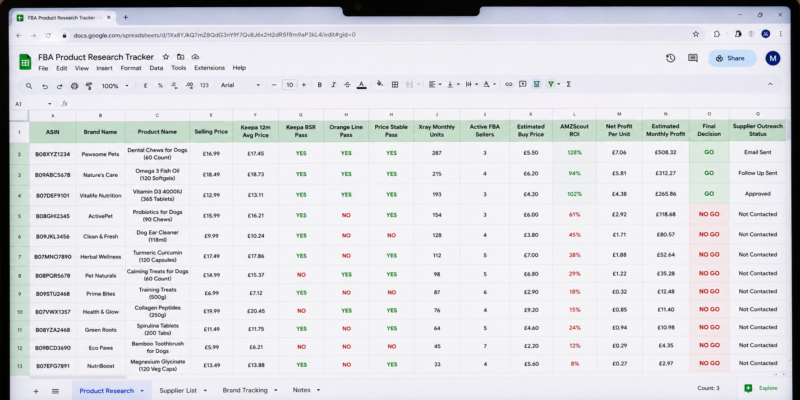
The validation sequence is the decision engine of your research system. Every product passes through the same checks in the same order — with every failure triggering an immediate disqualification rather than a rationalisation. The sequence is structured to eliminate the most common disqualifiers first — saving time by preventing you from spending 20 minutes calculating margin on a product that should have been removed at the 2-minute Keepa check.
| Order | Validation Check | Tool | Time | Fail Action |
|---|---|---|---|---|
| 1 | BSR under 50,000 — consistent 12-month drops | Keepa | 2 mins | Delete row — move to next |
| 2 | Orange line completely absent — all 12 months | Keepa | 1 min | Delete row — move to next |
| 3 | Blue price flat or rising — under 10% decline | Keepa | 1 min | Delete row — move to next |
| 4 | Xray monthly units minimum 30 — ideally 60+ | Helium 10 | 2 mins | Delete row — move to next |
| 5 | Active FBA sellers — maximum 6 on listing | Helium 10 | 1 min | Delete row — move to next |
| 6 | ROI minimum 30% after all fees confirmed | AMZScout | 5 mins | Delete row — move to next |
| 7 | Gating check in Seller Central | Seller Central | 2 mins | Note gating — plan ungating |
| ✅ | All 7 checks passed — record GO in tracker — proceed to supplier outreach | |||
Component 5 — Your Research System Performance Metrics
A system without measurement cannot be improved. Every month review your research tracker to measure the following four metrics — your discovery-to-validation rate your validation-to-go rate your go-to-approval rate and your approval-to-profit rate. These four numbers tell you exactly where your system is performing well and where the biggest opportunity for improvement lies:
| Metric | How to Calculate | Healthy Benchmark |
|---|---|---|
| Discovery to Keepa pass rate | Products passing Keepa divided by total products researched | 30 to 50 percent |
| Keepa pass to GO rate | GO decisions divided by products that passed Keepa | 20 to 40 percent |
| GO to supplier approval rate | Supplier approvals divided by applications sent | 30 to 60 percent |
| Approval to active brand rate | Brands with first order placed divided by accounts approved | 50 to 70 percent |
What Your Research System Should Produce Each Month
Following this system consistently every week produces predictable outputs at every stage of the pipeline. Here is what a seller running 5 hours of research per week should expect to produce at each stage of the system on a monthly basis:
| Pipeline Stage | Monthly Output |
|---|---|
| Products researched and entered into tracker | 60 to 80 products |
| Products passing Keepa validation | 20 to 35 products |
| GO decisions confirmed after full validation | 8 to 15 products |
| Supplier applications sent | 8 to 15 applications |
| Supplier accounts approved | 3 to 8 new accounts |
| New active brands with first order placed | 1 to 4 new brands |
The Three System Rules That Protect Your Capital
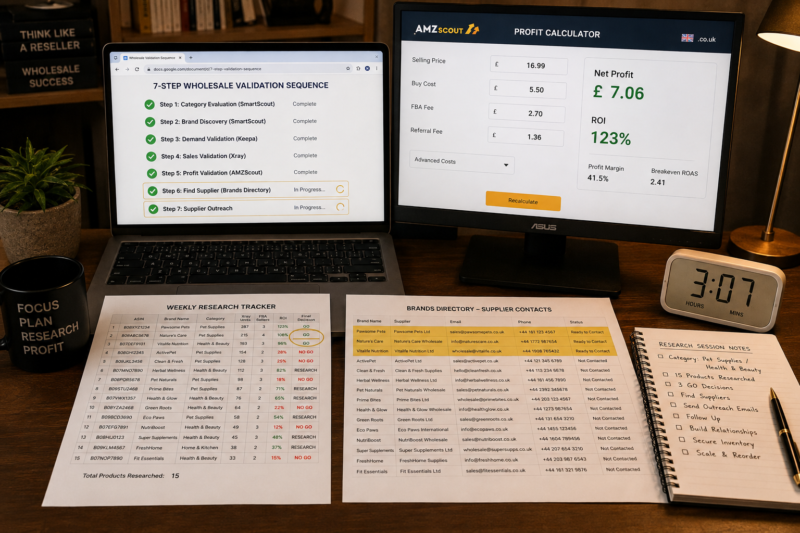
Every research system needs rules — non-negotiable commitments that protect you from the emotional decision-making that causes most wholesale FBA losses. Here are the three system rules that must never be broken regardless of how attractive a product looks:
THE THREE NON-NEGOTIABLE SYSTEM RULES
| Rule 1 | Never skip any validation step — not even for a product that looks obviously good |
| Why | The products that look most obviously good are often the ones with hidden problems that a skipped check would have caught — Amazon presence six months ago a seller count that peaked at 20 before crashing to 3 a blue line that has been declining slowly for 9 months |
| Rule 2 | Never order more than a minimum test quantity on any new brand — regardless of confidence |
| Why | Data confirms historical demand — it cannot guarantee future performance. A test order validates real-world velocity before you commit larger capital. Two profitable reorders confirm the product — your first order only suggests it |
| Rule 3 | Never rationalise a failed validation check — disqualify immediately and move on |
| Why | Every rationalisation of a red flag is a bet with your capital against the data. The data has no incentive to mislead you. Your optimism does. Trust the system not the feeling |
Conclusion — Build the System Once Follow It Every Week
A profitable Amazon FBA product research system is not complicated to build — but it requires commitment to follow consistently. Set up your tool stack. Build your research tracker. Fix your weekly research schedule. Follow the validation sequence without exception. Measure your metrics every month. The system does the work — you provide the consistency.
Start your brand discovery every week in SmartScout. Validate every candidate with Keepa and Helium 10. Confirm every margin with AMZScout. Find every supplier through our Brands Directory. Follow these steps every week and your wholesale portfolio builds itself — one confirmed product at a time.
START YOUR RESEARCH SYSTEM TODAY
Browse 5,000+ Verified Wholesale Brands Free
The Brandhunterz Brands Directory is the final step in your research system — find verified wholesale trade contacts for every brand your system identifies and send your application the same day your research confirms it is a GO.
About the Author
This article is written by the team at Brandhunterz Ltd — a UK registered Amazon FBA wholesale sourcing company (Company No: 15342697) registered in England and Wales since 2023. Visit brandhunterz.com to learn more.