
INTERNATIONAL AMAZON SELLING
Import Duties and Customs for International Amazon FBA Sellers Explained
By Brandhunterz Ltd | Company No: 15342697 | 14 minute read
Affiliate Disclosure: This article contains affiliate links. If you purchase through our links we may earn a commission at no extra cost to you. We only recommend tools we genuinely use and believe in. Read our full disclaimer.
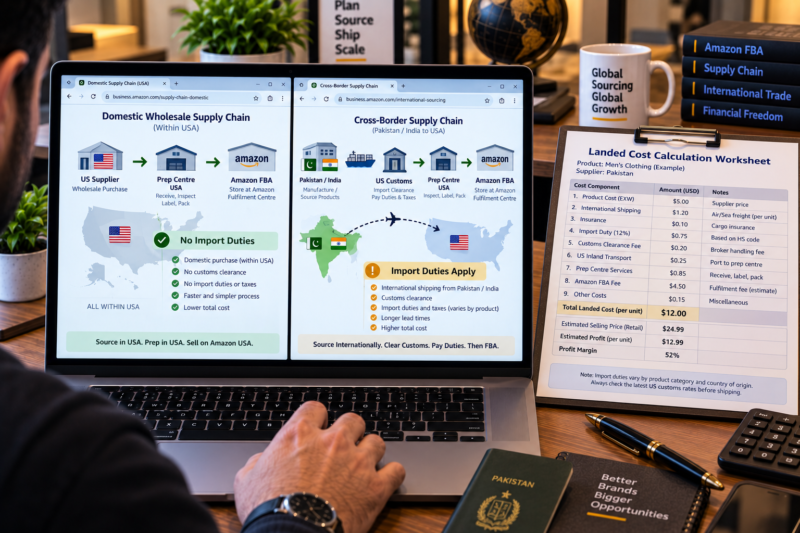
Import duties and customs procedures are among the most misunderstood aspects of international Amazon FBA selling — and for good reason. The rules are genuinely complex vary significantly between countries and change with trade policy decisions that can affect your costs overnight. For international sellers based in Pakistan India or other countries the question of import duties typically arises in two very different scenarios. The first is when you are sourcing wholesale products from suppliers in the USA or UK and having them shipped to a prep centre in the same country — in which case no import duties apply because the goods are not crossing an international border. The second is when you are considering shipping products from your home country to an Amazon FBA warehouse in the USA or UK — which does involve cross-border shipping and customs clearance and carries a completely different set of requirements and costs. Understanding which scenario applies to your business model is the essential starting point for every conversation about import duties and customs as an international Amazon seller.
We are Brandhunterz Ltd — a UK registered wholesale sourcing company (Company No: 15342697) — and in this complete guide we explain exactly how customs and import duties work for international Amazon FBA sellers — covering the domestic wholesale model where no import duties apply the cross-border shipping model and when it applies how import duty rates work for the USA and UK what an HS code is how customs clearance works for FBA shipments what a customs broker does and what the actual landed cost calculation looks like for any cross-border FBA shipment.
💡 Quick Summary
Most international Amazon FBA wholesale sellers using the prep centre model do NOT deal with import duties — because they source from US or UK wholesale suppliers who deliver domestically to a US or UK prep centre — no international border is crossed by the stock. Import duties only apply when you are physically shipping goods from your home country — Pakistan India etc — into the USA or UK as the importer of record. If you are considering cross-border shipping into FBA you must understand HS codes import duty rates customs clearance requirements and the landed cost calculation before deciding whether cross-border sourcing is viable for your specific products. Always use a licensed customs broker for any cross-border FBA shipment — never attempt to self-clear customs for commercial goods sent to Amazon FBA.
The Two Business Models — Which One Applies to You?
Before going further it is essential to understand which of the two international seller models your business uses — because the import duty situation is completely different for each:
| Model | How It Works | Import Duties? |
|---|---|---|
| Wholesale FBA — domestic sourcing via prep centre | You source from a US or UK wholesale supplier — supplier ships domestically to your US or UK prep centre — prep centre labels and ships to Amazon FBA — you manage everything remotely from Pakistan or India | ❌ No import duties — domestic shipment only — no border crossing |
| Cross-border sourcing — shipping from home country to FBA | You source products in Pakistan India or your home country — ship them internationally by air or sea freight to a US or UK FBA warehouse or prep centre — you are importing goods commercially into the selling country | ✅ Yes — import duties customs clearance and compliance required |
✅ Most International Wholesale FBA Sellers Have No Import Duty Exposure
If you are sourcing wholesale branded products from authorised US or UK distributors and having them delivered to a US or UK prep centre you are operating a purely domestic supply chain within the selling country. Your stock never crosses an international border — it goes from a US warehouse to a US prep centre to a US Amazon FBA centre — and import duties do not apply at any point. This is the model recommended for international wholesale FBA sellers in this guide and on brandhunterz.com — and it is the model that removes customs complexity from your business entirely.
When Import Duties Do Apply — Cross-Border Shipping to FBA
Import duties apply when you are physically shipping goods from one country into another — for example if you manufacture or source products in Pakistan or India and ship them to Amazon FBA warehouses in the USA or UK. This model is used by some private label sellers who manufacture their own products in their home country but it is also relevant to wholesale sellers who source products locally that happen to be sellable on international Amazon marketplaces. Here is what cross-border importing into FBA involves:
| Cross-Border Step | What It Involves |
|---|---|
| Classify your products with an HS code | Every product imported commercially must be classified under the Harmonised System — HS code — a six to ten digit number that determines the import duty rate applicable to that product in the destination country — the correct HS code is your starting point for all duty calculations |
| Determine the import duty rate | The import duty rate is set by the destination country’s customs authority — USA customs duty rates are set by US CBP — UK customs duty rates post-Brexit are set by HMRC — rates range from 0% for many product categories to 25% or more for others — the rate is applied to the customs value of the goods |
| Calculate the customs value | The customs value is typically the transaction value — the price you paid for the goods — plus international freight and insurance costs — this total is called the CIF value — Cost Insurance Freight — and is the base on which import duty is calculated |
| Appoint a customs broker | A licensed customs broker files the import declaration with the destination country’s customs authority on your behalf — pays duties and taxes on your behalf — handles any customs queries or examinations — essential for any commercial FBA shipment crossing an international border |
| Pay import duties and VAT | Import duty is paid to the destination country’s customs authority before your goods are released — in the UK import VAT at 20% is also charged and must be paid before release — import VAT is recoverable if you are VAT registered in the UK — US sales tax is not charged at the border |
| Deliver to prep centre or direct to FBA | After customs clearance the goods are released and delivered to your prep centre address or — for shipments that are already FBA-prepped — directly to Amazon’s designated fulfilment centre |
Understanding HS Codes — How to Find Your Product’s Code
The Harmonised System code — HS code — is a standardised international product classification system used by customs authorities worldwide to identify and categorise products for duty calculation. Every physical product has an HS code and the code determines your import duty rate. Here is how to find the correct HS code for your products:
| Method | How to Use It |
|---|---|
| US International Trade Commission — USITC HTS database | Search hts.usitc.gov — the official US Harmonized Tariff Schedule database — search by product description to find the correct HTS code and the corresponding US import duty rate for your product |
| UK Global Trade Tariff — HMRC | Search trade-tariff.service.gov.uk — the official UK trade tariff database — search by product description or commodity code — shows the UK import duty rate and any additional measures applicable to your product |
| Ask your customs broker | A licensed customs broker can classify your product correctly — misclassification of HS codes is one of the most common customs compliance errors and can result in underpayment or overpayment of duties — always verify your HS code with a professional before shipping commercially |
| Freight forwarder classification service | Most freight forwarders who handle FBA shipments offer HS code classification as part of their service — ask your freight forwarder to confirm the correct code before your first shipment |
US Import Duty Rates — Key Categories for Amazon FBA Sellers
US import duty rates — officially called tariff rates — vary widely by product category. Here is a guide to the typical import duty rates for the most common product categories sold by Amazon FBA wholesale sellers:
| Product Category | Typical US Import Duty Rate | Notes |
|---|---|---|
| Electronics and accessories | 0% to 5% | Many electronics are duty-free under the ITA agreement — accessories may carry 3% to 5% |
| Health and beauty products | 0% to 6.5% | Cosmetics typically 0% to 3% — personal care appliances up to 6.5% — varies significantly by specific product |
| Clothing and apparel | 10% to 32% | One of the highest duty categories — rate depends on fabric content and garment type — significant landed cost impact |
| Footwear | 7% to 67% | Highly variable — athletic footwear 20% — rubber-soled leather uppers up to 67% — HS code classification critical |
| Toys and games | 0% to 7% | Most toys 0% — board games and puzzles typically 0% — some electronic toys up to 7% |
| Home and kitchen | 0% to 14% | Cookware and kitchen tools vary widely — glassware 6% — plastic items up to 14% — metal items typically 3% to 8% |
| Sports and outdoor equipment | 0% to 9% | Most sports equipment 4% to 9% — some equipment 0% — camping gear varies by material |
| China-origin goods — Section 301 tariffs | +25% additional tariff | Products manufactured in China face additional Section 301 tariffs of 7.5% to 25% on top of normal duty rates — these tariffs apply based on country of manufacture not country of export — critical consideration for any China-manufactured product |
UK Import Duty Rates — Post-Brexit Tariff Schedule
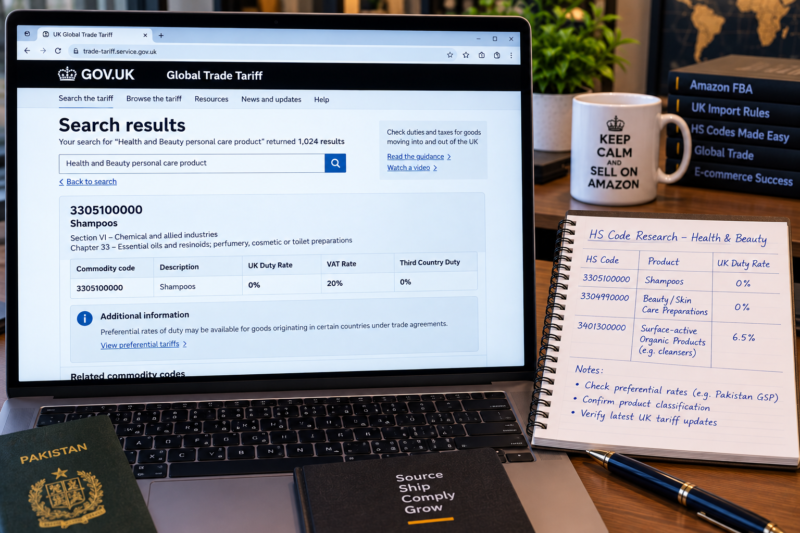
Since Brexit the UK operates its own independent tariff schedule — the UK Global Tariff — separate from the EU’s Common External Tariff. Key points for international sellers shipping into Amazon UK FBA:
| UK Customs Factor | Detail |
|---|---|
| Import duty rates | UK duty rates are broadly similar to pre-Brexit EU rates for most consumer goods categories — typically 0% to 12% — check the UK Global Trade Tariff at trade-tariff.service.gov.uk for the exact rate applicable to your product’s commodity code |
| Import VAT | 20% import VAT is charged on all commercial goods entering the UK — calculated on the CIF value plus the import duty — must be paid before goods are released by UK customs — recoverable if you are VAT registered in the UK by claiming on your VAT return |
| EORI number required | Any business importing commercially into the UK needs an EORI — Economic Operators Registration and Identification — number — register for a UK EORI number through HMRC before your first commercial import |
| Country of origin matters | The UK has trade agreements with some countries offering preferential duty rates — for example the UK-India trade agreement under negotiation may affect duty rates for Indian-manufactured goods in future — always verify the current preferential rate applicable based on your product’s country of manufacture |
| Amazon FBA and the importer of record | Amazon will NOT act as the importer of record for goods you ship from overseas into UK FBA — you or your customs broker must be the named importer of record — Amazon explicitly states this in their FBA policies and will refuse delivery of shipments where Amazon is listed as the importer |
The Landed Cost Calculation — What Your Product Actually Costs
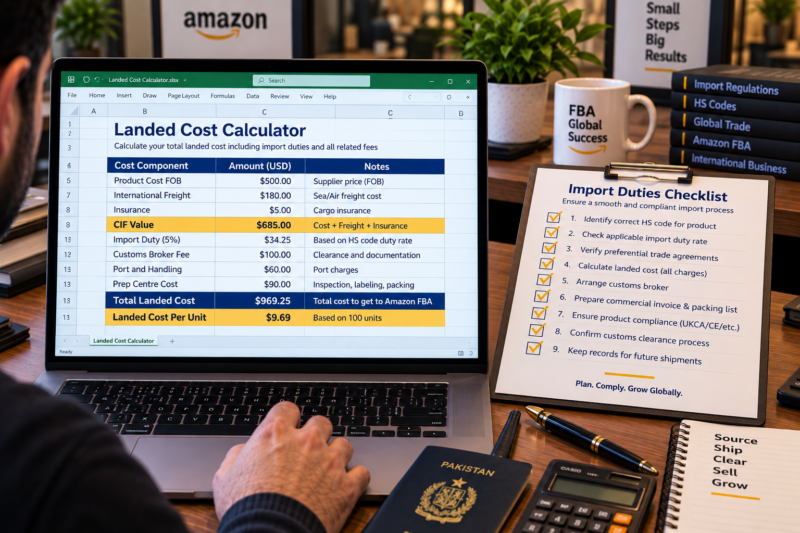
The landed cost is the total cost of getting your product from its origin to your Amazon FBA warehouse — including all shipping import duties taxes and fees. Here is the full landed cost formula for a cross-border FBA shipment and a worked example:
| Landed Cost Component | Description | Example — 100 Units |
|---|---|---|
| Product cost (FOB) | What you paid the supplier for the goods at origin | $500.00 |
| International freight | Air freight or sea freight from origin country to destination port | $180.00 |
| Insurance | Cargo insurance — typically 0.5% to 1% of cargo value | $5.00 |
| CIF value (customs base) | Product + freight + insurance — this is what duty is calculated on | $685.00 |
| Import duty (example 5%) | 5% of CIF value — rate depends on HS code and destination country | $34.25 |
| Customs broker fee | Broker’s fee for filing customs declaration — typically $50 to $200 per shipment | $100.00 |
| Port and handling fees | Port handling container inspection and drayage fees | $60.00 |
| Prep centre cost | FNSKU labelling and FBA prep at destination prep centre | $90.00 |
| Total landed cost — 100 units | All costs combined to deliver 100 units to Amazon FBA | $969.25 |
| Landed cost per unit | Total landed cost divided by number of units | $9.69 per unit |
This landed cost per unit — $9.69 in the example above — is the figure you enter as your cost price in AMZScout when calculating your FBA margin. Every cost component must be included — omitting freight duties or broker fees overstates your margin and leads to sourcing decisions that lose money.
What a Customs Broker Does and Why You Need One
A licensed customs broker is a professional who specialises in clearing goods through customs on behalf of importers. For any international seller shipping commercial goods across a border into the USA or UK a customs broker is not optional — it is a requirement for doing it correctly. Here is what a customs broker handles for you:
| Customs Broker Service | What They Do |
|---|---|
| HS code classification | Classifies your products under the correct HS code — determines the applicable duty rate — advises on any additional tariffs or restrictions that apply |
| Import declaration filing | Files the formal customs entry or import declaration with CBP in the USA or HMRC in the UK — includes all required documentation — commercial invoice packing list bill of lading and any certificates of origin or compliance |
| Duty payment | Pays import duties and any applicable taxes to customs on your behalf from funds you provide — tracks payment confirmation — obtains customs release |
| Customs queries and examinations | If customs selects your shipment for examination or raises queries about documentation or valuation your broker responds on your behalf — without a broker you would need to handle this yourself from another country which is extremely difficult |
| Coordination with freight forwarder | Works with your freight forwarder to coordinate the handoff from port clearance to final delivery — many freight forwarders who specialise in Amazon FBA shipments offer integrated broker services |
Import Duties Checklist for International FBA Sellers
| Import Duties Step | Done |
|---|---|
| Business model confirmed — domestic wholesale via prep centre (no import duties) OR cross-border shipping (import duties apply) | ☐ |
| If cross-border — HS code identified for each product — verified against USITC or UK Global Tariff database | ☐ |
| Import duty rate confirmed for each product — Section 301 China tariffs checked if applicable | ☐ |
| Full landed cost calculated — product cost freight insurance duty broker fee prep centre cost — per unit cost confirmed | ☐ |
| AMZScout margin recalculated using landed cost per unit — minimum 25% ROI confirmed after all costs | ☐ |
| Licensed customs broker appointed — broker confirmed as importer of record — broker briefed on shipment details | ☐ |
| UK sellers — EORI number registered with HMRC — VAT registration obtained if required | ☐ |
| Amazon confirmed NOT listed as importer of record on any shipping documentation | ☐ |
| Import duties and customs compliance confirmed — landed cost accurate — cross-border FBA shipment ready | ✅ Compliant |
Conclusion — Know Your Model and Calculate Every Cost Before You Ship
Import duties and customs are genuinely complex but for most international Amazon FBA wholesale sellers using the domestic prep centre model the complexity is entirely irrelevant — because no international border is ever crossed by their stock. If you are sourcing from US or UK wholesale suppliers and using a prep centre in the selling country you are operating a clean domestic supply chain with no customs exposure. If you are or are considering shipping goods from your home country into Amazon FBA you must approach it with a complete landed cost calculation a correct HS code a licensed customs broker and a clear understanding that your margin must absorb every cost in that chain before it becomes viable. Find your wholesale suppliers through our Brands Directory. Research demand with Keepa. Calculate every cost correctly with AMZScout — including your full landed cost per unit for any cross-border shipment.
SOURCE WHOLESALE PRODUCTS WITHOUT CUSTOMS COMPLEXITY
Browse 5,000+ Verified Wholesale Brands Free
Find verified wholesale trade contacts in the Brandhunterz Brands Directory — source from US and UK suppliers directly — no cross-border customs complexity — no import duties — just clean domestic wholesale supply chains.
About the Author
This article is written by the team at Brandhunterz Ltd — a UK registered Amazon FBA wholesale sourcing company (Company No: 15342697) registered in England and Wales since 2023. Visit brandhunterz.com to learn more.