
WHOLESALE BUSINESS FINANCE · 2026
How to Use Business Credit to Scale Your Amazon FBA Business
By Brandhunterz Ltd | Company No: 15342697 | 13 minute read
Affiliate Disclosure: This article contains affiliate links. If you purchase through our links we may earn a commission at no extra cost to you. We only recommend tools we genuinely use and believe in. Read our full disclaimer.
The single biggest constraint on growth for most Amazon FBA wholesale sellers is not a lack of profitable products to source — it is a lack of working capital to fund larger orders with more brands simultaneously. Sellers who rely exclusively on reinvested profits to fund growth are limited by the 14 to 28 day Amazon disbursement cycle and the time it takes for capital to cycle back through the business. Business credit — used strategically and responsibly — breaks this constraint by allowing you to place significantly larger orders than your available cash would otherwise support and to scale your brand portfolio faster than organic reinvestment alone would permit.
We are Brandhunterz Ltd — a UK registered wholesale sourcing company (Company No: 15342697) — and in this complete guide we explain exactly how to build business credit from scratch use it strategically to accelerate your FBA wholesale growth and avoid the debt traps that catch sellers who use credit recklessly. Every strategy in this article applies to both Amazon USA and Amazon UK sellers.
💡 Quick Summary
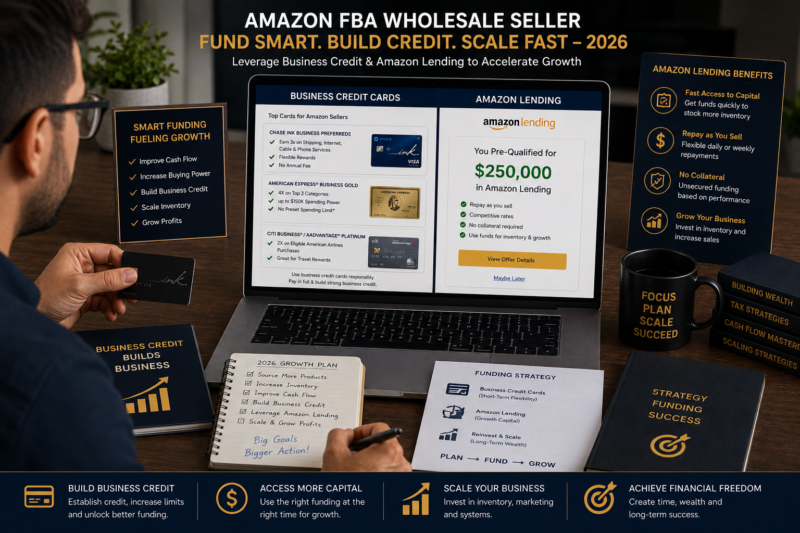
Business credit is a powerful scaling tool when used correctly — the golden rule is to only use credit to fund stock purchases where your projected Amazon revenue from that stock will arrive before or alongside your credit repayment deadline. The five main business credit sources for FBA sellers are business credit cards (most accessible), Amazon Lending (platform-native), supplier trade credit (best terms), business lines of credit (most flexible), and inventory financing (specialist for larger operations). Build your business credit profile before you need it — not when you need it urgently.
Why Business Credit Accelerates FBA Growth
To understand why business credit is such a powerful growth tool for FBA wholesale sellers consider the mathematical reality of scaling through reinvestment alone versus scaling with credit support.
A seller with $5,000 in working capital generating a 25 percent margin reinvests every dollar of profit back into stock. After 12 months of consistent reinvestment — accounting for the 30 to 45 day working capital cycle — their capital base has grown to approximately $15,000 to $20,000. Strong growth but constrained by the cash cycle. The same seller with a $10,000 business credit line available can double their effective ordering capacity from day one — accessing product opportunities and brand relationships that require larger minimum orders than their cash alone would support. The credit does not create profit — the strong product margins and consistent sales velocity do. The credit simply removes the timing constraint that limits how fast those margins compound.
| Growth Method | Month 6 Capital | Month 12 Capital | Active Brands |
|---|---|---|---|
| Reinvestment Only — $5,000 Start | ~$8,000 | ~$18,000 | 8 to 12 |
| With $10,000 Credit Line — $5,000 Start | ~$18,000 | ~$40,000 | 20 to 30 |
The Golden Rule of Business Credit for FBA Sellers
Before covering the specific credit sources available to FBA sellers it is essential to establish the golden rule that separates sellers who use credit as a growth accelerator from those who use it as a debt spiral.
The Golden Rule
Only use business credit to fund stock purchases where your projected Amazon revenue from that specific stock will arrive before or at the same time as your credit repayment deadline — and where your true net margin on that stock is sufficient to cover both the cost of goods and the cost of borrowing with profit remaining.
This rule has two components. The timing component ensures you are not paying interest because your Amazon revenue arrived late. The margin component ensures you are not borrowing to fund stock that generates insufficient profit to justify the borrowing cost. Any credit decision that fails either component is a red flag — regardless of how attractive the product or brand appears.
Good Use of Credit — Proven Product Reorder
You have a product with 60 days of confirmed sales velocity at a 28 percent true margin. Your next reorder of $3,000 will sell through in 45 days generating $4,200 in revenue. Your business credit card has a 56-day interest-free period. You charge the $3,000 supplier invoice to the card — your Amazon revenue arrives in 45 days — you pay the card balance in full before interest accrues. Net result: $1,200 profit with zero borrowing cost.
Bad Use of Credit — Unproven Product at Low Margin
You find a new product from a brand you have never sourced before. The Keepa data looks promising but you have no confirmed sales velocity. The margin is 18 percent — below your 20 percent minimum threshold. You use your credit card to fund a $2,000 order hoping it sells quickly. The product sells slowly — 90 days to sell through — and your card interest charges over 60 days eliminate most of the already-thin margin. Net result: near-zero profit with significant stress and tied-up capital.
The 5 Business Credit Sources for FBA Wholesale Sellers
Source 1 — Business Credit Cards (Most Accessible)
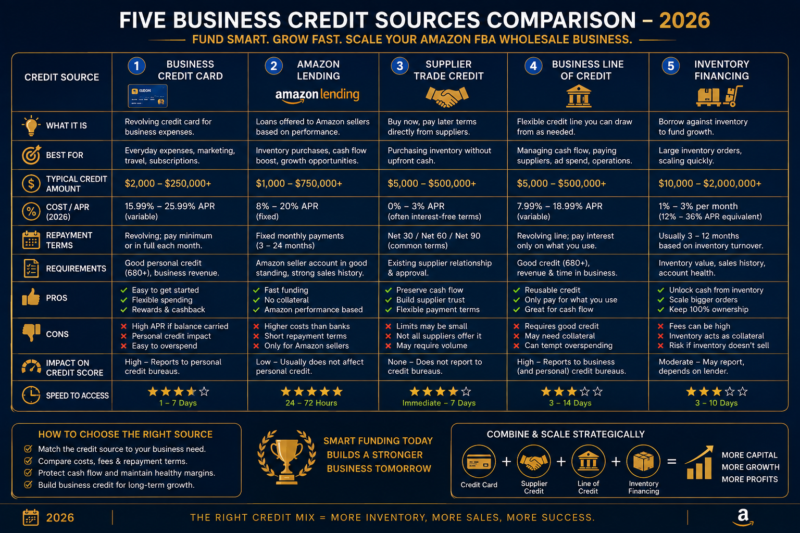
Business credit cards are the most accessible and commonly used credit source for FBA sellers at all stages. They provide a revolving credit line that you can draw on and repay repeatedly — making them ideal for the regular wholesale reorder cycle where you need short-term credit for 30 to 56 days at a time. When managed correctly — paying the full balance before the interest-free period expires — business credit cards are effectively free credit that also generates cash back rewards on every supplier payment.
| Card | Market | Key Benefit for FBA Sellers | Annual Fee |
|---|---|---|---|
| Chase Ink Business Cash | USA | 5% cash back on office supplies 1.5% on all other purchases | $0 |
| Capital One Spark Cash Plus | USA | 2% unlimited cash back on all purchases — no cap | $150 |
| American Express Business Gold | USA and UK | 4x points on top 2 spend categories — up to 54 days interest-free | $375 / £325 |
| Barclaycard Business — UK | UK | Up to 56 days interest-free — straightforward business card | £0 |
Source 2 — Amazon Lending (Platform-Native — USA and UK)
Amazon Lending is a short-term business loan programme offered directly through Seller Central to eligible sellers. Amazon pre-approves sellers based on their sales history account health and FBA performance metrics — meaning no traditional credit application is required. Loan amounts range from $1,000 to $750,000 in the USA and £1,000 to £750,000 in the UK with repayment automatically deducted from your Amazon disbursements in fixed monthly instalments over 3 to 12 months.
| Amazon Lending — Key Facts | Details |
|---|---|
| Loan Range | $1,000 to $750,000 USA — £1,000 to £750,000 UK |
| Term Length | 3 to 12 months fixed repayment |
| Interest Rate | Varies by seller — typically competitive with traditional business loans |
| Application Process | Invitation only — appears in Seller Central when eligible |
| Repayment Method | Automatic deduction from Amazon disbursements — no manual payments |
| Eligibility | Based on sales history account health FBA performance — invitation only |
Amazon Lending’s automatic repayment from disbursements is both its greatest advantage and its most important consideration. The advantage is simplicity — no manual payments to track or miss. The consideration is that your effective disbursement amount is reduced by the monthly repayment — which must be factored into your working capital planning to ensure you maintain sufficient cash flow for ongoing stock purchases alongside the loan repayment.
Source 3 — Supplier Trade Credit (Best Terms Available)
Supplier trade credit — extended payment terms negotiated directly with your wholesale suppliers — is the most cost-effective form of business credit available to FBA sellers because it carries zero interest cost. When a supplier extends you 30-day net or 60-day net payment terms they are effectively lending you the value of your order interest-free for that period. This bridges the cash gap between receiving stock and receiving your Amazon disbursements without any borrowing cost.
As covered in our cash flow guide the key to obtaining trade credit from suppliers is building a consistent payment track record over 3 to 6 months before requesting terms. Start with 14-day net terms as a first request and work toward 30 to 60 days over time as your order volume and relationship depth grows. A supplier extending you $10,000 of 30-day net credit on a regular order cycle is providing you with the equivalent of a $10,000 interest-free revolving credit facility — the most valuable form of business credit in your FBA toolkit.
Source 4 — Business Line of Credit (Most Flexible)
A business line of credit is a revolving credit facility from a bank or alternative lender that allows you to draw funds up to a set limit repay them and draw again as needed — similar to a credit card but typically with higher limits and lower interest rates. For FBA sellers with established trading histories a business line of credit of $20,000 to $100,000 provides the most flexible capital facility for scaling wholesale operations — allowing you to respond to large restocking opportunities or new brand relationships without being constrained by your current cash balance.
Business lines of credit are typically available to businesses with 12 to 24 months of trading history and demonstrable revenue. In the USA options include traditional bank lines of credit from Chase or Bank of America and fintech lenders like Bluevine or Fundbox which offer faster application processes and more flexible eligibility criteria for ecommerce sellers. In the UK NatWest, Barclays and Funding Circle offer business credit lines to established Limited Companies with documented revenue history.
Source 5 — Inventory Financing (For Larger Operations)
Inventory financing is a specialist form of business lending where your wholesale inventory acts as collateral for the loan. The lender advances you a percentage of your inventory’s value — typically 50 to 80 percent — which you use to purchase more stock. As the stock sells and generates Amazon revenue you repay the advance plus interest. Inventory financing is particularly relevant for FBA sellers managing $50,000 or more in inventory value who need capital to scale faster than traditional credit lines support. Specialist providers in this space include Clearco Payoneer Capital and Uncapped — all of which offer revenue-based financing products specifically designed for ecommerce sellers.
How to Build Your Business Credit Profile
Access to business credit — and the size of the credit limits available to you — is determined by your business credit profile. Unlike personal credit which is tied to your individual history business credit is built under your business entity and grows independently of your personal credit score. Building a strong business credit profile from the first months of your FBA business opens access to progressively larger and better-priced credit facilities as you scale.
Register Your Business Entity First
Business credit is built under your registered business entity — LLC in the USA or Limited Company in the UK. Without a formally registered business entity you have no business credit profile to build. Register your LLC or Limited Company before taking any of the credit steps below to ensure all credit activity is correctly attributed to your business rather than your personal profile.
Open a Dedicated Business Bank Account
A business bank account in your company name is the foundation of your business credit profile. Every transaction that flows through this account — Amazon disbursements supplier payments tool subscriptions — builds the banking relationship and transaction history that lenders use to assess your creditworthiness. Keep this account consistently active with regular deposits and payments from day one.
Apply for a Business Credit Card Early
Apply for your first business credit card within the first 3 months of trading — even with a modest initial credit limit. Use it for regular business purchases and pay the full balance every month without exception. This consistent on-time payment history is the fastest way to build a strong business credit score. Start with a card from the bank where you hold your business account — they are most likely to approve a new business with limited history.
Establish Supplier Trade References
Trade references from suppliers who can confirm you pay invoices on time are a critical component of your business credit profile. When applying for business credit lines or larger credit facilities lenders typically ask for 2 to 5 trade references. Build these references by paying your wholesale suppliers consistently on time from your first order — even before you have negotiated extended payment terms. Each prompt payment strengthens your creditworthiness in the eyes of future lenders.
Request Credit Limit Increases Regularly
After 6 months of consistent on-time payments request a credit limit increase on your existing business credit card. Most card issuers will grant increases of 25 to 50 percent for accounts with clean payment histories — moving a $5,000 initial limit to $7,500 to $10,000 within the first year. Request increases every 6 months and your available credit facility grows progressively without requiring new credit applications.
Credit Warning Signs — When Credit Becomes Dangerous
Using Credit to Fund Operating Losses
If you are using business credit to cover tool subscriptions salary or operating expenses because your FBA revenue is insufficient to cover them you have a business model problem — not a cash flow problem. Credit cannot fix a business that is not generating sufficient profit. Stop adding new brands and focus on improving the profitability of your existing portfolio before drawing on any credit facility for operating costs.
Carrying Revolving Credit Card Balances Beyond the Interest-Free Period
Business credit card APRs typically range from 18 to 29 percent. Carrying a $5,000 balance for 3 months at 25 percent APR costs $312 in interest — more than the profit from a $1,250 wholesale order at 25 percent margin. Never carry a credit card balance beyond the interest-free period for FBA stock purchases unless the margin and velocity on that stock mathematically covers the interest cost with profit remaining.
Maxing Out Credit Facilities Before Building Revenue
Using your full credit limit in the first months of trading before you have confirmed sales velocity on new products is the fastest route to a debt trap. Credit should supplement established cash flow — not replace it. Never commit more than 40 to 50 percent of your available credit limit on any single ordering cycle to maintain buffer capacity for unexpected opportunities or urgent reorders.
Frequently Asked Questions
How Much Business Credit Should I Target for My FBA Business?
A reasonable target is a total business credit facility equal to 30 to 50 percent of your monthly revenue — enough to fund one additional ordering cycle beyond what your cash covers without overextending your credit utilisation. For a seller generating $10,000 per month in revenue a total credit facility of $3,000 to $5,000 is a sensible starting point — scaling proportionally as revenue grows. Never target credit limits significantly larger than your current monthly revenue can service through normal trading operations.
Does Using Business Credit Affect My Personal Credit Score?
For most business credit cards and business loans the lender will conduct a personal credit check during the initial application — which creates a hard inquiry on your personal credit report. However ongoing utilisation of business credit facilities typically does not affect your personal credit score as long as the business entity is the primary borrower. The exception is personal guarantees — common on small business credit lines — where the lender can pursue your personal assets if the business defaults. Always understand whether a personal guarantee is required before signing any business credit agreement.
When is the Right Time to Start Using Business Credit?
The right time to begin using business credit is when you have confirmed sales velocity on at least 3 to 5 products — meaning you have real data showing these products sell consistently at your projected margin. Before this point you are using credit to fund unproven stock which violates the golden rule. After this point you are using credit to accelerate the ordering cycle on products with confirmed profitability — which is exactly the correct application of business credit for FBA wholesale growth.
Can Non-US Residents Access US Business Credit?
Non-US residents including UK sellers can access some forms of US business credit — particularly business credit cards from issuers that use ITIN (Individual Taxpayer Identification Number) rather than requiring a Social Security Number. However traditional US business lines of credit and bank loans are significantly harder to access without a US Social Security Number established US credit history and a physical US presence. UK sellers selling on Amazon USA typically build their credit facilities with UK lenders for their overall business and use the credit proceeds to fund their US stock purchases through their USD account.
Related Articles — Keep Learning
- How to Manage Cash Flow in Your Amazon FBA Wholesale Business
- How to Calculate Your True Amazon FBA Profit Margin
- How to Set Up Business Banking for Your Amazon FBA Business
- Amazon FBA Tax Guide for USA and UK Sellers 2026
- How to Scale Your Amazon FBA Business from $0 to $10,000 Monthly
- How to Find Your First Wholesale Product to Sell on Amazon FBA
- Browse the Brandhunterz Brands Directory — Free Access
- Amazon FBA and eBay Wholesale Courses by Brandhunterz
FIND THE BRANDS WORTH FUNDING
Browse Verified Wholesale Brands — Free Access
Business credit is only as powerful as the products you fund with it. The Brandhunterz Brands Directory gives you instant free access to verified wholesale brands with real trade contacts across USA and UK marketplaces — ensuring every dollar of credit you deploy goes into proven profitable brands.
About the Author
This article is written by the team at Brandhunterz Ltd — a UK registered Amazon FBA wholesale sourcing company (Company No: 15342697) registered in England and Wales since 2023. Visit brandhunterz.com to learn more.