
WHOLESALE BUSINESS FINANCE · 2026
Amazon FBA Tax Guide for USA and UK Sellers 2026
By Brandhunterz Ltd | Company No: 15342697 | 13 minute read
Affiliate Disclosure: This article contains affiliate links. If you purchase through our links we may earn a commission at no extra cost to you. We only recommend tools we genuinely use and believe in. Read our full disclaimer.
⚠️ Important Disclaimer
This article provides general educational information about tax obligations for Amazon FBA sellers in the USA and UK. It is not professional tax advice. Tax laws change frequently and your specific circumstances may differ from the general guidance provided here. Always consult a qualified tax professional or accountant experienced with ecommerce businesses before making tax decisions for your Amazon FBA business.
Tax is one of the most intimidating topics for new Amazon FBA sellers — and one of the most consequential if mishandled. Many new sellers either ignore their tax obligations entirely in the early months — assuming they are too small to matter — or overcomplicate their approach by trying to implement complex tax strategies before they have even made their first sale. Both extremes are costly. Ignoring tax obligations creates compounding liabilities that become increasingly difficult and expensive to resolve. Overcomplicating your approach wastes time and money on professional fees for strategies that only become relevant at significantly higher revenue levels.
We are Brandhunterz Ltd — a UK registered wholesale sourcing company (Company No: 15342697) — and in this complete Amazon FBA tax guide for 2026 we cover the essential tax obligations every FBA wholesale seller needs to understand across both the USA and UK markets — from income tax and sales tax in the USA to Corporation Tax and VAT in the UK — giving you a clear foundation of understanding to discuss intelligently with your accountant.
💡 Quick Summary
USA FBA sellers face two primary tax obligations — federal and state income tax on business profits and sales tax nexus obligations in states where your FBA inventory is stored. UK FBA sellers face Corporation Tax on company profits at 19 to 25 percent and VAT obligations once turnover exceeds the registration threshold. In both markets Amazon handles marketplace-facilitated tax collection for most consumer sales — but income tax and in some cases sales tax nexus obligations remain your personal responsibility regardless of Amazon’s role in collecting customer-facing taxes.
Amazon FBA Tax — USA Sellers
Federal Income Tax
As a US Amazon FBA seller your business profits are subject to federal income tax regardless of your business structure. The specific mechanism depends on how your business is organised. For sole proprietors and single-member LLCs profits are reported on Schedule C of your personal Form 1040 and taxed at your individual income tax rate — which ranges from 10 percent on the lowest bracket to 37 percent on income above $609,350 for single filers in 2026. For S-Corps and multi-member LLCs profits pass through to owners’ personal returns via Schedule K-1. For C-Corps profits are taxed at the corporate rate of 21 percent at the federal level before any dividends are distributed.
In addition to federal income tax self-employed sole proprietors and LLC members are subject to self-employment tax of 15.3 percent on net business income up to the Social Security wage base — currently $168,600 in 2026 — and 2.9 percent above that threshold. S-Corp election can reduce this self-employment tax burden for higher-earning sellers by splitting income between salary and distributions but adds administrative complexity that only becomes worthwhile at significantly higher income levels.
Quarterly Estimated Tax Payments
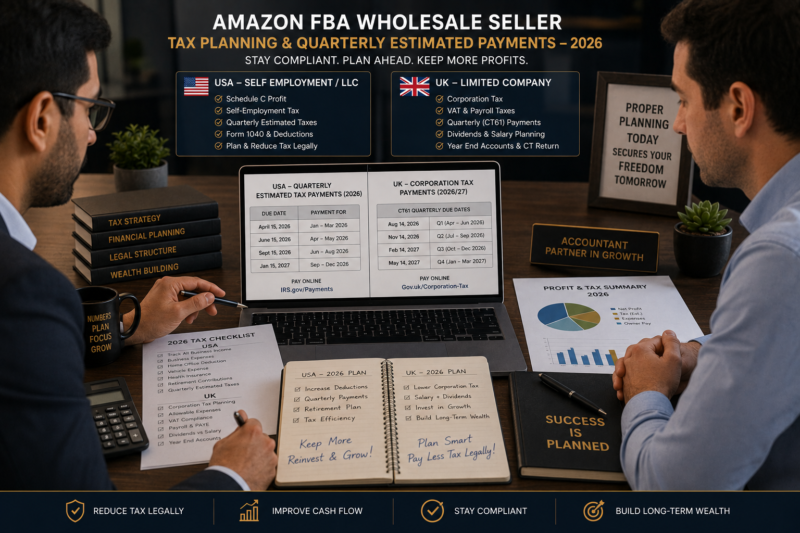
Unlike employees who have income tax withheld from their salary by their employer self-employed FBA sellers must pay their estimated federal income tax quarterly. If you expect to owe $1,000 or more in federal taxes for the year you are required to make quarterly estimated payments to the IRS. Missing quarterly payments results in an underpayment penalty — typically a small percentage of the unpaid amount but one that adds up over time. Estimated tax payment due dates for 2026 are April 15 June 16 September 15 and January 15 2027.
✅ Simple Tax Reserve Rule for USA FBA Sellers
- Set aside 25 to 30 percent of every Amazon disbursement in a dedicated tax reserve account
- Make quarterly estimated payments to the IRS from this reserve
- Keep all receipts for business expenses — they reduce your taxable profit directly
- File your annual federal return by April 15 each year or request a 6-month extension
- Consult a CPA familiar with Amazon ecommerce for your first year filing
Sales Tax and Nexus — The Most Complex USA Tax Issue for FBA Sellers
Sales tax is the most complicated and frequently misunderstood tax obligation for Amazon FBA sellers in the USA. Unlike federal income tax which applies uniformly nationwide sales tax is administered at the state level with 45 states plus Washington DC imposing sales tax — each with different rates rules and thresholds. The critical concept every FBA seller must understand is nexus — the legal connection between your business and a state that creates a sales tax collection obligation.
What Creates Nexus for FBA Sellers?
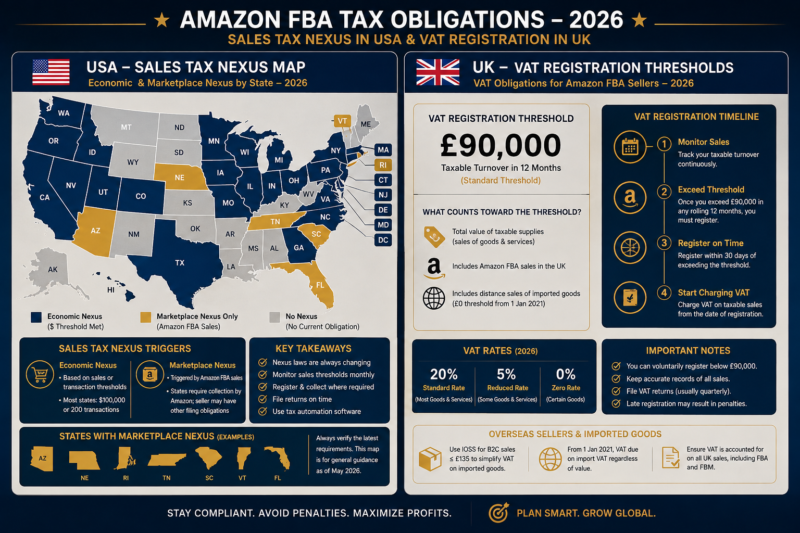
For Amazon FBA sellers nexus is created in any state where Amazon stores your inventory in their fulfilment centres — even if you have no other presence in that state. Because Amazon operates fulfilment centres across dozens of states and distributes seller inventory across multiple centres simultaneously most active FBA sellers have nexus in 10 to 25 states without ever choosing to operate there. This creates sales tax filing obligations in each of those states that many sellers are unaware of.
| Nexus Type | What Creates It | FBA Relevance |
|---|---|---|
| Physical Nexus | Inventory stored in a state — including Amazon FBA warehouses | Highly relevant — FBA inventory creates nexus |
| Economic Nexus | Exceeding a state’s sales threshold — typically $100,000 or 200 transactions | Relevant for high-volume sellers |
Marketplace Facilitator Laws — Amazon Collects for You in Most States
The significant development that has simplified sales tax compliance for most Amazon sellers is marketplace facilitator legislation — now enacted in all 45 sales tax states. Under marketplace facilitator laws Amazon is required to collect and remit sales tax on behalf of third-party sellers for sales made through the Amazon marketplace. This means Amazon automatically collects the correct sales tax from customers at checkout and remits it to the relevant state tax authority — without any action required from you as the seller.
However marketplace facilitator laws do not eliminate all your sales tax obligations. You may still need to register for sales tax in states where you have nexus — even if Amazon is collecting and remitting on your behalf — and file periodic sales tax returns showing zero sales tax due because Amazon has remitted on your behalf. The registration and filing requirements vary by state. Consult a sales tax specialist or use a service like TaxJar or Avalara to manage your multi-state compliance automatically.
Deductible Business Expenses — USA
Every legitimate business expense you incur in running your Amazon FBA wholesale business is potentially deductible from your taxable income — directly reducing the amount of income tax you owe. The most common deductible expenses for FBA sellers include:
| Expense Category | Examples |
|---|---|
| Cost of Goods Sold | Wholesale product costs — your single largest deductible expense |
| Amazon Fees | Referral fees FBA fees storage fees advertising charges |
| Software Subscriptions | Keepa Helium 10 AMZScout Zik Analytics accounting software |
| Shipping Costs | Inbound FBA shipping postage and packaging materials |
| Professional Fees | Accountant CPA legal fees business formation costs |
| Home Office | Proportional home office expenses if used exclusively for business |
| Education and Training | FBA courses books and professional development directly related to your business |
| Bank and Credit Card Fees | Business account fees payment processing charges interest on business loans |
Amazon FBA Tax — UK Sellers
Corporation Tax
UK Limited Company sellers pay Corporation Tax on their company’s taxable profits — the revenue generated by the business minus all allowable business expenses. As of 2026 the Corporation Tax rates in the UK are 19 percent on profits up to £50,000 and 25 percent on profits above £250,000 with a marginal relief taper for profits between these thresholds. Your Corporation Tax return must be filed with HMRC within 12 months of your company’s accounting year end and the tax itself must be paid within 9 months and 1 day of your accounting year end.
For most new FBA sellers in their first year of trading the 19 percent small profits rate applies — making the UK a genuinely competitive tax environment for small business owners compared to many other countries. The key to minimising your Corporation Tax liability is ensuring all legitimate business expenses are correctly claimed — reducing your taxable profits before the tax rate is applied.
VAT — Value Added Tax
VAT is the UK equivalent of sales tax — a consumption tax charged on most goods and services at the standard rate of 20 percent. Unlike US sales tax which is only collected at the point of final sale VAT is charged at every stage of the supply chain with businesses recovering the VAT they pay on purchases against the VAT they collect on sales.
When Must You Register for VAT?
You must register for VAT when your taxable turnover — your total sales revenue — exceeds the VAT registration threshold in any rolling 12-month period. The VAT registration threshold in the UK for 2026 is £90,000. Once you exceed this threshold you must register for VAT within 30 days and begin charging VAT on your Amazon sales. You can also register voluntarily before reaching the threshold — which some FBA sellers do to reclaim VAT on their wholesale purchases and business expenses even before their sales revenue reaches the compulsory level.
| VAT Registration — Key Facts | Details |
|---|---|
| Compulsory Threshold | £90,000 taxable turnover in any rolling 12-month period |
| Standard VAT Rate | 20% on most goods — 0% on most food and children’s clothing |
| VAT Return Frequency | Quarterly — every 3 months via Making Tax Digital compatible software |
| Amazon and VAT | Amazon collects and remits VAT on marketplace sales — but you remain responsible for registration and filing |
| VAT Reclaim | Reclaim VAT on wholesale purchases tool subscriptions shipping and other business costs |
How Amazon Handles VAT for UK Sellers
Amazon acts as the deemed supplier for VAT purposes on sales made through the Amazon UK marketplace — meaning Amazon collects and remits the VAT on your sales directly to HMRC. This applies to both UK-registered sellers and overseas sellers selling on Amazon UK. However Amazon’s collection of VAT on your behalf does not remove your obligation to be VAT registered if you exceed the threshold or to file quarterly VAT returns. You must still account for this VAT in your returns — even though Amazon has already remitted it — to maintain accurate VAT accounting records.
Allowable Business Expenses for UK Corporation Tax
UK Limited Company sellers can deduct all genuine business expenses from their company’s taxable profits before Corporation Tax is calculated. The most significant deductible expenses for FBA wholesale sellers include cost of goods sold Amazon fees software subscriptions shipping costs accountant fees home office costs and any salary paid to yourself as a director. Maximising your legitimate expense claims is the most straightforward way to reduce your Corporation Tax liability — but all claims must be supported by receipts and relate exclusively to business purposes.
USA vs UK Tax Comparison — Amazon FBA Sellers
| Tax Obligation | USA (LLC) | UK (Ltd Company) |
|---|---|---|
| Business Profit Tax | Federal income tax at personal rate 10 to 37% | Corporation Tax 19 to 25% |
| Sales Tax / VAT | Sales tax — Amazon collects via marketplace facilitator laws | VAT 20% — register when turnover exceeds £90,000 |
| Self Employment Tax | 15.3% on net income up to $168,600 | Not applicable for Ltd Company directors |
| Filing Frequency | Quarterly estimated tax — annual return April 15 | Quarterly VAT returns — annual Corporation Tax return |
| Complexity Level | Higher — multi-state nexus obligations | Moderate — single national framework |
Frequently Asked Questions
Does Amazon Report My Sales to the IRS?
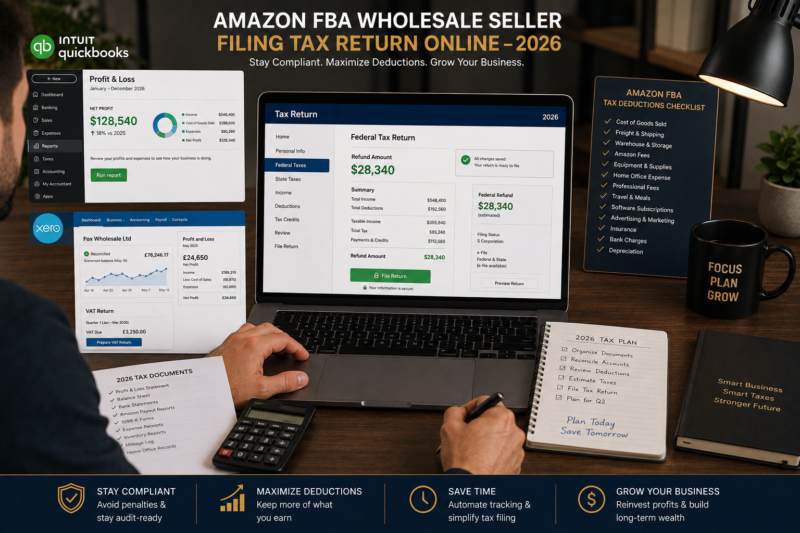
Yes — Amazon issues a 1099-K form to US sellers who process more than $5,000 in gross sales through the platform in a calendar year as of 2026 reporting thresholds. This form reports your total gross sales to the IRS — not your profit — and a copy is sent to both you and the IRS automatically. It is important to understand that the 1099-K reports gross revenue before deducting your cost of goods sold Amazon fees and business expenses. Your actual taxable profit will be significantly lower than the gross figure on your 1099-K once all deductions are applied.
Do I Need an Accountant for My Amazon FBA Business?
Yes — a qualified accountant or CPA experienced with ecommerce businesses is strongly recommended for all FBA wholesale sellers from their first year of trading. FBA businesses have specific accounting complexities including inventory cost tracking Amazon fee categorisation multi-state sales tax compliance and the reconciliation of Amazon disbursements with actual sales data. An experienced ecommerce accountant typically saves you significantly more in tax efficiency and avoided penalties than their fees cost. USA sellers should look for a CPA experienced with Amazon sellers. UK sellers should look for an accountant familiar with ecommerce and Making Tax Digital compliance.
What is A2X and Do I Need It?
A2X is an accounting integration tool that automatically fetches your Amazon settlement data and maps it into your accounting software — QuickBooks or Xero — in a format that correctly accounts for Amazon’s complex fee structures and payout cycles. Without A2X reconciling your Amazon disbursements with your accounting records is a time-consuming manual process that is prone to errors. A2X costs from $19 per month and pays for itself in accountant time saved within the first month of use for any seller generating more than $5,000 per month in Amazon revenue.
Can UK Sellers Sell on Amazon USA and What Are the Tax Implications?
Yes — UK sellers can sell on Amazon USA and many do successfully. The tax implications are significant and require careful planning. UK sellers selling on Amazon USA may have sales tax nexus obligations in US states where Amazon stores their inventory — creating multi-state registration and filing requirements even as a non-US business. US-source business income may also be taxable in both the USA and UK depending on the tax treaty position and your specific business structure. This area is genuinely complex and specialist advice from a tax professional experienced with cross-border ecommerce is essential before launching on Amazon USA as a UK seller.
Related Articles — Keep Learning
- How to Manage Cash Flow in Your Amazon FBA Wholesale Business
- How to Calculate Your True Amazon FBA Profit Margin
- How to Set Up Business Banking for Your Amazon FBA Business
- How to Register Your Business for Amazon FBA — LLC vs Sole Trader
- How to Scale Your Amazon FBA Business from $0 to $10,000 Monthly
- Best Amazon FBA Tools for Beginners in 2026 — Complete Guide
- Browse the Brandhunterz Brands Directory — Free Access
- Amazon FBA and eBay Wholesale Courses by Brandhunterz
BUILD YOUR WHOLESALE BUSINESS ON SOLID FOUNDATIONS
Browse Verified Wholesale Brands — Free Access
With your tax obligations understood find the profitable wholesale brands to build your FBA business. The Brandhunterz Brands Directory gives you instant free access to verified wholesale brands with real trade contacts across USA and UK marketplaces.
About the Author
This article is written by the team at Brandhunterz Ltd — a UK registered Amazon FBA wholesale sourcing company (Company No: 15342697) registered in England and Wales since 2023. Visit brandhunterz.com to learn more.