
WHOLESALE BUSINESS FINANCE · 2026
How to Build a Wholesale FBA Budget from Scratch
By Brandhunterz Ltd | Company No: 15342697 | 13 minute read
Affiliate Disclosure: This article contains affiliate links. If you purchase through our links we may earn a commission at no extra cost to you. We only recommend tools we genuinely use and believe in. Read our full disclaimer.
Building a budget is one of those business activities that new Amazon FBA sellers consistently delay — either because it feels premature before revenue is established or because it seems overly complex and time-consuming. The reality is the opposite on both counts. A budget is most valuable before you have significant revenue because it forces you to think clearly about where every dollar goes before it is spent — preventing the reactive spending patterns that kill margins and drain working capital in the early months. And building an effective FBA wholesale budget takes less than two hours the first time and thirty minutes each month to update.
We are Brandhunterz Ltd — a UK registered wholesale sourcing company (Company No: 15342697) — and in this complete guide we walk you through exactly how to build a wholesale FBA budget from scratch — covering starting capital allocation monthly expense budgeting inventory budget planning and the key financial targets every FBA seller should be measuring every month across both Amazon USA and Amazon UK.
💡 Quick Summary
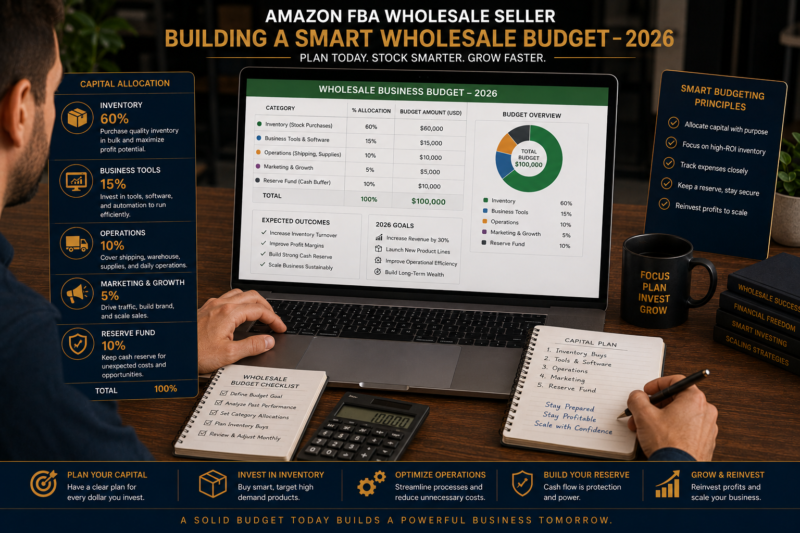
A complete wholesale FBA budget has four components — a starting capital allocation plan that assigns every dollar of your initial investment to a specific purpose, a monthly fixed expenses budget covering all recurring costs, a variable expenses budget covering stock-dependent costs, and an inventory budget plan that sets your maximum stock investment per ordering cycle. The most important budget rule for wholesale FBA sellers is the 80-10-10 rule — allocate at least 80 percent of your starting capital to inventory no more than 10 percent to tools and setup and keep at least 10 percent as a cash reserve.
Why Most New FBA Sellers Misallocate Their Starting Capital
The most common budget mistake new Amazon FBA sellers make is spending too large a proportion of their starting capital on tools subscriptions courses and business setup costs before investing in inventory. A seller who starts with $2,000 and spends $600 on tools $300 on courses $200 on business registration and $150 on miscellaneous setup has only $750 left for actual inventory — insufficient to place meaningful first orders with even a single wholesale brand at most minimum order values.
Amazon FBA is an inventory business. Revenue is generated by selling inventory. Tools and education support better decisions about which inventory to buy — but they generate zero revenue on their own. Every dollar allocated to non-inventory expenses in the early months is a dollar that is not working to generate the Amazon sales that fund future growth. The budget framework in this guide ensures your capital allocation reflects this fundamental reality.
Part 1 — Starting Capital Allocation
Your starting capital allocation plan assigns every dollar of your initial investment to a specific purpose before you spend a single cent. This prevents the reactive spending that erodes capital in the early weeks and ensures the majority of your investment goes directly into inventory — the asset that generates your revenue.
The 80-10-10 Starting Capital Rule
| Allocation | Percentage | Purpose | $2,000 Start | $5,000 Start |
|---|---|---|---|---|
| Inventory Budget | 80% | First wholesale orders — 2 to 3 brands | $1,600 | $4,000 |
| Tools and Setup | 10% | Keepa business registration Seller Central | $200 | $500 |
| Cash Reserve | 10% | Emergency buffer — never touch unless essential | $200 | $500 |
Starting Capital Allocation — By Starting Amount
Here is how the 80-10-10 rule translates into specific spending decisions at different starting capital levels. Notice that the tools allocation covers only essential tools in the early months — additional tools are added as revenue grows to fund them without touching inventory capital.
| Starting Capital | Inventory Budget | Essential Tools | Cash Reserve |
|---|---|---|---|
| $1,000 | $800 | $100 — Keepa only | $100 |
| $2,000 | $1,600 | $200 — Keepa + AMZScout first month | $200 |
| $5,000 | $4,000 | $500 — Keepa + Helium 10 Starter + registration | $500 |
| $10,000 | $8,000 | $1,000 — full tool stack + registration + accountant | $1,000 |
Part 2 — Monthly Fixed Expenses Budget
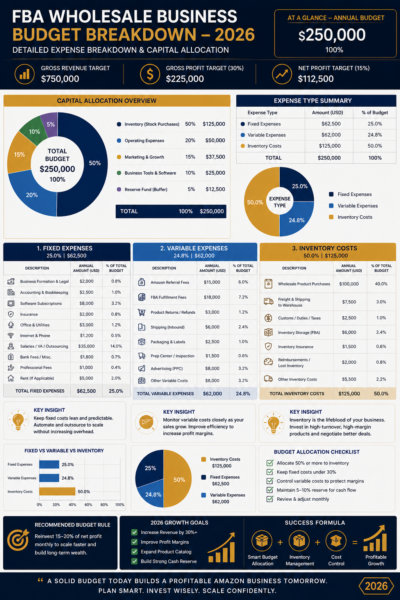
Your monthly fixed expenses are the recurring costs your business incurs every month regardless of how much inventory you buy or how many units you sell. Knowing your exact fixed expense total is essential because these costs must be covered by your revenue before any profit is generated. A seller who does not know their fixed expense total cannot accurately calculate their break-even revenue level.
| Fixed Expense | Stage 1 — New Seller | Stage 2 — Growing | Stage 3 — Scaled |
|---|---|---|---|
| Amazon Seller Central Fee | $39.99/month | $39.99/month | $39.99/month |
| Keepa Subscription | ~$20/month | ~$20/month | ~$20/month |
| Helium 10 / AMZScout | $29/month | $29 to $99/month | $99/month |
| Zik Analytics | — | $29.99/month | $59.99/month |
| Accounting Software | — | $30/month | $50/month |
| Business Bank Account | $0 (Mercury/Starling) | $0 to $15/month | $15 to $30/month |
| Accountant (monthly allocation) | — | $50 to $100/month | $100 to $200/month |
| Total Monthly Fixed Costs | ~$89/month | ~$200 to $315/month | ~$385 to $495/month |
Part 3 — Variable Expenses Budget
Variable expenses are costs that fluctuate with your sales and inventory volume. Unlike fixed expenses which are predictable and consistent variable expenses scale up as your business grows — making them harder to budget precisely but equally important to track. For FBA wholesale sellers the main variable expense categories are:
Amazon FBA Fees — Variable by Product and Volume
Amazon FBA fees — referral fees fulfilment fees and storage fees — are your largest variable expense category and should be budgeted as a percentage of revenue rather than a fixed dollar amount. For most wholesale FBA sellers across standard consumer goods categories total Amazon fees represent 25 to 35 percent of revenue depending on your product mix. Budget 30 percent of projected revenue as your Amazon fee allowance and refine this figure monthly as your actual fee data accumulates in Seller Central.
Inbound Shipping Costs — Variable by Order Volume
Inbound shipping costs vary with the volume and weight of stock you send to FBA each month. Budget approximately $0.30 to $1.00 per unit for domestic US shipping using Amazon’s Partnered Carrier Programme — or $0.20 to $0.60 per unit for UK shipping using UPS through Amazon. As your order sizes increase your per-unit shipping cost typically decreases — more units per carton means lower cost per unit shipped.
Advertising Spend — Percentage of Revenue
If you run Sponsored Products advertising budget this as a percentage of revenue — typically 3 to 8 percent for established wholesale products with strong organic Buy Box presence. New product launches may require higher initial advertising spend of 8 to 15 percent of revenue until organic rank builds. Set a maximum monthly advertising budget and track your Advertising Cost of Sale (ACoS) weekly to ensure advertising spend is generating profitable returns.
Returns and Refunds — Percentage of Revenue
Budget a returns and refunds allowance based on the typical return rate for your product categories. For Grocery and Health products budget 2 to 3 percent of revenue. For Home and Kitchen budget 5 to 7 percent. For Electronics budget 8 to 12 percent. This allowance covers both the refunded revenue and the cost of any units that cannot be resold after return.
Part 4 — Inventory Budget Planning
Your inventory budget determines how much capital you allocate to purchasing wholesale stock each ordering cycle. Getting this right is the most important financial decision you make as a wholesale FBA seller — too little inventory and you stock out and lose sales rank and Buy Box position. Too much inventory and you tie up capital in slow-moving stock generating storage fees instead of profit.
The Inventory Budget Formula
Inventory Budget Formula
Maximum Reorder Quantity = (Average Daily Sales Rate × Target Days of Cover) ÷ Wholesale Cost Per Unit
Target Days of Cover = Lead time from order to FBA availability (typically 14 to 21 days) plus your desired safety stock buffer (typically 14 to 21 additional days) = 28 to 42 days total cover per reorder cycle
Worked Example — Inventory Budget Calculation
| Variable | Product A | Product B |
|---|---|---|
| Average Daily Sales Rate | 3 units per day | 1 unit per day |
| Target Days of Cover | 35 days | 35 days |
| Reorder Quantity | 3 × 35 = 105 units | 1 × 35 = 35 units |
| Wholesale Cost Per Unit | $6.00 | $12.00 |
| Inventory Budget Required | $630 | $420 |
In this example maintaining adequate stock cover for both products requires $1,050 of inventory capital per ordering cycle. If you are managing 10 products with similar profiles your inventory budget requirement would be approximately $10,500 per ordering cycle — the working capital your business needs to keep all products in stock simultaneously without stockouts.
Part 5 — Monthly Budget Template
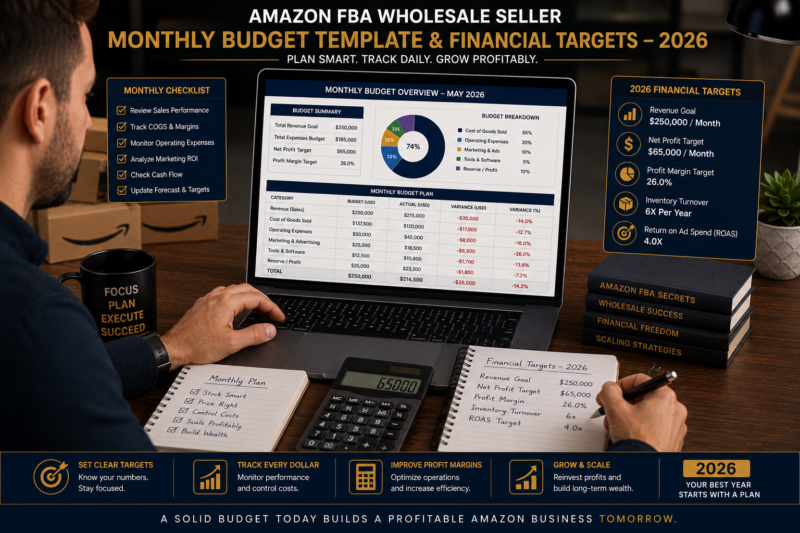
Combine all four components into a single monthly budget that you review and update at the start of every month. This becomes your primary financial management tool — showing you at a glance whether your business is generating sufficient revenue to cover all expenses grow your inventory base and hit your profit targets.
📋 Monthly FBA Wholesale Budget Template
INCOME
- Total Amazon Disbursements Received: $______
- Less Amazon Fees Already Deducted: $______
- Gross Revenue (before fees): $______
COST OF GOODS SOLD
- Wholesale Stock Purchases This Month: $______
- Inbound Shipping Costs: $______
- Total COGS: $______
FIXED EXPENSES
- Amazon Seller Central Fee: $39.99
- Keepa Subscription: $______
- Helium 10 / AMZScout: $______
- Zik Analytics: $______
- Accounting Software: $______
- Accountant Fee: $______
- Other Fixed Costs: $______
- Total Fixed Expenses: $______
VARIABLE EXPENSES
- Advertising Spend: $______
- Returns and Refunds Allowance: $______
- FBA Storage Fees: $______
- Total Variable Expenses: $______
SUMMARY
- Gross Revenue: $______
- Less Total COGS: $______
- Less Total Fixed Expenses: $______
- Less Total Variable Expenses: $______
- Net Profit This Month: $______
- Net Profit Margin: ______%
- Amount Reinvested in Stock: $______
- Tax Reserve Transfer (25-30%): $______
Key Financial Targets to Track Monthly
| Metric | Target Range | Action if Below Target |
|---|---|---|
| True Net Profit Margin | Above 20% | Review pricing and cut underperforming products |
| Fixed Expenses as % of Revenue | Below 10% | Increase revenue before adding new tools or costs |
| Advertising ACoS | Below 15% | Pause underperforming keywords reduce bids |
| Stock Cover — Days Remaining | Above 21 days | Place emergency reorder immediately |
| Working Capital Reserve | Above 60 days stock cost | Pause personal draws and reinvest to rebuild |
| Revenue Growth Month on Month | Above 10% in first 12 months | Increase brand application volume and reorder sizes |
Frequently Asked Questions
How Much Starting Capital Do I Need to Start Amazon FBA Wholesale?
The minimum practical starting capital for Amazon FBA wholesale is $1,000 — though $2,000 to $5,000 gives you significantly more flexibility to place meaningful first orders with multiple brands and absorb the learning curve costs of early mistakes. With $1,000 following the 80-10-10 rule you have $800 for inventory — enough for one or two small first orders with brands that have low minimum order values. The more capital you start with the faster you can build a diversified brand portfolio and reach meaningful monthly revenue levels.
When Should I Start Paying Myself From My FBA Business?
Begin drawing a modest personal salary from your FBA business only when three conditions are met simultaneously — your working capital reserve exceeds 90 days of stock cost your monthly net profit is consistently above $2,000 and your revenue has shown at least 3 consecutive months of stable or growing performance. Before these conditions are met every dollar of profit that leaves the business is a dollar that cannot fund future stock growth. Patience in the early months creates the compound growth that funds a sustainable personal income later.
How Do I Budget for Q4 as an FBA Seller?
Q4 budgeting for FBA sellers requires specific forward planning starting in July and August. Estimate your Q4 stock requirements at 2 to 3 times your normal monthly inventory budget — Q4 demand for most consumer product categories is significantly higher than the rest of the year. Reserve this capital specifically for Q4 stock purchases made in August and September so your inventory arrives at FBA before the October peak begins. Also budget for increased storage fees during Q4 at Amazon’s elevated October to December storage rate.
Should I Use a Spreadsheet or Accounting Software for My Budget?
Start with a simple spreadsheet for your first 3 to 6 months — it forces you to understand every line item in your budget rather than relying on software to categorise everything automatically. Once your business generates more than $5,000 per month in revenue upgrade to QuickBooks or Xero and add A2X for automatic Amazon settlement reconciliation. The accounting software produces more accurate reports with less manual input at scale — but the discipline of building your budget manually first gives you the financial literacy to interpret those reports correctly.
Related Articles — Keep Learning
- How to Manage Cash Flow in Your Amazon FBA Wholesale Business
- How to Calculate Your True Amazon FBA Profit Margin
- How to Use Business Credit to Scale Your Amazon FBA Business
- Amazon FBA Tax Guide for USA and UK Sellers 2026
- How to Scale Your Amazon FBA Business from $0 to $10,000 Monthly
- Best Amazon FBA Tools for Beginners in 2026 — Complete Guide
- Browse the Brandhunterz Brands Directory — Free Access
- Amazon FBA and eBay Wholesale Courses by Brandhunterz
PUT YOUR BUDGET TO WORK — FIND BRANDS TO SOURCE
Browse Verified Wholesale Brands — Free Access
With your budget built and your inventory capital allocated find the wholesale brands worth sourcing. The Brandhunterz Brands Directory gives you instant free access to verified wholesale brands with real trade contacts across USA and UK marketplaces.
About the Author
This article is written by the team at Brandhunterz Ltd — a UK registered Amazon FBA wholesale sourcing company (Company No: 15342697) registered in England and Wales since 2023. Visit brandhunterz.com to learn more.