
AMAZON FBA PRODUCT RESEARCH
How to Validate Amazon FBA Product Demand Before Placing a Wholesale Order
By Brandhunterz Ltd | Company No: 15342697 | 14 minute read
Affiliate Disclosure: This article contains affiliate links. If you purchase through our links we may earn a commission at no extra cost to you. We only recommend tools we genuinely use and believe in. Read our full disclaimer.
One of the most damaging assumptions a wholesale FBA seller can make is confusing the appearance of demand with confirmed demand. A product might have a reasonable BSR today a handful of positive reviews and a price point that looks workable — but none of these signals alone confirm that the product generates consistent repeatable monthly sales at the volume you need to justify a wholesale order. Validating demand before committing capital means going beyond surface observations and interrogating the actual historical sales data using multiple tools in sequence — so that by the time you send a trade account application you already know with high confidence exactly how many units the listing sells per month and whether that velocity is stable enough to build a profitable wholesale business around.
We are Brandhunterz Ltd — a UK registered wholesale sourcing company (Company No: 15342697) — and in this complete guide we show you the exact demand validation process we apply to every product before placing any wholesale order — covering every data source every check and every threshold that separates a product worth ordering from one that looks viable but will disappoint once your stock arrives at FBA.
💡 Quick Summary
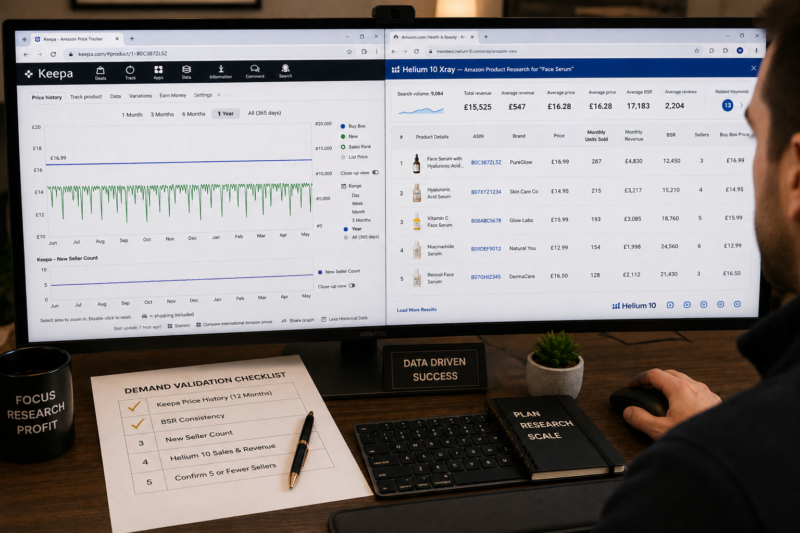
Validating Amazon FBA product demand before placing a wholesale order requires five sequential confirmations — consistent BSR drops on Keepa over 12 months confirming regular sales estimated monthly units from Helium 10 Xray showing minimum 30 units per month no Amazon presence on the orange Keepa line stable Buy Box price on the Keepa blue line and a minimum 30 percent ROI on AMZScout after all fees. All five must be confirmed before any capital is committed. One failure disqualifies the product entirely.
Why Demand Validation is a Separate Step From Product Discovery
Product discovery and demand validation are two distinct stages of the research process — and conflating them is one of the most common errors new wholesale sellers make. Discovery is about identifying candidates — products that look worth investigating. Validation is about confirming with data that those candidates actually sell consistently at a volume that supports a profitable wholesale order. Many products that survive the discovery stage fail the validation stage. That failure is valuable — it protects your capital from being committed to a product that would have delivered poor results.
| Discovery Signal | What It Tells You | What It Does NOT Confirm |
|---|---|---|
| BSR of 25,000 in category | Product sells reasonably well today | Whether it sold consistently for the past 12 months |
| 4.3 star review rating | Customers are generally satisfied | Whether return rates are low enough for profitable FBA |
| 3 sellers on the listing | Competition appears low today | Whether seller count was recently much higher and prices crashed |
| Selling price of £18.99 | Price looks viable for wholesale margin | Whether that price has been stable or was £24.99 six months ago |
| Brand name on listing | Product is from an identifiable brand | Whether that brand offers wholesale accounts or is brand-gated |
Validation Step 1 — Confirm 12 Months of Consistent BSR Drops on Keepa
The first and most important demand validation check is the 12-month BSR drop pattern on Keepa. Every BSR drop on the green line represents a sale — and the frequency regularity and consistency of those drops across a full 12-month period is the single most reliable indicator of genuine stable product demand available to any Amazon FBA seller.
| BSR Drop Pattern on Keepa | Estimated Monthly Sales | Demand Validated |
|---|---|---|
| Drops every 1 to 2 days — consistent 12 months | 150 to 400 units | ✅ Strong |
| Drops every 3 to 5 days — consistent 12 months | 60 to 150 units | ✅ Good |
| Drops every 6 to 10 days — consistent 12 months | 30 to 60 units | ⚠️ Minimum viable |
| Drops every 2 or more weeks — inconsistent | Under 15 units | ❌ Too slow for FBA |
| Mostly flat — occasional single drops | Under 5 units | ❌ Disqualify immediately |
💡 The Minimum Viable Demand Threshold for Wholesale FBA
For wholesale FBA to be viable on any listing the total monthly sales volume across all sellers should be at least 30 units per month — and ideally 60 or more. At 30 units per month shared between 3 sellers you receive approximately 10 units as a new fourth seller. At £6 net profit per unit that generates £60 per month from a single product line — viable only as part of a multi-brand portfolio. At 60 or more units per month the economics improve significantly and justify larger initial orders.
Validation Step 2 — Confirm Monthly Sales Volume With Helium 10 Xray
Keepa BSR drops give you a pattern of demand. Helium 10 Xray gives you an estimated unit count — how many units the listing is selling per month as a specific number. Both data points together give you a much more complete picture than either one alone. Here is how to use Xray specifically for demand volume confirmation:
Open the Amazon Listing — Run Xray From the Chrome Extension
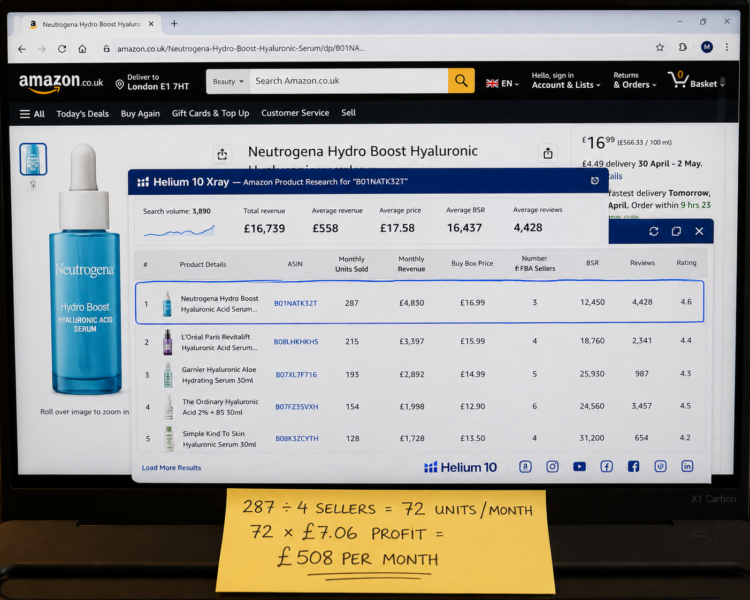
Navigate to the Amazon product page for the ASIN you are validating. Click the Helium 10 icon in your Chrome toolbar and select Xray. The Xray overlay loads a data panel across the top of the Amazon page showing the product’s estimated monthly sales volume in units estimated monthly revenue current BSR current Buy Box price and number of active sellers — all visible simultaneously without switching between tools.
Record the Monthly Units Sold Figure
Note the monthly units sold figure from the Xray overlay — for example 287 units per month. This is your total available demand figure. Divide it by the current number of FBA sellers plus one — adding yourself — to get your expected monthly sales share. For example 287 units divided by 4 sellers including yourself equals approximately 72 units per month as your estimated Buy Box share at an equal rotation rate.
Cross-Reference Xray Sales Volume With Keepa BSR Drop Frequency
Compare the Xray monthly units figure with the implied sales rate from your Keepa BSR drop analysis. If Xray shows 287 units per month and Keepa shows drops every 1 to 2 days the two data sources are consistent — confirming the demand estimate is reliable. If Xray shows 287 units but Keepa shows drops only every 7 to 10 days there is a discrepancy — the Keepa pattern suggests significantly lower actual sales and the Xray figure may be an overestimate. When the two sources conflict trust Keepa as the more reliable long-term indicator.
Calculate Your Realistic Monthly Revenue Estimate
Multiply your estimated monthly sales share by your net profit per unit to arrive at your expected monthly profit from this product. For example 72 units per month multiplied by £7.06 net profit per unit equals £508 per month net profit — a strong single product line contribution for a wholesale portfolio. Record this figure in your product research tracker alongside the ASIN brand name supplier contact status and margin data.
Validation Step 3 — Confirm No Amazon Presence on the Listing
This is the check that disqualifies more otherwise viable products than any other single factor. Even a product with 300 monthly units and a clean 12-month BSR history is completely unviable for wholesale FBA if Amazon is active on the listing — because Amazon’s fulfilment advantage and pricing power means third-party sellers receive almost zero Buy Box share when Amazon competes.
| Where to Check Amazon Presence | What to Look For | Pass or Fail |
|---|---|---|
| Keepa orange line — 12-month chart | Orange line completely absent for all 12 months | ✅ Pass — proceed |
| Keepa orange line — 12-month chart | Orange line present at any point — even briefly | ❌ Fail — disqualify |
| Amazon offer listing page — sold by field | Sold by Amazon — not a third-party seller name | ❌ Fail — disqualify |
| Helium 10 Xray sellers panel | Amazon appears as a seller in the Xray seller breakdown | ❌ Fail — disqualify |
Validation Step 4 — Confirm Stable Buy Box Price Over 12 Months
Price stability validation answers a critical question — is the selling price you are using in your margin calculation the price the product will realistically still be selling at when your stock arrives at FBA and for the months following? If the price has been declining the answer is likely no — and the margin you calculated today may not exist in two or three months when your orders begin selling through.
| Keepa Blue Line Pattern | What to Use for Margin Calculation | Proceed |
|---|---|---|
| Flat at same price for full 12 months | Use that price — highly reliable | ✅ Yes |
| Slight variation — within £1.00 band over 12 months | Use the lower end of the price band for conservative margin | ✅ Yes |
| Gently rising over 12 months | Use current price — trend is protective of margins | ✅ Yes |
| Declining — down more than 10% over 12 months | Disqualify — price erosion will continue | ❌ No |
| Volatile — large swings up and down | Disqualify — unpredictable — margin planning impossible | ❌ No |
Validation Step 5 — Confirm Minimum 30 Percent ROI on AMZScout
The final validation step is the margin confirmation — calculating your exact net profit and ROI using AMZScout with the stable Buy Box price confirmed in Step 4 as the selling price input. This calculation must account for every cost — referral fee FBA fulfilment fee storage fee inbound shipping cost and wholesale buy price — to arrive at the true net profit per unit.
DEMAND VALIDATED PRODUCT — COMPLETE MARGIN CONFIRMATION
| Line Item | Amount |
| Keepa 12-month average Buy Box price — confirmed stable | £16.99 |
| Amazon Referral Fee — 8% Health and Beauty | – £1.36 |
| FBA Fulfilment Fee — small parcel 250g | – £2.70 |
| FBA Monthly Storage Fee — per unit allocation | – £0.12 |
| Inbound Shipping to FBA — per unit estimate | – £0.25 |
| Wholesale Buy Price per unit — supplier price list | – £5.50 |
| Net Profit Per Unit | £7.06 |
| ROI — Net Profit divided by Total Cost x 100 | 123% ✅ Strong Pass |
| Estimated monthly profit — 72 units as 4th seller | £508.32 ✅ |
The Complete Demand Validation Checklist
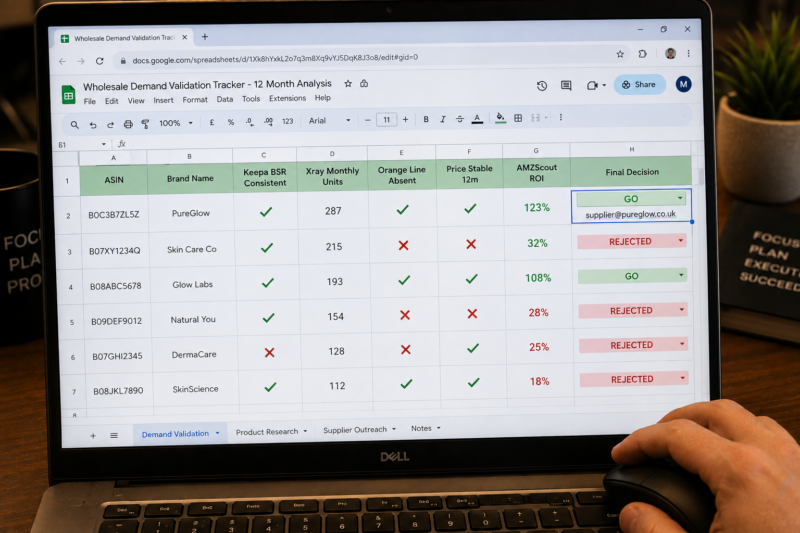
Every product must pass all five validation steps before a supplier is contacted. Record your findings for each product in a research tracker spreadsheet — ASIN brand name each validation step result and the final go or no-go decision. Here is the complete checklist:
| Demand Validation Step | Tool Used | Pass Threshold | Result |
|---|---|---|---|
| 12-month BSR drop pattern — consistent | Keepa | Drops minimum every 6 to 10 days year-round | ✅ Pass |
| Monthly units sold — minimum 30 total on listing | Helium 10 Xray | Minimum 30 units — ideally 60 or more | ✅ Pass |
| Amazon orange line — absent all 12 months | Keepa | Completely absent — no orange line at any point | ✅ Pass |
| Blue Buy Box price — stable or rising 12 months | Keepa | Price variance under 10% over 12 months | ✅ Pass |
| ROI minimum 30% after all fees and buy cost | AMZScout | Minimum 30% ROI — ideally 60% or more | ✅ Pass |
| All 5 validation steps passed | All tools confirmed | All thresholds met | ✅ GO |
How Many Products Should You Validate Per Week
Running the full five-step validation process on a single product takes approximately 15 to 20 minutes once you are familiar with the tools and sequence. At that rate a wholesale seller can validate 15 to 20 products per week in a dedicated Monday or Tuesday research session — generating 2 to 4 confirmed go products per week ready for supplier outreach. Over the course of a month that is 8 to 16 validated products to approach suppliers about — more than enough to add 1 to 2 new active brands to your portfolio every 4 to 6 weeks.
| Weekly Research Session | Products Validated | Expected Go Products | Monthly Total |
|---|---|---|---|
| 3 hours per week | 10 to 12 products | 1 to 3 go products | 4 to 12 go products |
| 5 hours per week | 15 to 20 products | 2 to 4 go products | 8 to 16 go products |
Conclusion — Validate Before Every Order Without Exception
Every pound you commit to a wholesale order should be backed by confirmed validated demand data — not by an impression of the product’s potential or a feeling that it looks like it should sell well. The five-step validation process takes less than 20 minutes per product and protects you from the most costly mistake in wholesale FBA — ordering stock before the demand is proven.
Validate every product with Keepa and Helium 10 Xray. Confirm every margin with AMZScout. Then find the verified wholesale supplier behind every validated product in our Brands Directory and apply for your trade account with confidence.
VALIDATE DEMAND — THEN FIND YOUR SUPPLIER
Browse 5,000+ Verified Wholesale Brands Free
Once all five validation steps confirm your product is a strong wholesale opportunity find its verified supplier contact in the Brandhunterz Brands Directory and send your trade account application today.
About the Author
This article is written by the team at Brandhunterz Ltd — a UK registered Amazon FBA wholesale sourcing company (Company No: 15342697) registered in England and Wales since 2023. Visit brandhunterz.com to learn more.