
FBA PACKAGING AND SHIPPING
Amazon FBA Packaging Requirements — Complete Guide for Wholesale Sellers
By Brandhunterz Ltd | Company No: 15342697 | 14 minute read
Affiliate Disclosure: This article contains affiliate links. If you purchase through our links we may earn a commission at no extra cost to you. We only recommend tools we genuinely use and believe in. Read our full disclaimer.
Amazon FBA packaging requirements exist to protect products during the fulfilment process — from the moment they arrive at the warehouse through picking packing and delivery to the customer. When your products do not meet these requirements Amazon can reject your shipment charge you a compliance fee return your stock at your cost or in some cases dispose of non-compliant units. For wholesale FBA sellers who are sourcing branded products from suppliers and sending them to Amazon the packaging requirements apply at two levels — the individual unit level and the shipping box level — and both must be fully met before your shipment leaves your hands.
We are Brandhunterz Ltd — a UK registered wholesale sourcing company (Company No: 15342697) — and in this complete guide we cover every Amazon FBA packaging requirement that wholesale sellers need to know — from individual unit prep requirements through poly bagging bubble wrapping and suffocation warning labels to box and pallet level specifications and the specific product types that have their own additional packaging rules.
💡 Quick Summary
Amazon FBA packaging requirements cover five areas — individual unit prep such as poly bagging or bubble wrapping for fragile or loose items FNSKU barcode labelling requirements expiry date labelling for food and supplements box packing specifications including maximum weight and dimensions and pallet requirements for large freight shipments. Most standard wholesale products in branded retail packaging require only an FNSKU label and correct box packing — no additional unit prep needed. Products that require additional prep are identified during the shipment plan creation process in Seller Central.
Understanding the Two Levels of FBA Packaging Requirements
Amazon’s FBA packaging requirements operate at two distinct levels. Confusing or conflating these two levels is one of the most common sources of shipment preparation errors for new sellers:
| Level | What It Covers | Who It Applies To |
|---|---|---|
| Unit Level | How each individual product unit must be prepared labelled and packaged before going into a shipping box | Every seller — applies to every unit in every shipment without exception |
| Box Level | How shipping boxes must be packed sealed labelled and dimensioned to be accepted at the fulfilment centre | Every seller — applies to every shipping box in every shipment without exception |
Unit Level Requirement 1 — FNSKU Barcode Labelling
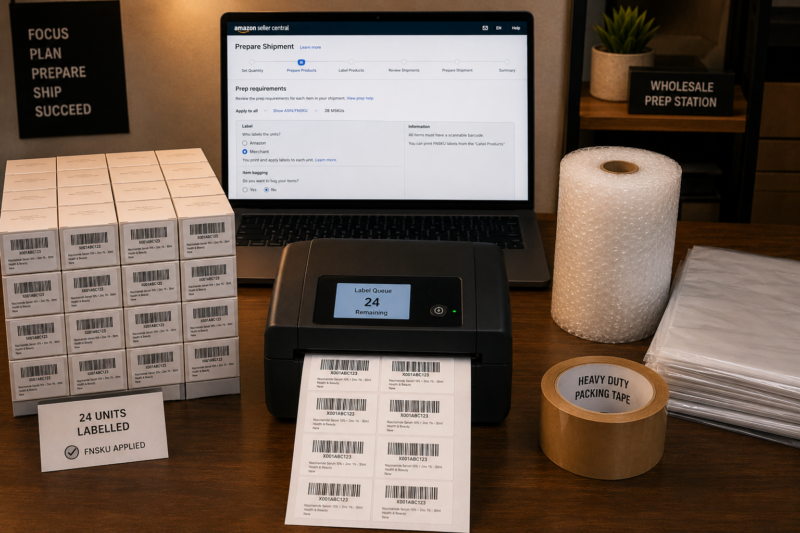
Every individual unit sent to Amazon FBA must carry an FNSKU barcode label on its outermost surface. The FNSKU is the Amazon-generated identifier that links your physical product to your seller account and your specific inventory at the fulfilment centre. Without a correctly applied FNSKU label Amazon cannot receive or process your unit.
| FNSKU Label Requirement | Specification |
|---|---|
| Label size | Minimum 22mm x 7mm — standard 30-up label sheet size 63.5mm x 38.1mm recommended |
| Print quality | Clear black and white — scannable at 15cm — no smudging or partial printing |
| Position on unit | Outermost surface — applied flat — not on curved surfaces — not inside packaging |
| Covering existing barcodes | Must cover all other scannable barcodes completely — EAN UPC and manufacturer codes |
| Number of labels per unit | Exactly one FNSKU label per unit — multiple labels cause scan confusion at receiving |
| Label adhesive | Must remain adhered through transport and warehouse handling — test adhesion before bulk applying |
Unit Level Requirement 2 — Poly Bagging Requirements
Certain product types must be placed inside a sealed transparent poly bag before being sent to FBA. The poly bag protects the product during storage and transit in the fulfilment centre. Amazon identifies which products require poly bagging based on their packaging type and product category. Here are the product types that require poly bagging and the specific requirements for the bags themselves:
| Product Type Requiring Poly Bag | Reason |
|---|---|
| Products with loose or exposed parts | Prevents parts from separating in storage and contaminating other units |
| Products with fabric or textiles not in retail packaging | Prevents dust accumulation and soiling during warehouse storage |
| Products that could leak — liquids creams gels | Contains any leakage and prevents contamination of adjacent inventory |
| Products with powders or small granules | Prevents powder escape and contamination during fulfilment handling |
| Multi-piece sets sold as a single unit | Keeps all components together — prevents individual pieces being sold separately by mistake |
POLY BAG SPECIFICATIONS — AMAZON REQUIREMENTS
| Specification | Requirement |
| Bag thickness | Minimum 1.5 mil — 2 mil or more recommended for heavier products |
| Bag sealing | Must be fully sealed — heat sealed or zip-lock closed — open bags are not accepted |
| Bag opening size | If opening is larger than 12.7cm — suffocation warning required on the bag |
| Suffocation warning text | Warning to keep away from children — in English — must be printed on or affixed to the bag |
| Barcode visibility | FNSKU barcode must be readable through the bag OR applied on the outside of the bag |
| Contents identification | Product must be identifiable through the bag without opening — use clear transparent bags only |
Unit Level Requirement 3 — Bubble Wrap for Fragile Products
Fragile products that could break or be damaged during fulfilment centre handling must be individually bubble-wrapped before being placed into shipping boxes. Amazon defines fragile products broadly — any item that could be damaged by a 1.5-metre drop test or by the mechanical sorting equipment used in fulfilment centres must be prepared with adequate protective wrapping.
| Fragile Product Type | Prep Required |
|---|---|
| Glass bottles and jars — perfume candles cosmetics | Minimum 2 inches of bubble wrap on all sides — taped closed — must pass drop test |
| Ceramic or porcelain items | Full wrap — no exposed surfaces — secure with tape — fragile sticker on outside of wrap |
| Items with protruding parts or delicate components | Individual component wrapping — additional padding over protruding elements |
| Products in retail packaging likely to crush | Outer protective layer — card sleeve or bubble pouch — to prevent box compression damage |
Unit Level Requirement 4 — Expiry Date Labelling
Food grocery supplement and health product units sent to FBA must carry a clearly visible expiry date in a format Amazon can read and verify. Amazon uses expiry date information to manage its first-in-first-out stock rotation and to ensure that units approaching expiry are removed from fulfilment centre inventory before they become unsellable. Units that do not carry a readable expiry date or whose expiry is within 90 days of the shipment arrival date are rejected at receiving.
| Expiry Date Requirement | Specification |
|---|---|
| Required date format | MM-YYYY or MM-DD-YYYY — month and year as a minimum — day optional |
| Minimum remaining shelf life at FBA arrival | Minimum 90 days remaining from the date Amazon receives the shipment |
| Label position | Visible on the outermost surface of the unit — cannot be hidden under packaging or labels |
| If manufacturer date not readable | Apply an additional sticker label with the expiry date in the correct format |
Box Level Requirements — Shipping Box Specifications
Once every unit is correctly prepped and labelled the boxes you pack them into must also meet Amazon’s specific requirements. Here is the complete box-level specification for standard FBA shipments:
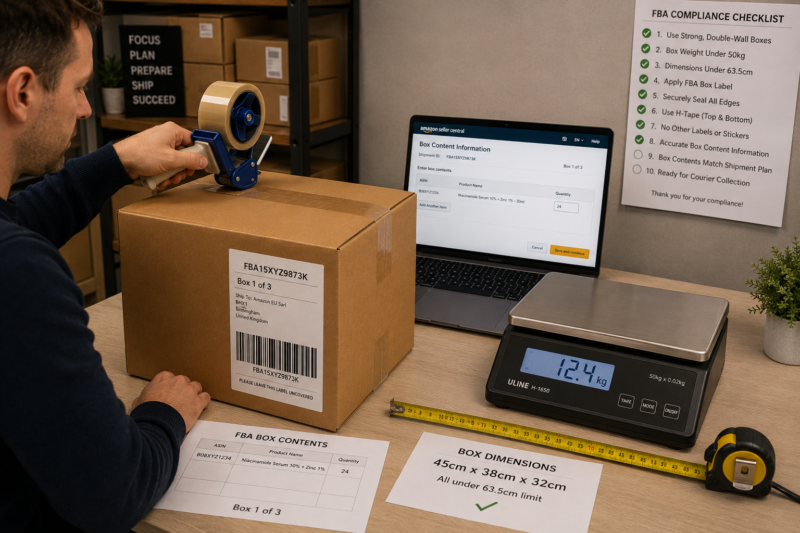
| Box Requirement | Specification | Why It Matters |
|---|---|---|
| Maximum box weight | 50kg gross | Manual handling limit for warehouse staff — boxes over 50kg refused |
| Maximum dimensions — any single side | 63.5cm maximum | Conveyor belt and automated sorting equipment limitations |
| Box construction | Double-wall corrugated | Must survive stacking in transit and warehouse — single-wall boxes collapse under weight |
| Box condition | No damage or holes | Damaged boxes rejected — stock inside may be refused if box is compromised |
| Sealing method | H-tape all seams | Prevents box opening during transit — tape both top and bottom seams in H pattern |
| Void fill | No movement when shaken | Products moving inside box cause damage and failed barcode scanning at receiving |
| Old labels and barcodes | Remove or cover all | Old barcodes confuse scanning systems — previous shipment labels cause routing errors |
| Box label position | Largest flat side — not on seam | Box label must be readable without rotating the box in the receiving area |
Special Packaging Requirements by Product Type
Beyond the standard unit and box requirements certain product types have additional specific packaging rules. These apply on top of the standard requirements — not instead of them. If your wholesale products fall into any of the following categories you must meet both the standard requirements and the category-specific requirements:
| Product Type | Additional Packaging Requirement |
|---|---|
| Liquid products — shampoo lotion cream | Must be in sealed leak-proof containers — additional poly bag required — openings taped or heat-sealed |
| Products sold as sets or multipacks | All components must be secured together as a single unit — labelled Do Not Separate on outer packaging |
| Footwear and shoes | Must be in original box — box placed inside a poly bag — FNSKU on outside of poly bag |
| Products with sharp edges — blades tools | Edges must be sheathed or covered — no exposed sharp edges that could injure warehouse staff |
| Products containing batteries — lithium | Special handling label required — UN3481 or UN3091 hazmat label on outer shipping box — check FBA dangerous goods policy |
| Loose powdery or granular products | Must be double-sealed — primary container sealed — then placed in a sealed poly bag — 6-drop test required |
What Happens When Packaging Requirements Are Not Met
Amazon enforces packaging requirements through its fulfilment centre receiving process. When units or boxes arrive that do not meet the requirements Amazon has several response options — all of which cost the seller money and delay their stock going live. Understanding these consequences helps reinforce why meeting requirements correctly before dispatch is always cheaper and faster than dealing with non-compliance after the fact:
| Non-Compliance Issue | Amazon Response | Cost to Seller |
|---|---|---|
| Missing or unreadable FNSKU label | Unit held — relabelling fee charged or return arranged | Relabelling fee per unit plus delay of 5 to 14 days going live |
| No box content information provided | Amazon manually scans entire box — compliance fee charged per unit | Compliance fee applied — typically £0.15 to £0.25 per unit |
| Expired product or under 90 days shelf life | Units refused — returned to seller or disposed of at seller cost | Return shipping cost plus possible disposal fee — full value of stock lost |
| Box over 50kg or over size limit | Box refused at dock — returned to sender | Return courier cost — repack and resend cost — delay of 7 to 14 days |
| Missing poly bag on required product | Units held — prep service applied at warehouse or returned | Per-unit prep service fee plus delay going live |
The Pre-Shipment Packaging Compliance Checklist
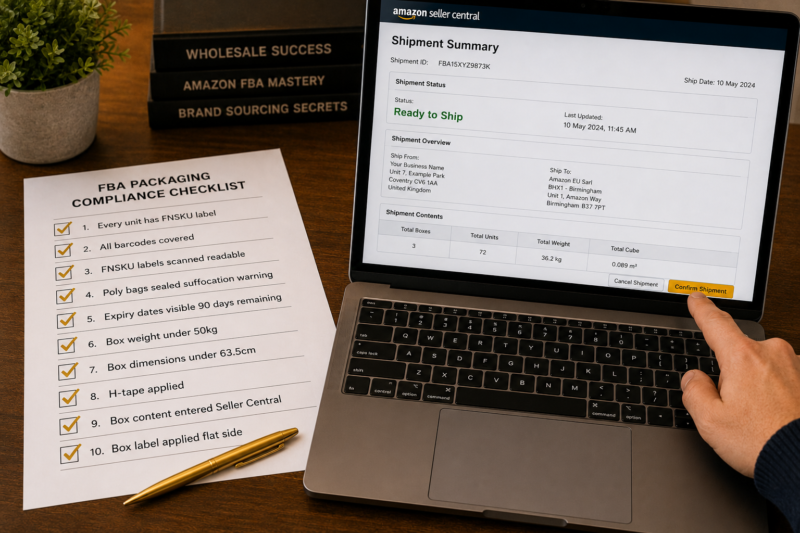
Run through this checklist on every shipment before booking your courier. Every item must be confirmed before boxes leave your location:
| Compliance Check | Confirmed |
|---|---|
| Every unit has one FNSKU label covering all original barcodes | ☐ |
| All FNSKU labels scanned and confirmed readable before boxing | ☐ |
| Poly bagging applied to all units requiring it — sealed and suffocation warning present | ☐ |
| Fragile units individually bubble-wrapped with minimum 2 inches protection | ☐ |
| Expiry dates visible and minimum 90 days remaining on all applicable units | ☐ |
| Each box weighed — under 50kg gross confirmed | ☐ |
| Each box measured — no side over 63.5cm confirmed | ☐ |
| All boxes sealed with H-tape on top and bottom seams | ☐ |
| Box content information entered in Seller Central for every box | ☐ |
| Amazon box label applied to largest flat side of every box | ☐ |
| All 10 checks confirmed — shipment ready to dispatch | ✅ GO |
Conclusion — Meet Every Requirement Before Every Shipment
Amazon’s FBA packaging requirements are not suggestions — they are enforceable standards with direct financial consequences when not met. Meeting every requirement correctly before your shipment leaves your location is always faster and cheaper than dealing with non-compliance issues after the fact. Build the compliance checklist into your standard shipment preparation process and confirm every item before you book your courier on every single shipment.
Find your next wholesale brand through our Brands Directory. Research every product with Keepa. Calculate every margin with AMZScout. And prepare every shipment to the exact standard this guide describes.
FIND YOUR NEXT WHOLESALE BRAND TO PREP AND SHIP
Browse 5,000+ Verified Wholesale Brands Free
Find verified wholesale trade contacts in the Brandhunterz Brands Directory — source your next product apply for your account and prep your shipment to Amazon FBA following every requirement in this guide.
About the Author
This article is written by the team at Brandhunterz Ltd — a UK registered Amazon FBA wholesale sourcing company (Company No: 15342697) registered in England and Wales since 2023. Visit brandhunterz.com to learn more.