
FBA PACKAGING AND SHIPPING
Amazon FBA Inbound Shipping Costs — How to Reduce What You Pay
By Brandhunterz Ltd | Company No: 15342697 | 13 minute read
Affiliate Disclosure: This article contains affiliate links. If you purchase through our links we may earn a commission at no extra cost to you. We only recommend tools we genuinely use and believe in. Read our full disclaimer.
Inbound shipping costs — the cost of getting your wholesale stock from your location into an Amazon FBA fulfilment centre — are a real and recurring line item in every FBA seller’s margin calculation. For many wholesale sellers starting out these costs are treated as fixed and unavoidable — but that is rarely the case. The amount you pay per unit to ship stock into FBA is determined by a combination of your shipping method your box packing efficiency your order frequency your use of Amazon’s Partnered Carrier programme and whether you are consolidating shipments intelligently or sending small expensive boxes unnecessarily often. Every one of these factors is within your control and each one offers a concrete opportunity to reduce your per-unit inbound cost without cutting corners on compliance or speed.
We are Brandhunterz Ltd — a UK registered wholesale sourcing company (Company No: 15342697) — and in this complete guide we cover every strategy wholesale FBA sellers can use to reduce their inbound shipping costs — from choosing the right carrier and maximising box density through batching shipments and using Amazon’s Partnered Carrier to sourcing closer to the fulfilment centre and working with prep centres that offer better shipping rates.
💡 Quick Summary
The five highest-impact ways to reduce FBA inbound shipping costs are — use Amazon’s Partnered Carrier programme for small parcel shipments to access heavily discounted UPS rates — maximise box density so you pay for the minimum number of boxes per unit — batch your orders to reduce shipment frequency and spread fixed courier collection costs across more units — consolidate multiple ASINs into fewer larger shipments rather than sending one small box per product — and for larger volumes negotiate directly with independent couriers for account-based pricing. Your per-unit inbound cost should always be included in your product margin calculation before placing any wholesale order.
Understanding Your Inbound Cost Per Unit
Before you can reduce your inbound shipping costs you need to understand what you are currently paying per unit. Most sellers know their total inbound courier cost for a shipment but fewer calculate the per-unit cost — which is the figure that actually matters for margin management. Here is how to calculate it:
INBOUND COST PER UNIT FORMULA
Total Inbound Shipping Cost ÷ Total Units in Shipment
Example: £18.00 courier cost ÷ 72 units shipped = £0.25 per unit inbound cost
This per-unit figure belongs in your product cost model alongside your wholesale unit cost Amazon referral fee FBA fulfilment fee and prep cost. A product that looks profitable at a 35 percent ROI based on buy price and Amazon fees may drop to 28 percent once inbound shipping is correctly included — which can push it below your minimum viable margin threshold. Always calculate inbound cost per unit before committing to a wholesale order.
What Determines Your Inbound Shipping Cost
Your total inbound shipping cost for any FBA shipment is determined by a combination of factors — some fixed and some entirely within your control. Understanding which factors drive your cost most directly is the starting point for reducing it:
| Cost Driver | How It Affects Cost | Within Your Control |
|---|---|---|
| Number of boxes in shipment | Each box has a base pickup and handling charge — fewer boxes means lower fixed cost component | ✅ Yes |
| Total shipment weight | Courier pricing is primarily weight-based — heavier shipments cost more but cost per kg reduces at volume | ⚠️ Partially |
| Dimensional weight of boxes | Large light boxes are charged at volumetric weight — packing efficiently reduces this charge | ✅ Yes |
| Distance from fulfilment centre | Greater distance increases courier cost — closer proximity to the assigned FC reduces it | ⚠️ Partially |
| Carrier chosen | Partnered Carrier rates are significantly lower than standard retail courier rates for most shipment sizes | ✅ Yes |
| Shipment frequency | Sending small shipments frequently costs more per unit than sending fewer larger consolidated shipments | ✅ Yes |
Strategy 1 — Use Amazon’s Partnered Carrier Programme
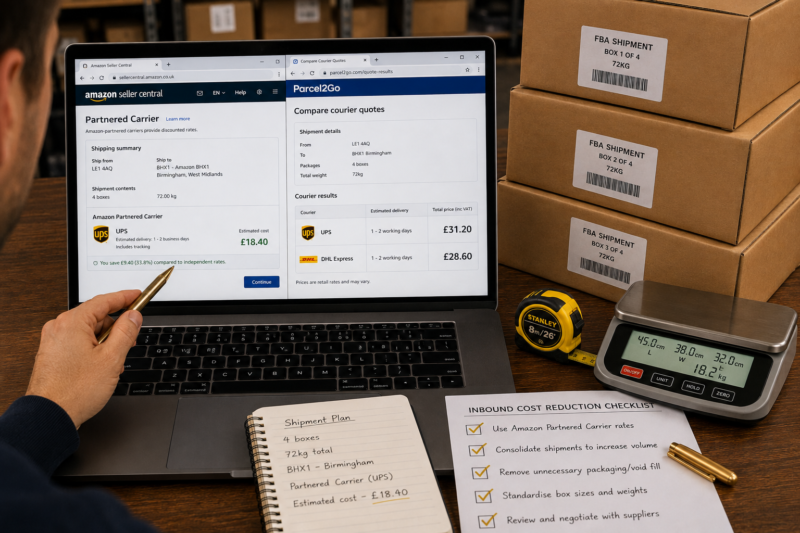
Amazon’s Partnered Carrier programme is the single most impactful cost reduction available to most FBA sellers sending small parcel shipments from the UK. Through the programme Amazon has negotiated bulk rates with UPS that are significantly lower than the rates you would get booking directly with UPS or any other standard retail courier. The programme is available to all sellers with a Professional account and is accessed directly through the shipment plan booking step in Seller Central.
| Partnered Carrier Feature | Detail |
|---|---|
| Carrier used | UPS — collection from your ship-from address — direct delivery to the assigned Amazon fulfilment centre |
| Rate vs standard UPS retail | Typically 30 to 50 percent lower per box than booking UPS directly at retail rates |
| How cost is charged | Deducted from your Seller Central account balance automatically after collection — no upfront payment needed |
| Tracking integration | Tracking updates appear automatically in your Seller Central shipment — no manual tracking number entry required |
| Additional weight charges | If actual box weight exceeds declared weight UPS charges the difference after collection — always weigh accurately |
| When not to use it | For very heavy or palletised shipments — independent freight forwarder or LTL rates may be lower |
Strategy 2 — Maximise Box Density to Reduce Per-Unit Shipping Cost
Courier pricing for small parcel shipments is calculated based on whichever is greater — the actual gross weight of the box or its volumetric weight. Volumetric weight is calculated by multiplying length by width by height and dividing by a standard volumetric divisor — typically 4000 for UPS. A large light box costs as much to ship as a small heavy box of the same calculated weight. Packing your boxes efficiently — using the right box size for the units inside and filling void space correctly — directly reduces your volumetric weight charge and therefore your per-unit cost.
| Box Density Principle | How It Reduces Cost |
|---|---|
| Use the smallest compliant box that fits your units | Reduces volumetric weight — lower calculated shipping charge for light products |
| Pack units in tight grid formation — no wasted space | More units per box means lower cost per unit — fewer boxes overall for same quantity of stock |
| Use minimum necessary void fill — not excessive padding | Excessive void fill adds weight without adding units — increases per-unit shipping cost |
| Match box size to product dimensions precisely | Buying multiple box sizes for different products — rather than one large box for everything — reduces volumetric waste |
VOLUMETRIC WEIGHT FORMULA — UPS STANDARD
Length (cm) × Width (cm) × Height (cm) ÷ 4000
Example: 45cm × 38cm × 32cm = 54,720 cm³ ÷ 4000 = 13.68kg volumetric weight
If actual box weight is 9kg — you are charged at 13.68kg volumetric weight
Strategy 3 — Batch Shipments to Reduce Per-Unit Fixed Costs
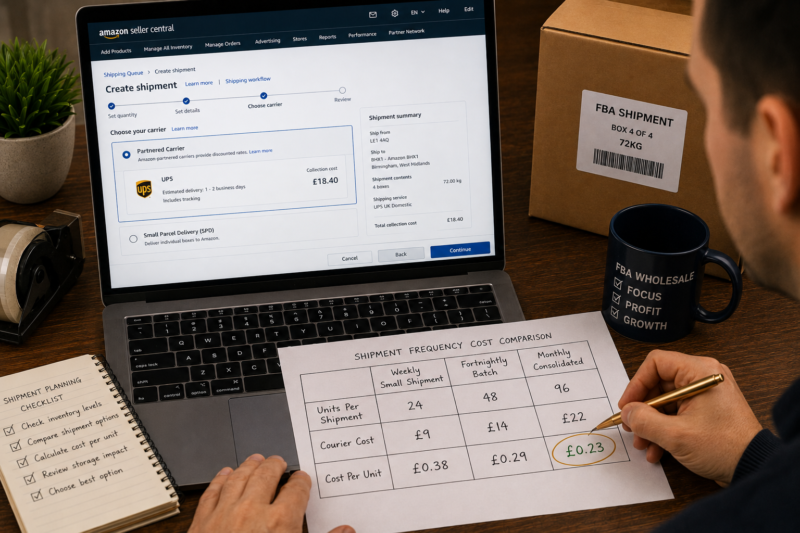
Every inbound FBA shipment has a fixed cost component — the courier collection booking fee and the time you spend creating the shipment plan labelling units packing boxes and booking the courier. When you send one or two small boxes to FBA every week those fixed costs are spread across very few units — making the per-unit inbound cost high. When you batch your orders and send a larger shipment less frequently the same fixed costs are spread across many more units — reducing per-unit cost significantly.
| Shipment Frequency Scenario | Units Per Shipment | Courier Cost | Cost Per Unit |
|---|---|---|---|
| Weekly small shipment — 1 to 2 boxes | 24 units | £9.00 | £0.38 |
| Fortnightly batched shipment — 3 to 4 boxes | 48 units | £14.00 | £0.29 |
| Monthly consolidated shipment — 6 to 8 boxes | 96 units | £22.00 | £0.23 |
The trade-off with batching is that larger less frequent orders require more upfront capital and more storage space at your location while you accumulate stock before dispatch. Balance your batching frequency against your available capital storage space and your reorder point requirements — never batch so infrequently that you risk a stockout because you are waiting to build a larger shipment.
Strategy 4 — Consolidate Multiple ASINs Into Single Shipments
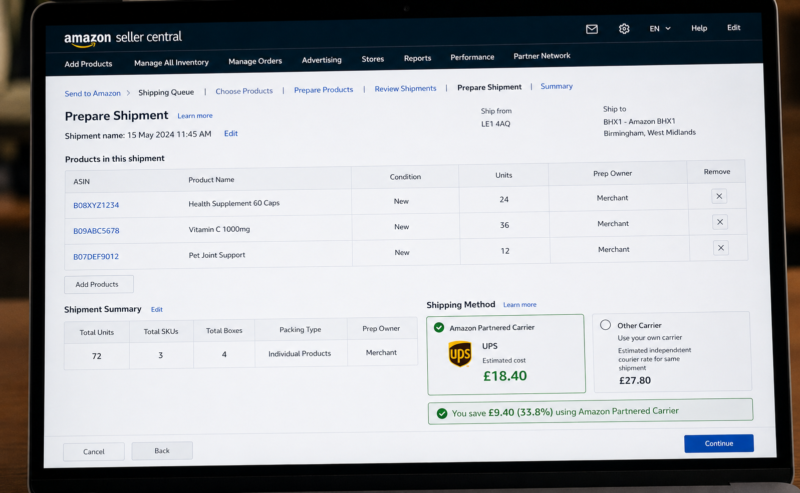
If you are selling multiple ASINs from the same or different suppliers you can include all of them in a single FBA shipment plan and a single courier booking — as long as they are all assigned to the same fulfilment centre by Amazon. This is one of the most straightforward cost reductions available to growing wholesale sellers with three or more active products — instead of sending three separate small shipments for three products you send one consolidated shipment containing all three and pay a single courier cost.
| Consolidation Approach | How to Execute It |
|---|---|
| Multiple ASINs from one supplier | Add all ASINs to the same Seller Central shipment plan — pack mixed ASIN boxes and declare contents accurately |
| Multiple ASINs from different suppliers | Order from multiple suppliers to arrive at your location on the same day — prep and pack together into one shipment plan |
| Replenishment across existing ASINs | Time your replenishment orders so multiple ASINs reach their reorder point at the same time — consolidate into one shipment |
⚠️ Split Shipment Limitation — One Fulfilment Centre Per Shipment Plan
Amazon sometimes splits a shipment plan and assigns different products to different fulfilment centres — requiring separate boxes sent to separate addresses. When this happens you cannot consolidate those products into one shipment — each assigned fulfilment centre must receive its own delivery. If Amazon consistently splits your shipments you can try adjusting your ship-from address or contacting Seller Support to enquire about inventory placement options.
Strategy 5 — Compare Partnered Carrier vs Independent Courier at Different Weights
Amazon’s Partnered Carrier programme is the best option for most standard small parcel shipments — but it is not always the cheapest at every weight and box count. For heavier shipments — typically above 100kg total — independent couriers or pallet freight services may offer lower rates than the Partnered Carrier UPS rate. It is worth comparing rates for larger shipments before automatically defaulting to Partnered Carrier.
| Shipment Size | Recommended Shipping Method | Why |
|---|---|---|
| 1 to 5 boxes — under 50kg total | Amazon Partnered Carrier — UPS | Best rate at this size — simple booking — integrated tracking — no account needed |
| 6 to 15 boxes — 50 to 150kg total | Compare Partnered Carrier vs Evri — DHL — Parcelforce | Independent couriers may offer lower per-box rates at higher volume — compare before booking |
| Over 15 boxes — over 150kg total | Pallet freight — LTL or FTL via freight forwarder | Palletised freight is typically far cheaper per kg at this volume — requires pallet building to Amazon spec |
Strategy 6 — Use a Prep Centre With Competitive Inbound Rates
Third-party prep centres that are physically located close to Amazon fulfilment centres often have negotiated freight rates with carriers for their regular inbound FBA shipping runs. If you are already using a prep centre for your unit labelling and packing ask them what their inbound shipping rate is per box or per kg to the relevant fulfilment centre. In many cases a well-located prep centre can ship your stock into FBA at a lower per-box rate than you could book independently — because they are consolidating multiple sellers’ stock into larger regular deliveries that attract volume pricing.
Strategy 7 — Include Inbound Cost in Every Product Margin Calculation
The most important habit for controlling inbound costs long term is including them in every product margin calculation before placing an order — not after. Use AMZScout to calculate your Amazon fees and then add your estimated inbound cost per unit to your total landed cost before assessing ROI. Products where the inbound cost per unit pushes ROI below your minimum threshold should be reconsidered — either by negotiating a lower buy price from the supplier or by increasing the order quantity to reduce the per-unit inbound cost through batching.
COMPLETE PER-UNIT COST MODEL INCLUDING INBOUND
| Cost Component | Example — Per Unit |
| Wholesale buy price per unit | £4.20 |
| Amazon referral fee — 8 percent of £11.99 | £0.96 |
| FBA fulfilment fee | £2.85 |
| Self prep cost per unit | £0.23 |
| Inbound shipping cost per unit | £0.25 |
| Total cost per unit | £8.49 |
| Selling price | £11.99 |
| Profit per unit | £3.50 |
| ROI on buy price | 83 percent |
Your Inbound Shipping Cost Reduction Checklist
| Cost Reduction Action | Potential Saving | Applied |
|---|---|---|
| Using Amazon Partnered Carrier for all small parcel shipments | 30 to 50 percent vs retail courier rates | ☐ |
| Packing boxes to maximum density using right-sized boxes | Up to 25 percent reduction in volumetric charges | ☐ |
| Batching shipments to at least fortnightly rather than weekly | £0.05 to £0.15 per unit saving on fixed courier costs | ☐ |
| Consolidating multiple ASINs into single shipment plans | Eliminates separate courier bookings for each product | ☐ |
| Comparing pallet freight for shipments over 150kg | Significant per-kg saving over parcel courier at volume | ☐ |
| Including inbound cost in margin model before every order | Prevents ordering products that are unviable once inbound is included | ☐ |
| All strategies applied — inbound cost optimised | ✅ Done | |
Conclusion — Small Per-Unit Savings Compound Into Significant Margin Improvement
Reducing your inbound shipping cost by £0.10 to £0.20 per unit may seem minor in isolation — but at 500 units per month that saving is £50 to £100 per month or £600 to £1,200 per year — recovered simply by switching to Partnered Carrier batching your shipments and packing your boxes more densely. The strategies in this guide require no additional capital investment and no complex operational change — they require only consistent application of better habits on every shipment you prepare.
Find your next wholesale product through our Brands Directory. Research demand with Keepa. Model your full margin including inbound shipping with AMZScout. And apply every cost reduction strategy in this guide to every shipment you send.
FIND YOUR NEXT WHOLESALE PRODUCT TO SHIP MORE PROFITABLY
Browse 5,000+ Verified Wholesale Brands Free
Find verified wholesale trade contacts in the Brandhunterz Brands Directory — source your product apply for your account and ship every FBA order at the lowest viable inbound cost using the strategies in this guide.
About the Author
This article is written by the team at Brandhunterz Ltd — a UK registered Amazon FBA wholesale sourcing company (Company No: 15342697) registered in England and Wales since 2023. Visit brandhunterz.com to learn more.