USA AMAZON SELLERS
Sales Tax for Amazon USA Sellers — What Every Seller Needs to Know
By Brandhunterz Ltd | Company No: 15342697 | 13 minute read
Affiliate Disclosure: This article contains affiliate links. If you purchase through our links we may earn a commission at no extra cost to you. We only recommend tools we genuinely use and believe in. Read our full disclaimer.
Sales tax is one of the most frequently misunderstood aspects of selling on Amazon USA — and for good reason. Unlike the straightforward single-rate VAT system used in the UK and most of Europe the United States operates a fragmented state-by-state sales tax system where each of the 50 states sets its own rates rules exemptions and filing requirements independently. There is no federal sales tax in the United States — no single national rate that applies uniformly across every sale — and the result is a system that varies significantly depending on where the buyer is located what product is being sold and whether the seller has a sufficient business presence in that state to create what is known as a sales tax nexus. For Amazon FBA sellers the landscape has been substantially simplified by marketplace facilitator laws that require Amazon itself to collect and remit sales tax on behalf of sellers in most states — but understanding what this means for your obligations as a seller is still essential before you start selling on Amazon.com.
We are Brandhunterz Ltd — a UK registered wholesale sourcing company (Company No: 15342697) — and in this complete guide we explain how US sales tax works for Amazon sellers what marketplace facilitator laws mean for your compliance obligations what sales tax nexus is and when it applies how Amazon handles collection and remittance on your behalf and what additional steps may be required for your specific business situation. Note that this article provides general educational information and is not a substitute for professional US tax advice — always consult a qualified US tax professional or CPA for guidance specific to your business and circumstances.
💡 Quick Summary
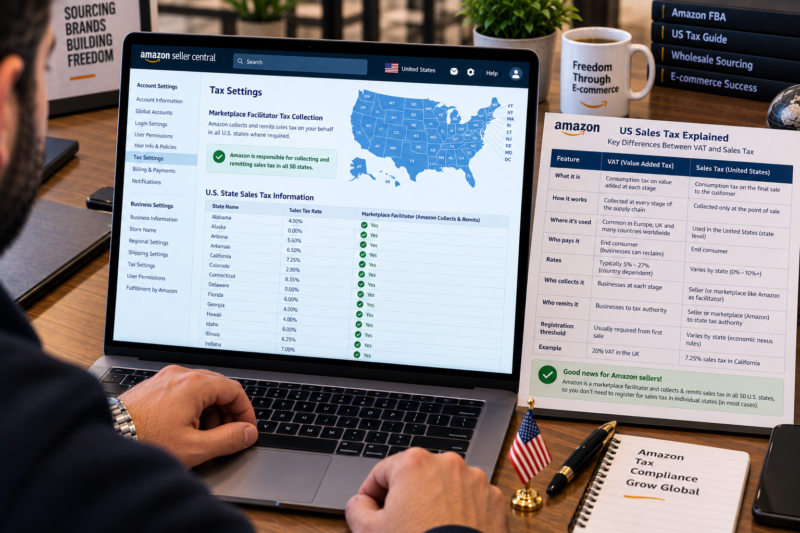
Amazon collects and remits sales tax on behalf of third-party sellers in all US states that have enacted marketplace facilitator laws — which as of now covers the vast majority of US states. This means Amazon automatically adds the correct sales tax to each buyer’s order calculates the applicable rate for their state and remits the collected tax directly to the relevant state tax authority — without the seller needing to file a sales tax return in those states for marketplace sales. However sellers may still have additional obligations in states where they have a physical presence or significant economic activity — nexus — and should seek qualified US tax advice to confirm their specific situation. Sales tax does not reduce your selling margin — it is added to the buyer’s price not deducted from your payment.
How US Sales Tax Differs From UK VAT
Understanding how US sales tax differs from the VAT system that most non-US sellers are familiar with is the essential starting point for navigating sales tax compliance on Amazon USA. The two systems work in fundamentally different ways:
| Aspect | UK VAT | US Sales Tax |
|---|---|---|
| Rate structure | Single national rate — 20% standard | 50 different state rates — 0% to over 10% |
| Price display | Tax-inclusive — price shown includes VAT | Tax-exclusive — sales tax added at checkout |
| Input tax recovery | Yes — VAT on purchases reclaimable | No — sales tax is a cost not reclaimable |
| Registration threshold | Single national threshold — one registration | Each state has its own threshold — up to 50 separate registrations potentially |
| Marketplace collection | Amazon collects and remits for UK marketplace sales | Amazon collects and remits in most US states under facilitator laws |
| Seller margin impact | Referral fee on VAT-inclusive price — minor margin effect | No margin impact — sales tax added to buyer price — not deducted from seller payment |
What Are Marketplace Facilitator Laws
Marketplace facilitator laws are state-level regulations that place the obligation to collect and remit sales tax on the marketplace platform — in this case Amazon — rather than on the individual seller. These laws were enacted by most US states following the 2018 Supreme Court ruling in South Dakota v Wayfair which established that states could require out-of-state sellers to collect and remit sales tax even without a physical presence in that state. Amazon responded by implementing automatic sales tax collection for marketplace sales across all states with marketplace facilitator laws in force.
For Amazon FBA sellers this means that in all states covered by marketplace facilitator laws Amazon automatically calculates adds and collects the correct sales tax amount from buyers at the point of purchase and remits the collected tax directly to the relevant state tax authority. The seller receives their payment net of Amazon’s fees — but the sales tax collected is handled entirely by Amazon and does not pass through the seller’s account at all.
✅ What Marketplace Facilitator Laws Mean for Amazon FBA Sellers
In states with marketplace facilitator laws in force — which covers the vast majority of US states — Amazon FBA sellers do not need to register for sales tax collect sales tax or file sales tax returns for their Amazon marketplace sales in those states. Amazon handles the entire process. Your sales proceeds arrive in your account without any sales tax deduction — Amazon has already separated and remitted the tax component. This significantly simplifies the sales tax compliance burden for most Amazon FBA sellers compared to what it was before these laws were enacted.
What Is Sales Tax Nexus
Sales tax nexus is the term used to describe the connection between a seller and a US state that creates an obligation for the seller to collect and remit sales tax in that state. Even with marketplace facilitator laws handling Amazon sales understanding nexus is important because sellers may have nexus in certain states through their non-Amazon sales activities — and because nexus can affect whether you need to register for sales tax in a state independently of Amazon’s collection.
There are two main types of nexus that Amazon sellers should be aware of:
| Nexus Type | What Creates It | Relevant For |
|---|---|---|
| Physical Nexus | Having a physical presence in a state — an office warehouse employees or inventory stored in the state — including FBA inventory stored in Amazon’s fulfilment centres | All sellers — especially FBA sellers whose inventory is distributed across Amazon’s national fulfilment network in multiple states |
| Economic Nexus | Exceeding a state’s economic nexus threshold — typically $100,000 in sales or 200 transactions in a state in a calendar year — without any physical presence required | Sellers with significant sales volumes — most high-volume Amazon USA sellers will exceed economic nexus thresholds in multiple states |
⚠️ FBA Inventory Creates Physical Nexus in Multiple States
When you send inventory to Amazon FBA Amazon distributes your stock across multiple fulfilment centres in different US states as part of their inventory distribution system. This means your inventory is physically present in multiple states — which can create physical nexus in those states. However because Amazon is the marketplace facilitator and collects and remits sales tax for your Amazon marketplace sales in those states the practical impact of this nexus on your Amazon sales is minimal. Where physical nexus becomes more significant is if you also sell through other channels — your own website or other platforms — where you are responsible for collecting and remitting sales tax independently. Seek professional US tax advice to understand your specific nexus situation across all your selling channels.
How Amazon Handles Sales Tax Collection on Your Behalf
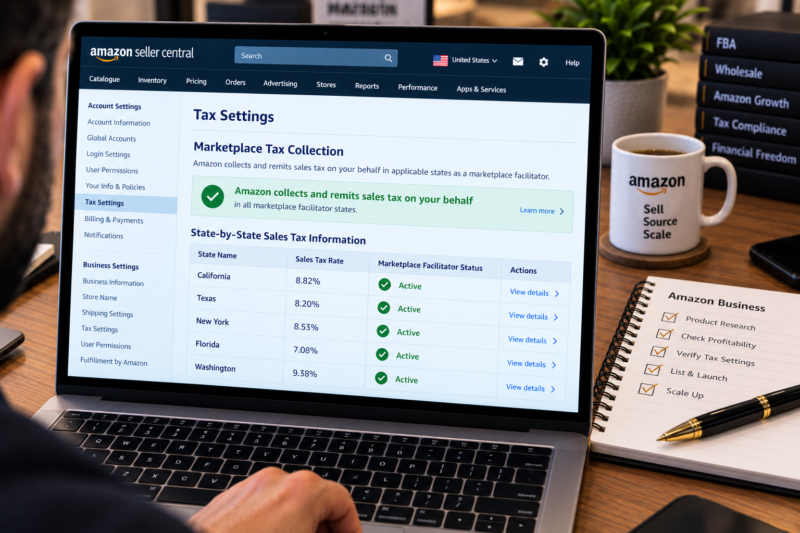
Amazon’s marketplace facilitator role means it handles the entire sales tax process for marketplace sales automatically. Here is what Amazon does and what it does not do on behalf of sellers:
| ✅ What Amazon Does for You | ❌ What Amazon Does Not Do for You |
|---|---|
| Calculates the correct sales tax rate for the buyer’s location in each state | Register you for sales tax in any state — registration remains your responsibility if required |
| Adds the sales tax to the buyer’s total at checkout — buyers pay the tax not sellers | File sales tax returns on your behalf — you may still need to file returns in states where you have nexus from non-Amazon activities |
| Collects the sales tax from buyers as part of the order payment | Handle sales tax from your own website or non-Amazon selling channels — only covers Amazon marketplace sales |
| Remits the collected sales tax directly to each state tax authority | Provide professional tax advice — consult a US CPA for your specific situation |
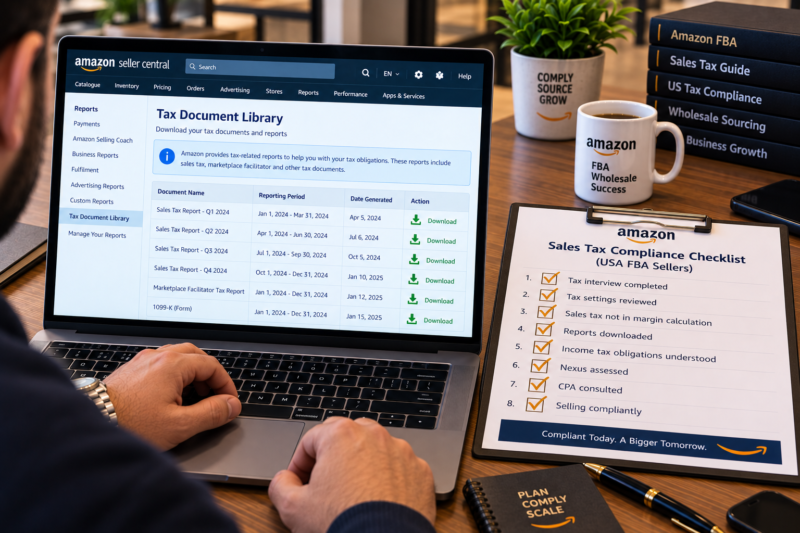
| Provides a Tax Document Library in Seller Central with sales tax reports for your records | Manage your federal income tax obligations — Amazon sales income is taxable and must be reported on your income tax return |
Sales Tax Rates Across US States
US sales tax rates vary dramatically from state to state — and in many states there are additional county and city-level taxes layered on top of the state rate. The combined rate a buyer pays depends entirely on their precise location. Here is an overview of the variation across key US states:
| State | State Rate | Average Combined Rate |
|---|---|---|
| California | 7.25% | 8.82% |
| Texas | 6.25% | 8.20% |
| New York | 4.00% | 8.53% |
| Florida | 6.00% | 7.08% |
| Washington | 6.50% | 9.38% |
| Oregon | 0% — No sales tax | 0% |
| Montana | 0% — No sales tax | 0% |
| Delaware | 0% — No sales tax | 0% |
Five US states currently have no state sales tax at all — Oregon Montana New Hampshire Delaware and Alaska — though Alaska allows local jurisdictions to impose their own taxes. Buyers in these states pay no sales tax on their Amazon purchases regardless of the product category. For sellers the variation in rates across states has no impact on your net margin because sales tax is added to the buyer’s price at checkout — not deducted from your payment — and Amazon handles the calculation collection and remittance automatically.
Does Sales Tax Affect Your Profit Margin on Amazon USA
This is one of the most commonly asked questions by new Amazon USA sellers — and the answer for marketplace sales is reassuring. Sales tax on Amazon USA marketplace sales does not reduce your profit margin because it is added to the buyer’s price at checkout rather than being deducted from your sales proceeds. Here is how it works in practice:
| Transaction Component | Amount |
|---|---|
| Your listed selling price on Amazon | $24.99 |
| Sales tax added at checkout — buyer pays — example 8% | $2.00 |
| Total buyer payment | $26.99 |
| Amazon remits sales tax to state — collected from buyer | – $2.00 — goes to state — not seller |
| Your gross proceeds — before Amazon fees | $24.99 — same as your listed price |
Your fee calculation and profit calculation remain exactly the same regardless of the sales tax rate in the buyer’s state because the tax component passes directly from Amazon to the state without touching your proceeds. This is a significant practical advantage of the marketplace facilitator model — your margin is unaffected by sales tax complexity.
What the Tax Interview Means for International Sellers
During Amazon USA seller registration all sellers must complete a tax interview that determines how Amazon treats their income for US tax reporting purposes. International sellers — those not based in the United States — complete a W-8 form during this interview which confirms their non-US tax status and may reduce or eliminate US withholding tax on their Amazon payments. Here is what each form covers:
| Form | Who Completes It | Effect on Withholding |
|---|---|---|
| W-9 | US persons — US individuals and US-registered businesses | No withholding — standard US income tax reporting applies |
| W-8BEN | Non-US individuals — sole traders and individual sellers from any non-US country | Confirms non-US status — reduced or zero withholding if tax treaty applies between seller’s country and USA |
| W-8BEN-E | Non-US business entities — limited companies partnerships and other non-US business structures | Confirms non-US entity status — reduced or zero withholding if tax treaty applies — most product sales income is not subject to withholding for non-US sellers |
Your Sales Tax Compliance Checklist for Amazon USA
| Sales Tax Compliance Check | Done |
|---|---|
| Tax interview completed in Seller Central — correct W-8 or W-9 form submitted | ☐ |
| Tax Settings in Seller Central reviewed — marketplace facilitator collection confirmed active | ☐ |
| Sales tax not factored into margin calculation — confirmed it does not affect seller proceeds | ☐ |
| Sales tax reports downloaded from Seller Central Tax Document Library for record keeping | ☐ |
| US income tax obligations understood — Amazon sales income is taxable income — reported on return | ☐ |
| Nexus situation assessed for all selling channels — not just Amazon marketplace sales | ☐ |
| Qualified US CPA or tax professional consulted for business-specific advice | ☐ |
| Sales tax compliance confirmed — selling on Amazon USA with correct tax setup | ✅ Compliant |
Conclusion — Amazon Handles the Complexity — You Focus on Selling
For the vast majority of Amazon USA FBA sellers the complexity of the US state-by-state sales tax system has been substantially reduced by marketplace facilitator laws. Amazon automatically calculates collects and remits sales tax on your marketplace sales across all covered states — without you needing to register file or pay anything separately for those sales. Your job is to complete the tax interview correctly when registering understand that sales tax does not affect your margin and maintain accurate records of your sales and income for your own income tax reporting. For specific advice on your business’s sales tax nexus obligations across all your selling channels and your income tax reporting requirements always work with a qualified US CPA — the marketplace facilitator framework simplifies your compliance significantly but does not eliminate the need for professional advice on your overall US tax position.
Find your next wholesale product through our Brands Directory. Research every opportunity with Keepa. Confirm every margin with AMZScout.
BUILD YOUR AMAZON USA FBA BUSINESS ON SOLID TAX FOUNDATIONS
Browse 5,000+ Verified Wholesale Brands Free
Find verified wholesale trade contacts in the Brandhunterz Brands Directory — source your products apply your fee and tax knowledge and sell on Amazon USA FBA with confidence from day one.
About the Author
This article is written by the team at Brandhunterz Ltd — a UK registered Amazon FBA wholesale sourcing company (Company No: 15342697) registered in England and Wales since 2023. Visit brandhunterz.com to learn more.