
USA AMAZON SELLERS
How to Win the Buy Box on Amazon USA — Complete Guide for Wholesale Sellers
By Brandhunterz Ltd | Company No: 15342697 | 14 minute read
Affiliate Disclosure: This article contains affiliate links. If you purchase through our links we may earn a commission at no extra cost to you. We only recommend tools we genuinely use and believe in. Read our full disclaimer.
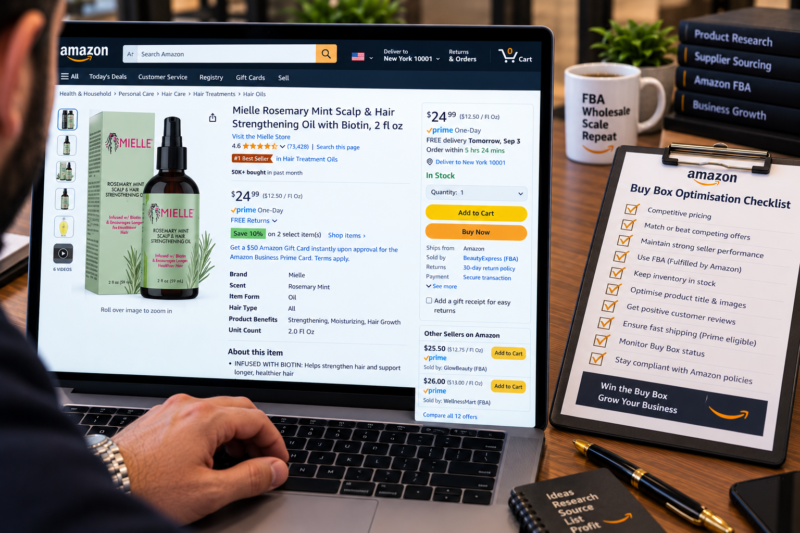
The Buy Box is the single most important feature on any Amazon USA product page for wholesale FBA sellers. It is the white box on the right-hand side of every Amazon product listing containing the Add to Cart and Buy Now buttons — and it determines which seller’s offer the buyer purchases when they click either of those buttons. On a listing with multiple sellers all offering the same product at similar prices the vast majority of sales — typically between 80% and 90% — go to whichever seller currently holds the Buy Box. Sellers who are not in the Buy Box are effectively invisible to most buyers — they can be found by clicking the Other Sellers link beneath the Buy Box but very few buyers do this consistently. Winning the Buy Box is not a secondary consideration for wholesale FBA sellers — it is the primary determinant of whether a product generates the sales volume you projected when you decided to source it.
We are Brandhunterz Ltd — a UK registered wholesale sourcing company (Company No: 15342697) — and in this complete guide we explain exactly how the Amazon USA Buy Box algorithm works which factors determine Buy Box eligibility and rotation how to use Keepa to research Buy Box history before sourcing how to price competitively without destroying your margin and how to build and maintain the seller metrics that give you the strongest possible Buy Box position across your entire catalogue.
💡 Quick Summary
The Amazon USA Buy Box algorithm selects which seller’s offer is featured on a product page based on a combination of fulfilment method pricing Account Health metrics and seller performance history. FBA sellers have a structural advantage over merchant-fulfilled sellers because Amazon’s own fulfilment network consistently delivers the fast reliable shipping the algorithm rewards. To win and maintain the Buy Box use FBA maintain a competitive price within a few percent of the lowest FBA price on the listing keep your Account Health Rating above 200 your Order Defect Rate below 1% and your late shipment rate below 4%. Research every ASIN’s Buy Box history using Keepa before sourcing to confirm the listing has healthy rotation between multiple sellers and that Amazon is not the dominant Buy Box holder.
What Is the Amazon USA Buy Box
The Buy Box — also called the Featured Offer — is the primary purchase point on every Amazon USA product page. When a buyer visits a product listing on Amazon.com and clicks Add to Cart or Buy Now they are purchasing from whichever seller currently holds the Buy Box — regardless of whether other sellers are also offering the same product at a lower price. The Buy Box seller is selected automatically by Amazon’s algorithm and rotates between eligible sellers over time — meaning multiple sellers can share Buy Box time on the same listing based on their relative competitiveness across a range of factors. Understanding which factors the algorithm weights most heavily and how to optimise them is the core skill of profitable wholesale FBA selling on Amazon USA.
Buy Box Eligibility — The Prerequisites
Before a seller can compete for the Buy Box on any listing they must first meet Amazon’s eligibility criteria. These are the baseline requirements — failing any of them removes a seller from Buy Box consideration entirely regardless of their price or metrics:
| Eligibility Requirement | Detail |
|---|---|
| Professional seller account | Individual account holders are not Buy Box eligible — Professional plan required |
| Account in good standing | No active account suspensions or policy violations that restrict listing or selling activity |
| Sufficient seller history | New accounts may have a period where Buy Box eligibility is limited while Amazon builds a performance baseline — typically a few weeks after first sales |
| Product in stock | A seller with zero FBA inventory for an ASIN is automatically removed from Buy Box consideration for that listing until stock is replenished |
| Competitive price | Pricing significantly above the current Buy Box price may make a seller ineligible — Amazon suppresses listings it considers uncompetitively priced |
The Key Factors the Buy Box Algorithm Weighs
Once a seller is Buy Box eligible the algorithm evaluates their offer against competing sellers across a range of weighted factors. Amazon has never published the exact weighting formula but years of seller data and research have identified the factors that matter most — and their relative importance for wholesale FBA sellers specifically:
| Buy Box Factor | Why It Matters | Weight for FBA Sellers |
|---|---|---|
| Fulfilment method — FBA vs MF | FBA sellers receive a significant algorithmic advantage because Amazon’s own delivery network guarantees fast reliable Prime shipping — the experience Amazon most wants to deliver to buyers | Highest |
| Landed price — item price plus shipping | The algorithm compares total landed price across all eligible sellers — a price within a few percent of the lowest competitive FBA price is generally sufficient to remain in rotation | Very High |
| Account Health Rating — AHR | A healthy AHR of 200 or above signals to Amazon that you are a trustworthy seller — poor account health directly reduces Buy Box allocation | High |
| Order Defect Rate — ODR | ODR above 1% triggers account action and suppresses Buy Box eligibility — must be kept well below 1% for consistent Buy Box performance | High |
| Seller feedback rating | A high positive feedback percentage over a trailing 12-month period improves Buy Box share — negative feedback directly reduces it | Medium |
| Inventory depth and stock availability | Sellers with healthy stock levels receive more consistent Buy Box allocation than sellers who frequently run low or go out of stock — stockouts immediately remove you from Buy Box consideration | Medium |
| Seller response time to messages | Response time to buyer messages within 24 hours is tracked — slower response rates are a negative signal for FBA sellers though less critical than for merchant-fulfilled sellers | Lower |
Why FBA Gives You a Structural Buy Box Advantage
Using FBA is the single most powerful Buy Box advantage available to wholesale sellers on Amazon USA. When you fulfil through FBA Amazon treats your delivery performance as part of their own — because they are the ones picking packing and shipping your orders. An FBA seller with a slightly higher price than a merchant-fulfilled seller will typically win a significantly larger share of Buy Box time because the algorithm weights Amazon’s fulfilment guarantee so heavily. In practical terms this means that as an FBA seller you can often maintain Buy Box rotation at a price that is 2% to 5% higher than a competing merchant-fulfilled offer — giving you the pricing flexibility to protect your margin without losing your share of sales.
How to Research Buy Box History Before Sourcing — Using Keepa
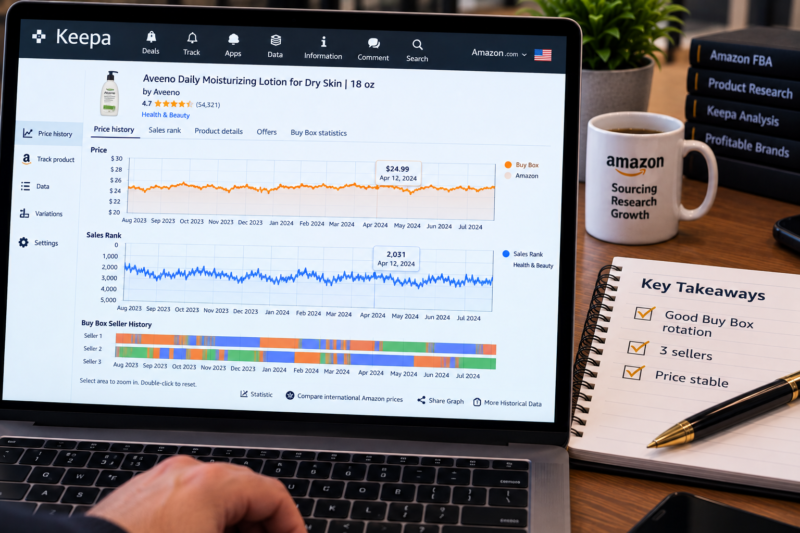
The most important Buy Box research step happens before you source — not after. Using Keepa to review the Buy Box history of any ASIN you are considering tells you whether the listing has a healthy competitive dynamic that makes it viable for wholesale FBA — or whether it has characteristics that signal you should avoid it. Here is what to look for in Keepa’s Buy Box data before sourcing any product:
| Keepa Data Point | What a Good Result Looks Like | What a Bad Result Looks Like |
|---|---|---|
| Buy Box price history — 12 months | Stable price — consistent within a tight range — no dramatic long-term price erosion trend | Steady downward price trend — price wars eroding the Buy Box price toward or below your wholesale cost |
| Number of sellers on the listing | Two to six sellers rotating through the Buy Box — enough competition to confirm demand — not so many that Buy Box share per seller is too low to be profitable | One dominant seller holding 90%+ of Buy Box time — or twenty or more sellers fighting over a small pool of sales |
| Amazon as a Buy Box seller | Amazon not present as a seller — or present for only a small percentage of time with gaps where it goes out of stock | Amazon holding the Buy Box 80% or more of the time — third-party sellers cannot compete with Amazon’s pricing power and fulfilment advantage when Amazon is the dominant seller |
| Sales rank history — consistency of demand | Consistent rank staying within a band — confirming steady repeating demand rather than seasonal spikes or single viral moments | Sales rank that was excellent 18 months ago but has been deteriorating steadily — demand declining as the listing ages or competition increases |
How to Price for the Buy Box Without Destroying Your Margin
Pricing strategy for Buy Box competition is one of the areas where new wholesale FBA sellers most commonly make costly mistakes. The two most common errors are pricing too low — entering a price war that erodes the Buy Box price to a level where no seller on the listing is making a viable margin — and pricing too high — setting a price above the competitive range and winning little or no Buy Box time at all. Here is how to price correctly for sustainable Buy Box rotation:
Price at or Near the Current Buy Box Price
When you add your offer to a listing check the current Buy Box price — visible in the Offers tab on the Amazon product page and in Keepa’s price history. Pricing at or within 1% to 2% of the current Buy Box price while using FBA places you in the optimal competitive position for Buy Box rotation. You do not need to undercut the current Buy Box price to win rotation — you need to be competitively priced within the range that the algorithm considers fair.
Set a Minimum Price Floor Before Using an Automated Repricer
If you use an automated repricer — which adjusts your price dynamically in response to competitor pricing — always set a hard minimum price floor that reflects your minimum acceptable margin. Without a floor an automated repricer will chase competitor prices downward indefinitely — often triggering a price war that reduces the Buy Box price to a level where no one on the listing is making money. Your minimum price should be set at a level where your net profit per unit — after all fees and your wholesale cost — remains above your target minimum margin.
Do Not Try to Win 100% of the Buy Box
On a healthy listing with two to five FBA sellers the Buy Box rotates between sellers based on competitiveness — no single seller holds 100% of Buy Box time unless they are significantly cheaper than all competitors or are the only FBA seller. Trying to hold 100% of the Buy Box by continuously undercutting competitors is a race to the bottom. A 20% to 40% share of Buy Box time on a high-volume listing with a strong margin is far more valuable than 80% of Buy Box time on a listing where a price war has destroyed the margin for everyone.
Use Helium 10 to Monitor Buy Box Percentage by ASIN
Helium 10 provides Buy Box tracking and competitive monitoring tools that allow you to see your Buy Box percentage by ASIN over time — and to track when competitors join or leave a listing which affects your share. Use this data to make informed pricing adjustments rather than reacting to short-term competitive pressure that resolves itself naturally as other sellers run out of stock.
Protecting Your Buy Box Position — Account Health Metrics
Pricing is only one part of Buy Box performance. Your account health metrics are equally important — and unlike pricing they cannot be quickly adjusted in response to a competitor’s move. Building and maintaining strong account health metrics is the long-term foundation of consistent Buy Box performance across your entire FBA catalogue. Here are the key metrics and the targets that support strong Buy Box allocation:
| Account Health Metric | Amazon’s Threshold | Target for Strong Buy Box |
|---|---|---|
| Account Health Rating — AHR | 200 minimum for Healthy status | 300 or above |
| Order Defect Rate — ODR | Below 1% | Below 0.5% |
| Late Shipment Rate — LSR | Below 4% | 0% — FBA removes this risk entirely |
| Pre-Fulfilment Cancel Rate — PFCR | Below 2.5% | 0% — FBA removes this risk entirely |
| Positive seller feedback — trailing 12 months | No specific threshold — higher is better | Above 95% positive |
| Valid Tracking Rate — VTR | Above 95% | 100% — FBA handles this automatically |
Your Buy Box Optimisation Checklist
| Buy Box Optimisation Check | Done |
|---|---|
| ASIN researched on Keepa — Buy Box history 12 months confirmed healthy rotation — no dominant single seller — no dominant Amazon presence | ☐ |
| Buy Box price history stable — no long-term downward erosion trend — margin at current price confirmed viable | ☐ |
| Product listed as FBA — fulfilment advantage confirmed active | ☐ |
| Listing price set at or within 2% of current Buy Box price — not undercutting aggressively | ☐ |
| Minimum price floor set in repricer — floor protects minimum margin target | ☐ |
| Account Health Rating confirmed at 200 or above — Healthy status | ☐ |
| Order Defect Rate confirmed below 1% — target below 0.5% | ☐ |
| FBA inventory levels healthy — minimum 30 days of cover in stock — no stockout risk | ☐ |
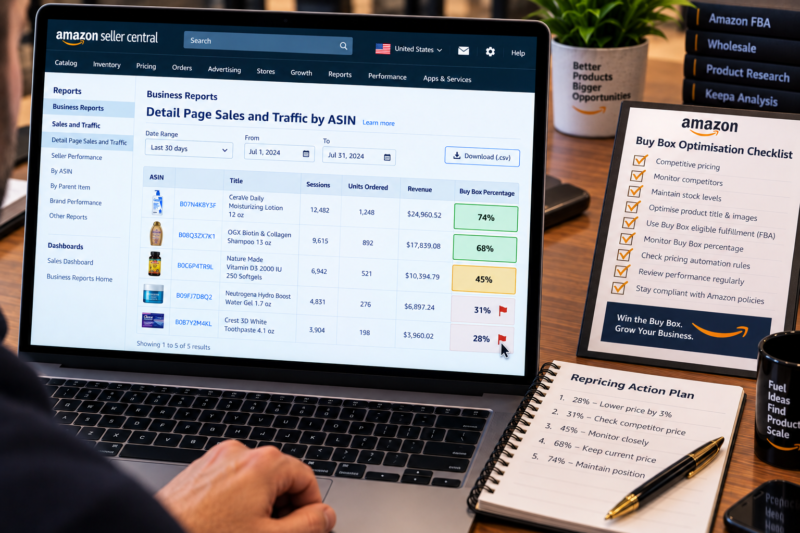
| Business Reports — Buy Box percentage reviewed weekly — ASINs below 20% investigated | ☐ |
| All Buy Box factors optimised — competitive FBA pricing — healthy metrics — consistent stock | ✅ Optimised |
Conclusion — FBA Pricing and Metrics Are Your Three Buy Box Levers
Winning the Buy Box on Amazon USA consistently is not a matter of luck or timing — it is the result of three things working together simultaneously. Selling via FBA gives you the structural fulfilment advantage the algorithm rewards most heavily. Pricing competitively within the range of the current Buy Box price without aggressively undercutting keeps you in rotation without destroying the listing’s margin for yourself and other sellers. And maintaining strong account health metrics — particularly your AHR your Order Defect Rate and your inventory levels — signals to Amazon that you are a reliable seller worthy of consistent Buy Box allocation. Get all three right and the Buy Box becomes a predictable and consistent source of sales across your entire wholesale FBA catalogue.
Find your next wholesale product through our Brands Directory. Research every ASIN’s Buy Box history with Keepa. Confirm your margins with AMZScout. Monitor your performance with Helium 10.
WIN THE BUY BOX WITH THE RIGHT WHOLESALE PRODUCTS
Browse 5,000+ Verified Wholesale Brands Free
Find verified wholesale trade contacts in the Brandhunterz Brands Directory — source products with confirmed Buy Box opportunity research every listing with Keepa and build a profitable Amazon USA FBA business with consistent Buy Box rotation.
About the Author
This article is written by the team at Brandhunterz Ltd — a UK registered Amazon FBA wholesale sourcing company (Company No: 15342697) registered in England and Wales since 2023. Visit brandhunterz.com to learn more.