
HOW TO START AMAZON FBA
Amazon FBA vs FBM — Which Model is Right for You?
By Brandhunterz Ltd | Company No: 15342697 | 12 minute read
Affiliate Disclosure: This article contains affiliate links. If you purchase through our links we may earn a commission at no extra cost to you. We only recommend tools we genuinely use and believe in. Read our full disclaimer.
When you start selling on Amazon one of the most fundamental decisions you will make is whether to use FBA — Fulfilment by Amazon — or FBM — Fulfilment by Merchant. This single choice affects your fees your Buy Box eligibility your workload your cash flow and ultimately your profitability. Getting it wrong from the start costs you time and money that could have been avoided with a clear understanding of both models.
We are Brandhunterz Ltd — a UK registered wholesale sourcing company (Company No: 15342697) — and in this complete comparison guide we explain exactly how FBA and FBM work, the real cost difference between them, which model wins the Buy Box and the specific situations where each model is the right choice for your wholesale business.
💡 Quick Summary
For wholesale sellers starting out FBA is almost always the right choice. FBA gives you automatic Prime badge eligibility strong Buy Box advantage hands-free fulfilment and better account health metrics. FBM makes sense in specific situations — oversized products with high storage costs items that sell very slowly or as a backup fulfilment method when FBA stock runs out. Most established wholesale sellers use both simultaneously.
What is FBA — Fulfilment by Amazon?
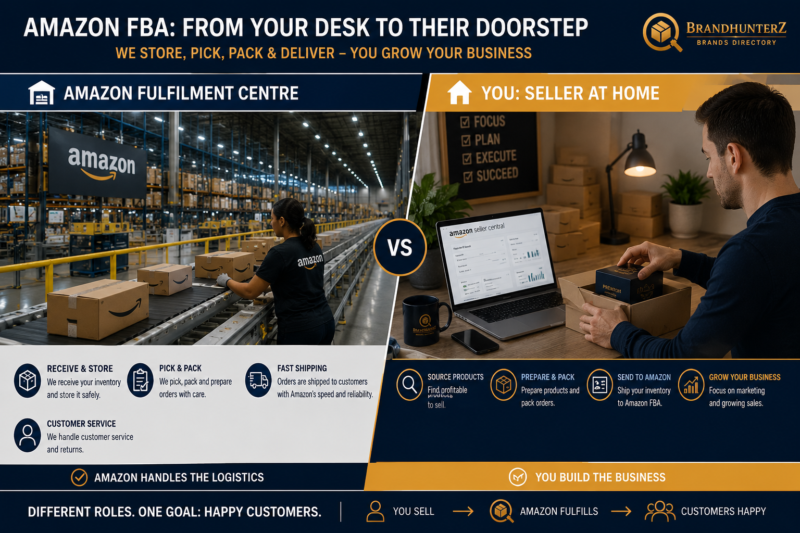
With FBA you send your stock to Amazon’s fulfilment centres and Amazon takes care of everything from that point — storing your products picking and packing each order shipping to the customer handling customer service and processing all returns. You pay Amazon a fulfilment fee per unit sold and a monthly storage fee for the space your stock occupies in their warehouse.
| FBA Process Stage | Who Handles It |
|---|---|
| Source and purchase stock | You |
| Label and ship to Amazon warehouse | You |
| Store pick pack and ship every order | Amazon ✅ |
| Handle all customer service and queries | Amazon ✅ |
| Process all returns | Amazon ✅ |
| Prime badge on all eligible listings | Amazon provides automatically ✅ |
What is FBM — Fulfilment by Merchant?
With FBM you store your own stock — typically at home or in a warehouse — and fulfil every customer order yourself. When an order comes in you pick pack and ship the item directly to the customer using your chosen courier. You are responsible for all customer service and returns. There are no Amazon storage fees and no FBA fulfilment fees — but you lose the Prime badge and have a significantly weaker Buy Box position.
| FBM Process Stage | Who Handles It |
|---|---|
| Source and purchase stock | You |
| Store stock at home or warehouse | You ❌ |
| Pick pack and ship every order | You ❌ |
| Handle all customer service and queries | You ❌ |
| Process all returns | You ❌ |
| Prime badge on listings | Not available unless Seller Fulfilled Prime ❌ |
FBA vs FBM — The Complete Side-by-Side Comparison
| Factor | FBA | FBM | Winner |
|---|---|---|---|
| Buy Box advantage | Very Strong | Weak | FBA ✅ |
| Prime badge | Automatic | Not available | FBA ✅ |
| Fulfilment workload | Zero — Amazon handles all | High — you ship every order | FBA ✅ |
| Fulfilment fee per unit | £2.10 to £5.00+ FBA fee | Your postage cost only | Depends on product |
| Storage cost | Monthly FBA storage fee | Your own space — free or low cost | FBM ✅ |
| Customer service | Amazon handles all | You handle all | FBA ✅ |
| Returns processing | Amazon handles all | You handle all | FBA ✅ |
| Scalability | Unlimited — Amazon scales with you | Limited by your capacity | FBA ✅ |
| Account health metrics | Easy to maintain — Amazon ships on time | At risk if you miss dispatch deadlines | FBA ✅ |
The Buy Box — Why FBA Wins Every Time
The Buy Box is the Add to Cart button on every Amazon product listing. Whichever seller holds the Buy Box receives the vast majority of sales — typically 80 to 90 percent of all orders on that listing. Understanding how the Buy Box works is the most important reason why FBA is the right model for wholesale sellers.
Amazon’s Buy Box algorithm rewards FBA sellers heavily. When an FBA seller and an FBM seller offer the same product at the same price the FBA seller wins the Buy Box because Amazon has confidence in the fulfilment quality speed and customer experience that FBA delivers. An FBM seller typically needs to undercut an FBA seller by 5 to 15 percent to compete for Buy Box share — which dramatically erodes margins.
BUY BOX SCENARIO — FBA vs FBM at SAME PRICE
| FBA seller — price £14.99 — free Prime delivery | Wins Buy Box — 85%+ of sales |
| FBM seller — price £14.99 — 3 to 5 day delivery | Loses Buy Box — under 15% of sales |
| FBM price needed to compete with FBA | £12.74 to £13.49 — margins destroyed |
Fee Comparison — What Does Each Model Actually Cost?
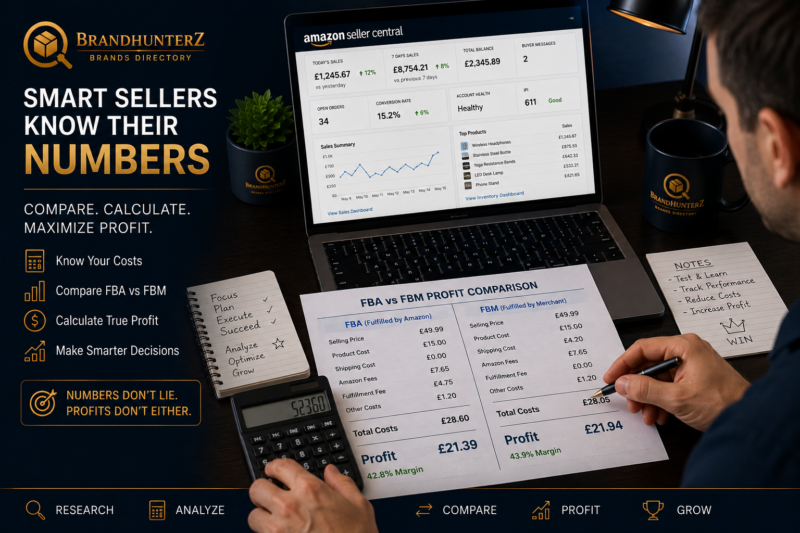
The fee difference between FBA and FBM is more nuanced than most sellers realise. FBA charges an additional fulfilment fee per unit — but eliminates your postage cost entirely. Use AMZScout or Helium 10 to calculate the exact fee comparison for any product before deciding which model to use:
| Cost Element | FBA | FBM |
|---|---|---|
| Referral Fee (8% on £14.99) | £1.20 | £1.20 |
| FBA Fulfilment Fee | £2.10 | £0.00 |
| Your Postage Cost | £0.00 — Amazon ships | £2.90 — you ship |
| Packaging Materials | £0.00 — Amazon packs | £0.20 |
| Storage Fee (per unit per month) | £0.10 to £0.20 | £0.00 |
| Total Variable Cost Per Unit | ~£3.40 to £3.50 | ~£4.30 |
💡 The Real Fee Comparison
For lightweight standard-size products FBA is often cheaper per unit than FBM once you account for your own postage and packaging costs. FBM only becomes cheaper per unit on heavy oversized products where FBA fees are high — or on very slow-moving products where FBA storage fees accumulate significantly over time. Always calculate the exact comparison for your specific product using the Amazon FBA Revenue Calculator before choosing your model.
When FBA is the Right Choice
FBA is almost always the right starting point for wholesale sellers. These are the specific situations where FBA delivers the clearest advantage:
| Use FBA When | Reason |
|---|---|
| You are starting out on Amazon | FBA gives you immediate Buy Box competitiveness and Prime badge |
| Your products are standard size and weight | FBA fees are competitive for small standard products |
| Your products sell at least 10 units per month | Stock turns fast enough to avoid long-term storage fees |
| You want to scale without hiring staff | Amazon handles all fulfilment regardless of order volume |
| You want to protect your account health metrics | Amazon’s late shipment rate is effectively zero for FBA sellers |
When FBM Makes Sense
FBM is not always the wrong choice — there are specific situations where it genuinely outperforms FBA for wholesale sellers:
| Use FBM When | Reason |
|---|---|
| Large or heavy products with high FBA fees | FBA fee may exceed your own postage cost — FBM more profitable |
| Slow-moving products under 5 units per month | FBA storage fees accumulate faster than stock turns |
| As a backup when FBA stock runs out | Keep FBM listing live to capture sales while restock ships to Amazon |
| Perishable or temperature-sensitive products | FBA warehouse conditions may not suit the product |
| Testing a new product before committing to FBA | Test demand with zero storage risk before sending FBA stock |
The Dual Listing Strategy — FBA and FBM Together
The most advanced and commercially efficient approach for established wholesale sellers is running both FBA and FBM listings simultaneously on the same product. This dual listing strategy delivers three important benefits:
Never Lose Sales When FBA Stock Runs Out
When your FBA inventory reaches zero your FBM listing automatically takes over — capturing sales from home stock while your FBA restock shipment is in transit. This prevents the revenue gap that FBA-only sellers experience during every stockout period.
Protect Against FBA Disruptions
If Amazon restricts your FBA sending limits or your FBA stock becomes stranded your FBM listing keeps generating revenue while you resolve the issue. A business with only one fulfilment channel is vulnerable to any disruption in that channel.
Suppress FBM When Not Needed
When your FBA stock is healthy suppress your FBM listing so you do not accidentally fulfil orders from home when Amazon can handle them more efficiently. Reactivate the FBM listing immediately if your FBA stock drops below a safe threshold or runs out entirely.
FBA vs FBM — The Decision Framework
WHICH MODEL SHOULD YOU USE?
Starting out — small to medium standard products — target 30%+ ROI
→ Use FBA. The Prime badge Buy Box advantage and hands-free fulfilment far outweigh the additional fee cost for standard products. Research every product with Keepa and AMZScout before ordering.
Large heavy products — FBA fee exceeds your postage cost significantly
→ Calculate both models precisely. If FBM postage is meaningfully cheaper and you can win enough Buy Box share at a competitive price FBM may be viable. Otherwise find a lighter product.
Established seller with multiple SKUs and consistent sales
→ Run FBA as primary with FBM backup on all key SKUs. The dual listing strategy gives you maximum revenue protection with minimal additional work.
Conclusion — FBA for Wholesale Sellers Almost Every Time
For Amazon FBA wholesale sellers the answer to FBA vs FBM is clear in the vast majority of cases — start with FBA. The Buy Box advantage the Prime badge the hands-free fulfilment and the protection of your account health metrics all combine to make FBA the structurally superior model for wholesale selling at scale.
Use Keepa to research every product before sourcing. Validate your FBA margins with AMZScout or Helium 10. Find your verified wholesale supplier through our Brands Directory. And build your business on the FBA model that gives you the best possible Buy Box position from day one.
START YOUR FBA WHOLESALE BUSINESS TODAY
Browse 5,000+ Verified Wholesale Brands Free
Every brand in the Brandhunterz Directory is verified as authentic and Amazon FBA compatible — giving you the right wholesale contacts to build your FBA business on solid foundations from day one.
About the Author
This article is written by the team at Brandhunterz Ltd — a UK registered Amazon FBA wholesale sourcing company (Company No: 15342697) registered in England and Wales since 2023. Visit brandhunterz.com to learn more.