
AMAZON FBA ACCOUNT HEALTH
Amazon Intellectual Property Complaints — How to Respond and Protect Your Account
By Brandhunterz Ltd | Company No: 15342697 | 14 minute read
Affiliate Disclosure: This article contains affiliate links. If you purchase through our links we may earn a commission at no extra cost to you. We only recommend tools we genuinely use and believe in. Read our full disclaimer.
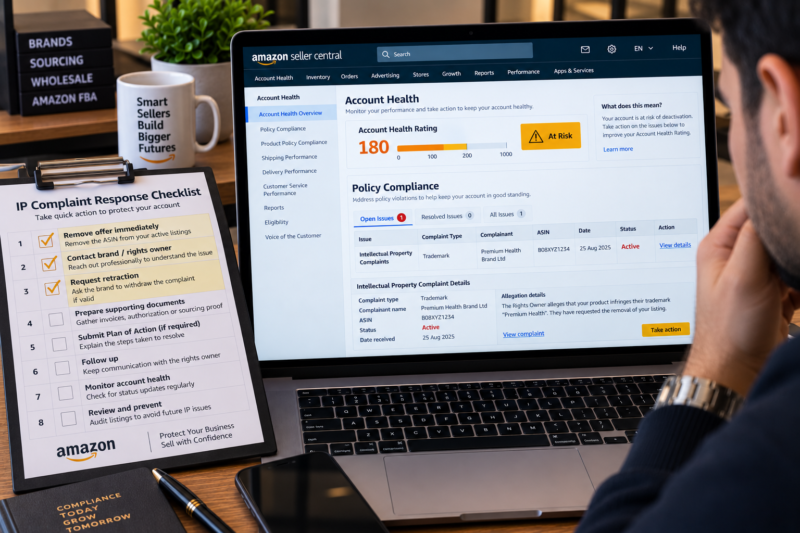
Intellectual property complaints are one of the most serious account health issues a wholesale FBA seller can face. An IP complaint — whether based on trademark copyright or patent infringement — is filed by a brand owner directly with Amazon alleging that your listing violates their intellectual property rights. Unlike a customer complaint which affects your ODR metrics an IP complaint sits in the Policy Compliance section of your Account Health dashboard and has a direct and immediate impact on your Account Health Rating score. A single unresolved IP complaint can drop your AHR from Healthy to At Risk overnight — and multiple IP complaints across different ASINs within a short period can push your account to Critical status and trigger suspension.
We are Brandhunterz Ltd — a UK registered wholesale sourcing company (Company No: 15342697) — and in this complete guide we explain exactly what Amazon intellectual property complaints are what the three main types cover how they appear on your Account Health dashboard the fastest and most effective ways to resolve each type what to do when a complaint is filed against you and the proactive sourcing and listing habits that prevent IP complaints from being filed in the first place.
💡 Quick Summary
Amazon IP complaints appear in the Policy Compliance section of your Account Health dashboard and immediately reduce your Account Health Rating score. The three main types are trademark complaints copyright complaints and patent complaints. The fastest resolution for most wholesale sellers is contacting the brand owner directly to request a retraction — which when submitted by the brand to Amazon removes the complaint and begins AHR score recovery. If retraction is not possible submit a counter-notice with supporting documentation through the Account Health dashboard. Prevent IP complaints by checking brand gating status before every new listing and sourcing only from authorised distributors with brand permission to sell.
The Three Types of Amazon IP Complaints
Amazon processes three distinct categories of intellectual property complaint — each based on a different type of IP right. Understanding which type of complaint you have received is essential before taking any response action because the resolution path and the evidence required differ significantly between them:
| Complaint Type | What It Alleges | Most Common for Wholesale Sellers |
|---|---|---|
| Trademark Complaint | Your listing uses the brand’s registered trademark — brand name logo or slogan — without authorisation to sell on the Amazon marketplace | Most common — brands restricting who can sell their products on Amazon |
| Copyright Complaint | Your listing uses copyrighted content — product images product descriptions or marketing copy — that belongs to the brand owner without permission | Less common — usually relates to listing content uploaded by the seller |
| Patent Complaint | The product you are selling infringes a patent held by the brand owner — the product itself or a feature of it is covered by a registered patent | Less common — typically involves branded technology or design patents |
How IP Complaints Appear on Your Account Health Dashboard
When a brand owner files an IP complaint with Amazon the complaint appears in the Intellectual Property Complaints section within the Policy Compliance area of your Account Health dashboard. Here is what you will see and what each element means:
| Dashboard Element | What It Shows |
|---|---|
| Complaint type | Trademark — Copyright — or Patent — determines your resolution path |
| Complainant name | The brand owner or rights holder who filed the complaint — this is your contact for retraction requests |
| ASIN affected | The specific product listing against which the complaint was filed |
| Date complaint filed | When the brand owner submitted the complaint to Amazon — used to track resolution timeline |
| Status | Active — Under Review — Resolved — Dismissed — each status indicates where the complaint stands in the resolution process |
| Available actions | Submit Appeal — Contact Brand — or View Details — the available actions depend on the complaint type and current status |
Resolution Path 1 — Brand Retraction — The Fastest Route
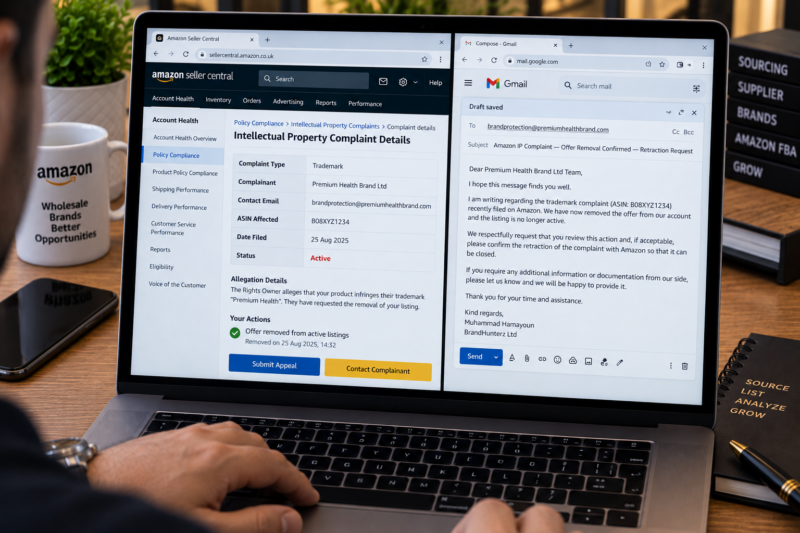
A brand retraction is the fastest and most effective way to resolve an IP complaint on your Account Health dashboard. A retraction is when the original complainant — the brand owner — formally withdraws the complaint by submitting a retraction to Amazon through Amazon’s IP complaint portal. Once Amazon receives a valid retraction the complaint is removed from your Account Health dashboard and your AHR score begins recovering immediately. Here is how to pursue a retraction:
Identify the Complainant and Their Contact Information
Click through to the full complaint detail on your Account Health dashboard. Note the complainant name and any contact information provided. In many cases Amazon provides a contact email address for the brand or rights holder that filed the complaint. If no contact information is shown search for the brand’s official website or trade contact — many brand owners in the UK have a legal or brand protection department that handles Amazon IP complaints.
Remove Your Offer From the Affected ASIN Immediately
Before contacting the brand owner remove your offer from the affected ASIN in Seller Central. Continuing to sell on a listing that is the subject of an IP complaint while the complaint is active can be viewed as disregarding the complaint and may make the brand owner less willing to engage with you for a retraction. Removing your offer demonstrates good faith and in many cases is what the brand owner primarily wanted to achieve by filing the complaint.
Contact the Brand Owner — Professionally and Concisely
Contact the brand owner by email or through their brand protection contact channel. Your message should be brief and professional — state that you have received notice of an IP complaint they filed against your Amazon listing for their brand confirm that you have removed your offer from the affected ASIN and ask whether they would be willing to submit a retraction of the complaint to Amazon through Amazon’s IP complaint portal. Do not argue your case or dispute their right to file the complaint — focus the communication on achieving the retraction.
If Authorised — Request the Brand Confirm Your Authorisation
If you are an authorised reseller of the brand — meaning your wholesale supplier holds an authorised distributor agreement with the brand — ask the brand to confirm your authorisation status and submit the retraction on that basis. In this scenario provide your supplier invoice and distributor authorisation chain to the brand as supporting evidence. Some brands will retract and also issue an authorisation letter that protects you against future complaints for the same brand.
Resolution Path 2 — Submitting a Counter-Notice
When a retraction is not forthcoming — either because the brand owner is unresponsive or because they refuse to retract — you may have the option to submit a counter-notice through Amazon’s IP dispute process. A counter-notice is a formal statement that you have a legal right to sell the product or use the content in question. Counter-notices are most commonly used in copyright and trademark disputes and they carry legal weight — submitting a false counter-notice has legal consequences. Here is when and how to use this route:
| Counter-Notice Situation | When to Use It | Key Evidence Required |
|---|---|---|
| Trademark complaint — you are an authorised reseller | Brand owner filed complaint but you have authorisation to sell — brand unresponsive to retraction request | Authorisation letter from brand or authorised distributor — supplier invoices — proof of legitimate sourcing chain |
| Copyright complaint — content is not infringing | The complaint alleges copyright infringement on content you legally created or have licence to use | Evidence that you created the content or hold a licence — original files timestamps or licensing agreement |
| Patent complaint — product does not infringe | Complaint alleges patent infringement on a product that does not infringe the stated patent — requires legal analysis | Legal opinion — patent analysis — difference comparison between product and patent claims |
⚠️ Counter-Notice Caution — Only Submit When You Have a Genuine Legal Basis
A counter-notice is a legal document submitted under penalty of perjury. Submitting a false or misleading counter-notice — for example claiming authorisation you do not have — can result in legal action by the brand owner and additional Amazon account consequences. If you are uncertain whether you have a genuine legal basis for a counter-notice seek legal advice before submitting one. For most wholesale sellers who are not authorised to sell a brand on Amazon the correct course of action is to remove the offer accept the complaint and ensure the same mistake is not made again with that brand.
What Happens If You Cannot Resolve the Complaint
If a brand owner refuses to retract and you do not have a valid basis for a counter-notice the complaint will remain active on your Account Health dashboard — continuing to impact your AHR score — until it ages out of Amazon’s system. Amazon does not specify an exact timeline for how long an unresolved IP complaint remains on an account but resolved complaints typically begin losing their AHR score impact after several months of clean selling following the removal of the problematic listing. The most important actions in this situation are:
| Action | Why It Matters |
|---|---|
| Remove your offer from the affected ASIN permanently | Prevents additional complaints from the same brand — shows Amazon you have ceased the activity |
| Do not list on any other ASIN from the same brand | Multiple complaints from the same brand compound AHR score damage significantly |
| Continue selling cleanly on all other brands and ASINs | High clean order volume rebuilds AHR score over time despite the unresolved complaint |
| Monitor your AHR score weekly and respond to any new violations immediately | A second violation on top of an unresolved IP complaint can push the account into Critical |
How to Prevent IP Complaints — The Proactive Approach
The most effective IP complaint management strategy is prevention — ensuring you never list on a brand that has restricted its Amazon selling rights in a way that would trigger a complaint. Here are the specific checks and practices that eliminate the majority of IP complaint risk for wholesale FBA sellers:
Check Brand Gating Status Before Every New Listing
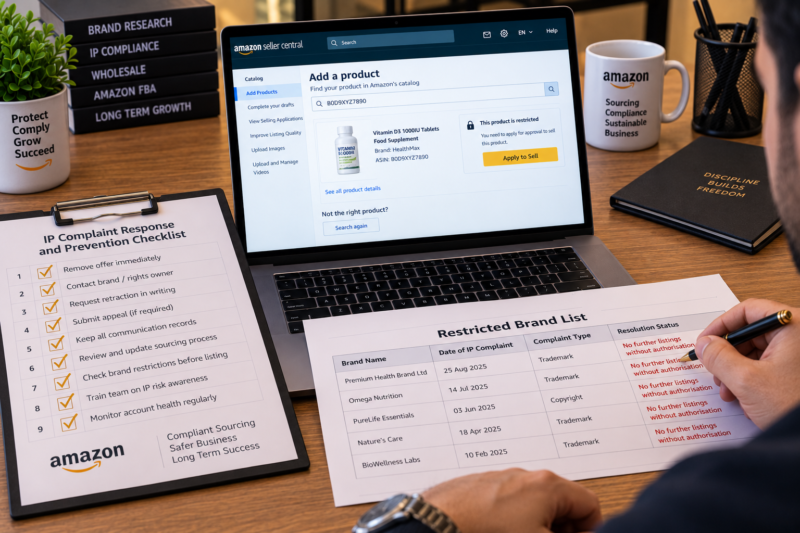
Before listing any new product on Amazon check whether the brand requires approval to sell — commonly called brand gating or category restriction. In Seller Central navigate to Inventory — Add a Product and search for the ASIN. If Amazon shows an Apply to Sell button rather than allowing you to create an offer directly the brand requires approval before you can list. Never create a workaround or alternative listing for a gated brand — this is one of the most common triggers for IP complaints from brands that actively police their Amazon selling rights.
Source Only From Authorised Distributors
Many IP complaints are filed not because of what you are selling but because of where you sourced it from. Brands frequently have exclusive distribution arrangements or selective distribution policies that restrict who can resell their products. When you source from an unauthorised distributor — even if the products themselves are genuine — the brand may file a trademark complaint against your listing because you are not part of their authorised sales chain. Always ask new suppliers whether they hold an authorised distributor agreement with the brands you intend to list and request documentation of that agreement before placing an order.
Use the Brandhunterz Brands Directory to Find Authorised Wholesale Sources
Our Brands Directory lists verified wholesale brands with confirmed trade access for Amazon FBA sellers — giving you a starting point for sourcing brands where the wholesale trade channel is open to resellers rather than exclusively controlled by the brand directly. Starting your product research with brands that are known to sell through open wholesale channels significantly reduces your IP complaint exposure compared to attempting to list on tightly controlled premium brands.
Build a Restricted Brand List and Check It Before Every Order
Maintain a simple spreadsheet of brands that have filed IP complaints against you in the past or that you know to be gated on Amazon. Check every new product you are considering sourcing against this list before placing an order. A brand that has filed one IP complaint against you is highly likely to file another if you relist on their ASINs — treat any brand that has previously complained as permanently off-limits unless you have obtained clear authorisation directly from the brand owner.
The IP Complaint Response and Prevention Checklist
| IP Complaint Check | Confirmed |
|---|---|
| Account Health dashboard reviewed this week — Policy Compliance section checked | ☐ |
| Any new IP complaint identified — complaint type and complainant noted | ☐ |
| Offer removed from affected ASIN immediately on identifying complaint | ☐ |
| Brand owner contacted — retraction requested with proof of legitimate sourcing | ☐ |
| Counter-notice submitted only where clear legal basis exists — not otherwise | ☐ |
| Brand added to restricted brand list — no further listings from that brand without authorisation | ☐ |
| Brand gating status checked in Seller Central for every new ASIN before listing | ☐ |
| All new suppliers asked for authorised distributor confirmation before first order | ☐ |
| Supplier invoices filed for every active ASIN — available for appeal documentation | ☐ |
| All IP checks confirmed — account protected against IP complaints | ✅ Protected |
Conclusion — Prevent First Respond Fast and Document Everything
Intellectual property complaints are one of the most impactful account health events a wholesale FBA seller can face — but they are also among the most preventable when you build the right pre-listing checks into your sourcing process. Check brand gating status before every new listing source from authorised distributors and maintain a restricted brand list that grows with your experience of which brands actively police their Amazon selling rights. When a complaint does appear respond immediately by removing the offer contacting the brand for a retraction and submitting proper documentation. The combination of proactive prevention and fast professional response is the most powerful IP complaint management system available to any wholesale FBA seller.
Find your next authorised wholesale brand through our Brands Directory. Research every product with Keepa. Confirm every margin with AMZScout. And protect your account from IP complaints using the process in this guide.
FIND YOUR NEXT AUTHORISED WHOLESALE BRAND — SELL WITHOUT IP RISK
Browse 5,000+ Verified Wholesale Brands Free
Find verified wholesale trade contacts in the Brandhunterz Brands Directory — source from authorised distributors apply for your account and sell on Amazon FBA with a clean IP complaint-free account health record.
About the Author
This article is written by the team at Brandhunterz Ltd — a UK registered Amazon FBA wholesale sourcing company (Company No: 15342697) registered in England and Wales since 2023. Visit brandhunterz.com to learn more.