
HOW TO START AMAZON FBA · 2026
How to Calculate Amazon FBA Fees and Profit Margins
By Brandhunterz Ltd | Company No: 15342697 | 13 minute read
Affiliate Disclosure: This article contains affiliate links. If you purchase through our links we may earn a commission at no extra cost to you. We only recommend tools we genuinely use and believe in. Read our full disclaimer.
Calculating your Amazon FBA fees and profit margins accurately before ordering stock is the single most important financial discipline you can build as a wholesale seller. More Amazon FBA businesses fail not because of poor sourcing instincts but because sellers consistently overestimate their margins and underestimate their costs. Every pound of unaccounted fees is a pound taken directly from your profit — and across hundreds of units those unaccounted pounds become a significant loss that compounds with every reorder.
We are Brandhunterz Ltd — a UK registered wholesale sourcing company (Company No: 15342697) — and in this complete guide we break down every Amazon FBA fee you need to account for show you exactly how to calculate your true net profit margin and walk you through the tools and process that experienced wholesale sellers use to evaluate every product before placing an order.
💡 Quick Summary
Your true Amazon FBA profit margin is your selling price minus wholesale cost, referral fee, FBA fulfilment fee, storage fee, and inbound shipping cost. Use the Amazon FBA Revenue Calculator for exact fees on every product and validate pricing trends with Keepa and revenue estimates with Helium 10 before committing to any wholesale order. Target a minimum net margin of 20 percent on every product.
The Complete List of Amazon FBA Fees You Must Account For
Before you can calculate your profit margin you need to understand every fee that Amazon charges. Many beginners only account for the referral fee and FBA fulfilment fee — missing several other costs that can significantly erode their actual profitability. Here is the complete list of fees every FBA wholesale seller must factor into their margin calculations.
1. Referral Fee
The referral fee is Amazon’s commission on every sale — charged as a percentage of the total selling price including VAT. The exact percentage varies by product category. Most consumer goods categories charge between 8 and 15 percent. Health and beauty products typically attract a 15 percent referral fee. Electronics attract 7 to 8 percent. Clothing attracts 15 percent. Always check the correct referral fee for your specific product category on the Amazon UK referral fee schedule before calculating your margin.
| Product Category | Referral Fee |
|---|---|
| Health and Beauty | 15% |
| Grocery and Gourmet Food | 8% or 15% |
| Toys and Games | 15% |
| Pet Supplies | 15% |
| Home and Kitchen | 15% |
| Electronics | 7% |
| Clothing and Accessories | 15% |
| Sports and Outdoors | 15% |
2. FBA Fulfilment Fee
The FBA fulfilment fee is charged per unit sold and covers the cost of Amazon picking packing and shipping your product to the customer. The fee is calculated based on the product’s size tier — which Amazon determines from the product’s dimensions and weight. Understanding size tiers is critical because moving from one size tier to the next can increase your fulfilment fee by £1.00 to £2.00 per unit — a significant impact on margin at scale.
| Size Tier | Max Dimensions | Typical FBA Fee Range |
|---|---|---|
| Small Standard | Up to 33cm x 23cm x 2.5cm, under 400g | £2.40 — £3.20 |
| Standard | Up to 45cm x 34cm x 26cm, under 12kg | £3.20 — £5.50 |
| Large Standard | Up to 61cm x 46cm x 46cm, under 30kg | £5.50 — £9.00 |
| Extra Large | Over 61cm x 46cm x 46cm or over 30kg | £9.00+ |
3. FBA Storage Fee
Amazon charges a monthly storage fee based on the cubic foot volume your inventory occupies in their fulfilment centres. Storage fees increase significantly during October to December — Amazon’s peak season — when warehouse space is in high demand. For most small standard-size products the monthly storage cost per unit is minimal — often just a few pence — but for slower-moving products or bulky items storage fees can accumulate to levels that meaningfully impact your annual profitability.
| Period | Standard Size Rate per cubic foot | Oversized Rate per cubic foot |
|---|---|---|
| January to September | £0.51 | £0.36 |
| October to December | £1.21 | £0.61 |
4. Inbound Shipping Cost
The inbound shipping cost is what you pay to send your stock from your supplier or home address to Amazon’s fulfilment centre. For small standard-size products shipped in mixed cases this typically works out at £0.15 to £0.50 per unit depending on the total weight of your shipment and the courier you use. Use Amazon’s Partnered Carrier Programme for discounted inbound shipping rates that are often 30 to 50 percent cheaper than standard courier quotes.
5. Closing Fee (Media Products)
If you sell in media categories — books music DVDs and video games — Amazon charges an additional closing fee per item sold typically around £0.50 per unit. This fee is specific to media categories and does not apply to consumer goods most wholesale sellers focus on. Include it in your calculations if you plan to sell in these categories.
6. Long-Term Storage Fee
Amazon charges a long-term storage fee on any inventory that has been stored in their fulfilment centres for more than 365 days. The fee is charged on top of standard monthly storage fees and applies at the rate of £6.90 per cubic foot or £0.15 per unit — whichever is greater. Avoid long-term storage fees by monitoring your inventory age in Seller Central weekly and running price reductions or removal orders before stock reaches the 365-day threshold.
The Complete Profit Margin Calculation — Step by Step
Now that you understand every cost involved here is the complete step-by-step profit margin calculation process for any Amazon FBA wholesale product. Follow this exact calculation for every product before placing any wholesale order — no exceptions.
Find the Current Buy Box Price on Amazon
Go to the product page on Amazon and note the current Buy Box price. This is the price you will realistically be selling at — not the highest price on the listing and not the lowest. Use Keepa to check the 90-day average Buy Box price to get a realistic selling price estimate rather than a single day’s snapshot which may be temporarily high or low.
Open the Amazon FBA Revenue Calculator
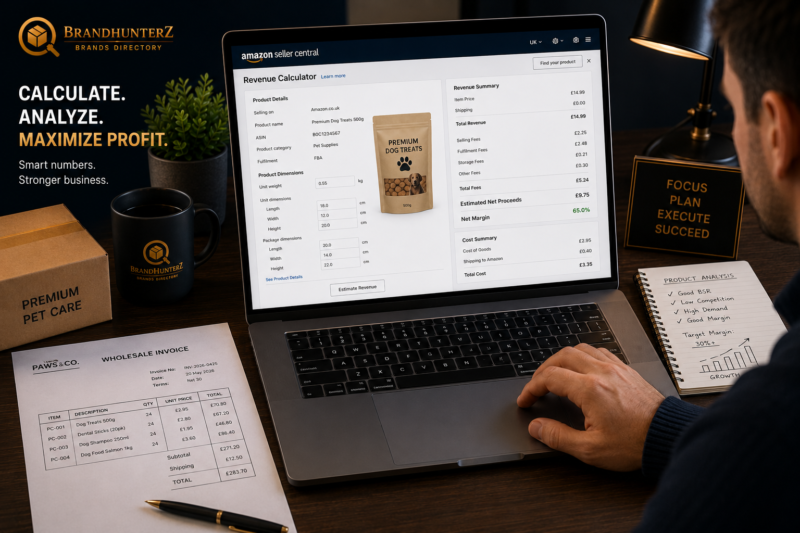
Go to the Amazon FBA Revenue Calculator available inside Seller Central or directly at sellercentral.amazon.co.uk. Search for the product by ASIN or product name. Enter the current Buy Box price and your estimated wholesale cost. The calculator will automatically calculate the referral fee and FBA fulfilment fee and show you your estimated net profit and margin percentage.
Add Your Additional Costs Manually
The Revenue Calculator does not automatically include your inbound shipping cost or storage fee. Add these manually to your calculation. For inbound shipping use £0.25 to £0.40 per unit as a conservative estimate for small standard-size products. For storage use £0.05 to £0.15 per unit per month based on the product’s size and your expected sell-through rate.
Apply the 20 Percent Minimum Margin Rule
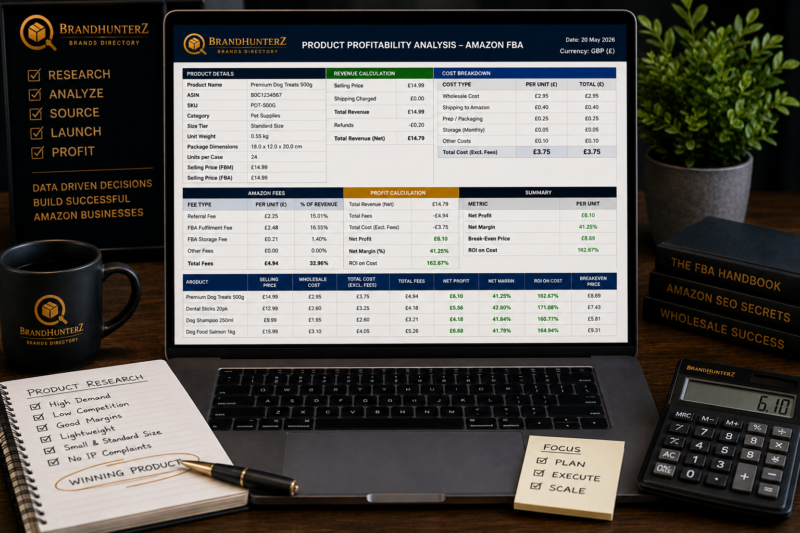
Once you have calculated your true net profit per unit divide it by the selling price to get your margin percentage. If the result is below 20 percent do not source the product. The 20 percent minimum gives you enough buffer to absorb unexpected price competition a return rate of 2 to 3 percent and the occasional storage fee spike without turning a profit into a loss.
Three Worked Margin Examples
To make the calculation process concrete here are three worked examples across different product types commonly sourced by wholesale Amazon FBA sellers.
Example 1 — Health and Beauty Product (Strong Margin)
| Item | Amount |
|---|---|
| Selling Price (Buy Box) | £15.99 |
| Wholesale Cost | – £5.50 |
| Referral Fee (15%) | – £2.40 |
| FBA Fulfilment Fee (small standard) | – £2.85 |
| Storage and Inbound Shipping | – £0.40 |
| Net Profit Per Unit | £4.84 (30% margin) ✓ |
Example 2 — Household Cleaning Product (Acceptable Margin)
| Item | Amount |
|---|---|
| Selling Price (Buy Box) | £9.99 |
| Wholesale Cost | – £3.20 |
| Referral Fee (15%) | – £1.50 |
| FBA Fulfilment Fee (small standard) | – £2.65 |
| Storage and Inbound Shipping | – £0.35 |
| Net Profit Per Unit | £2.29 (23% margin) ✓ |
Example 3 — Low-Priced Product (Below Threshold — Do Not Source)
| Item | Amount |
|---|---|
| Selling Price (Buy Box) | £5.99 |
| Wholesale Cost | – £2.00 |
| Referral Fee (15%) | – £0.90 |
| FBA Fulfilment Fee (small standard) | – £2.65 |
| Storage and Inbound Shipping | – £0.30 |
| Net Profit Per Unit | £0.14 (2% margin) ✗ Do Not Source |
💡 Why Products Under £8 Are Almost Never Viable for FBA
Example 3 illustrates why products priced under £7 to £8 on Amazon are almost never viable for FBA wholesale. The FBA fulfilment fee alone — typically £2.40 to £2.85 for small standard products — represents 30 to 40 percent of the selling price before any other costs are deducted. Add the referral fee and wholesale cost and there is simply no room for a meaningful margin. Always use the 20 percent minimum margin rule and avoid being tempted by the volume potential of low-priced products.
How to Use Keepa to Stress-Test Your Margin
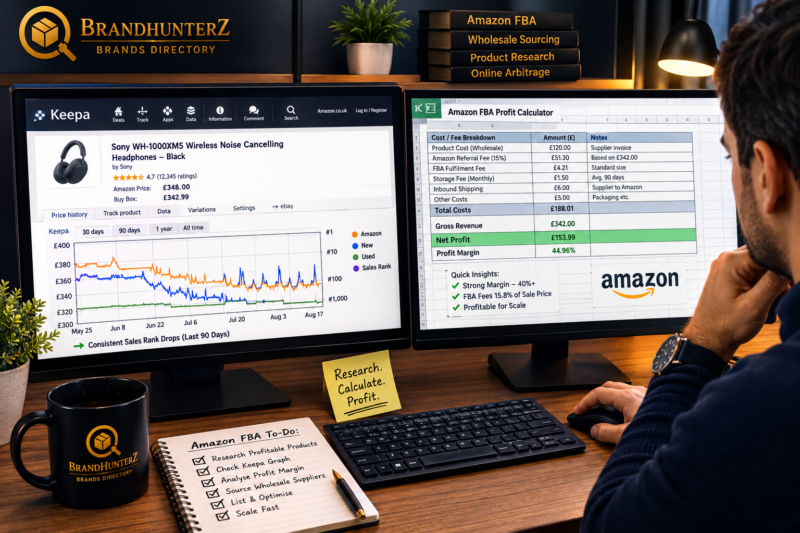
A margin calculation based on today’s Buy Box price is only valid if that price is stable. If the price has been declining over the past 6 months your actual margin when you receive your stock in 3 to 4 weeks could be significantly lower than when you calculated it. Keepa allows you to stress-test your margin by recalculating using the 90-day low Buy Box price rather than today’s price.
If your margin calculation still shows above 20 percent using the 90-day low Buy Box price the product is genuinely robust and worth sourcing. If the margin falls below 20 percent using the 90-day low price the product is at risk of becoming unprofitable during a competitive pricing period and should be avoided or monitored further before committing to stock.
Building a Simple Margin Tracking Spreadsheet
Every serious Amazon FBA wholesale seller should maintain a simple margin tracking spreadsheet that records the key financial metrics for every product they are considering sourcing or currently selling. This spreadsheet becomes your central decision-making tool — preventing emotion-driven sourcing decisions and ensuring every order placed meets your minimum margin requirements.
📅 Recommended Spreadsheet Columns
- Product Name and ASIN
- Brand Name
- Current Buy Box Price
- 90-Day Average Buy Box Price (from Keepa)
- 90-Day Low Buy Box Price (from Keepa)
- Wholesale Cost (per unit)
- Amazon Referral Fee
- FBA Fulfilment Fee
- Inbound Shipping Cost (per unit)
- Monthly Storage Fee Estimate (per unit)
- Net Profit Per Unit
- Net Margin Percentage
- Estimated Monthly Units Sold (from Helium 10)
- Estimated Monthly Profit
- Decision (Source / Monitor / Reject)
Frequently Asked Questions
What is a Good Profit Margin for Amazon FBA?
A minimum net margin of 20 percent after all Amazon fees is the standard benchmark for wholesale FBA sellers. The strongest wholesale products generate 25 to 35 percent net margins. Anything below 20 percent leaves insufficient buffer for return rates competitive price pressure storage fee increases and unexpected costs. Never source a product showing a margin below 20 percent in your pre-order calculation.
Does Amazon Charge VAT on FBA Fees?
Yes — Amazon charges VAT at 20 percent on its referral fees and FBA fulfilment fees for UK sellers. If you are VAT registered you can reclaim this VAT through your VAT return. If you are not VAT registered the VAT becomes an additional cost you cannot recover — another reason why VAT registration is worth considering early in your business growth even before the mandatory threshold.
How Often Do Amazon FBA Fees Change?
Amazon typically reviews and updates its FBA fee schedule annually — usually in January or February each year. Fee increases in recent years have been driven by rising logistics and warehouse costs. Always check the current Amazon UK FBA fee schedule in Seller Central before calculating margins on new products and review your existing product margins whenever Amazon announces a fee update.
Should I Use the Amazon Revenue Calculator or a Spreadsheet?
Use both. The Amazon Revenue Calculator gives you the most accurate referral fee and FBA fulfilment fee for any specific product because it pulls the exact size tier data from Amazon’s records. A spreadsheet lets you add your additional costs track multiple products simultaneously and build a pipeline of sourcing opportunities. The two tools work best together — use the calculator for accurate fee data then input the results into your spreadsheet for decision-making and tracking.
Related Articles — Keep Learning
- How to Start Amazon FBA in 2026 — Complete Beginner Guide
- Amazon FBA vs FBM — Which Model is Right for You in 2026
- How to Find Your First Wholesale Product to Sell on Amazon FBA
- How to Send Your First Shipment to Amazon FBA Warehouses
- How to Read a Keepa Graph for Amazon FBA Wholesale Research
- How to Scale Your Amazon FBA Business from £0 to £10,000 Monthly
- Browse the Brandhunterz Brands Directory — Free Access
- Amazon FBA and eBay Wholesale Courses by Brandhunterz
FIND PROFITABLE WHOLESALE PRODUCTS TODAY
Browse Verified Wholesale Brands — Free Access
Now you know how to calculate your FBA margins accurately find the wholesale brands worth sourcing. The Brandhunterz Brands Directory gives you instant free access to verified wholesale brands with real trade contacts and confirmed Amazon FBA approval status.
About the Author
This article is written by the team at Brandhunterz Ltd — a UK registered Amazon FBA wholesale sourcing company (Company No: 15342697) registered in England and Wales since 2023. Visit brandhunterz.com to learn more.