
WHOLESALE BRAND REVIEWS
How to Evaluate Any Wholesale Brand for Amazon FBA — Complete Framework
By Brandhunterz Ltd | Company No: 15342697 | 15 minute read
Affiliate Disclosure: This article contains affiliate links. If you purchase through our links we may earn a commission at no extra cost to you. We only recommend tools we genuinely use and believe in. Read our full disclaimer.
Every successful Amazon FBA wholesale seller builds their business on a repeatable process for evaluating new brands — a consistent framework that separates the brands worth pursuing from the ones that will waste your time capital and storage space. The nine brand reviews published earlier in this series — covering CeraVe Yankee Candle Milton Dove Oral-B Pedigree Johnson’s Baby Fairy and Nivea — each apply the same underlying evaluation logic to a specific brand. But the brands reviewed in this series represent a tiny fraction of the thousands of wholesale brands available to UK and US FBA sellers. The ability to evaluate any new brand that crosses your path — whether you find it through the Brandhunterz Brands Directory reverse sourcing on Amazon or a supplier’s price list — using the same rigorous framework is what separates sellers who build consistent growing catalogues from those who make random sourcing decisions and end up with stock they cannot sell at a profit.
We are Brandhunterz Ltd — a UK registered wholesale sourcing company (Company No: 15342697) — and in this complete framework guide we lay out the exact five-stage process for evaluating any wholesale brand for Amazon FBA — covering brand profile assessment Amazon demand and competition analysis margin calculation wholesale accessibility evaluation and final scoring — with the specific tools research steps and decision criteria that tell you clearly whether a brand is worth sourcing or not.
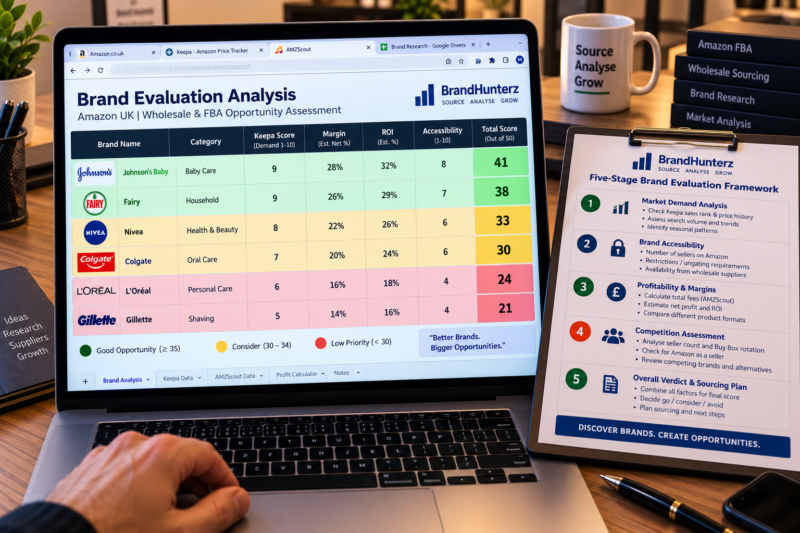
💡 Quick Summary — The Five Stage Brand Evaluation Framework
Stage 1 is Brand Profile — understand what the brand sells its parent company its distribution model and its Amazon category gating status before researching a single ASIN. Stage 2 is Amazon Demand Analysis — use Keepa to verify that at least three ASINs in the brand have consistent year-round sales rank healthy Buy Box rotation and manageable seller counts. Stage 3 is Margin Calculation — use AMZScout to confirm that the specific ASINs you intend to source meet your minimum 25% ROI threshold at your confirmed wholesale cost including all fees. Stage 4 is Wholesale Accessibility — verify that you can access the brand through an authorised distributor at the pricing your margin calculation requires before approaching any supplier. Stage 5 is Final Scoring — score the brand across five criteria and only proceed with sourcing if the total score meets your minimum threshold. Apply this framework to every brand before placing a single order and you will almost never buy stock that does not sell profitably.
Why You Need a Brand Evaluation Framework
The most common mistake new Amazon FBA wholesale sellers make is ordering stock based on brand name recognition alone. A brand being well known to consumers does not mean it is a viable FBA wholesale opportunity. As the nine brand reviews in this series demonstrate — even within the same brand some SKUs are excellent FBA opportunities and others are completely unviable. Without a systematic evaluation framework sellers make sourcing decisions based on incomplete information — ordering products that have too many competing sellers products where FBA fees exceed the margin products in gated categories they cannot list in or products from brands whose wholesale pricing leaves no room for profit after all costs are included. A consistent framework eliminates these mistakes before they cost you money.
| Common Sourcing Mistake | What Goes Wrong | Framework Stage That Prevents It |
|---|---|---|
| Ordering based on brand name alone | Popular brand but all its ASINs have 10 or more competing sellers and a declining Buy Box price — stock sits and loses margin | Stage 2 — Amazon Demand Analysis |
| Ordering without calculating FBA fees | Low price product with high FBA fees — selling price of £4 with FBA fees of £3.50 leaves nothing for stock cost — instant loss | Stage 3 — Margin Calculation |
| Ordering a gated product before ungating | Stock arrives at prep centre — seller cannot list because the ASIN or category requires prior approval — capital tied up with no income | Stage 1 — Brand Profile Assessment |
| Sourcing at secondary market pricing | Pays too much for stock through an unofficial channel — margin calculation was based on projected trade pricing — actual cost kills the ROI | Stage 4 — Wholesale Accessibility |
| Chasing a low-scoring brand | Invests time and capital in a brand that scores poorly on demand accessibility and margin — opportunity cost of not pursuing a better brand instead | Stage 5 — Final Scoring |
Stage 1 — Brand Profile Assessment
Before looking at a single ASIN or opening Keepa understand the brand at a macro level. Stage 1 takes fifteen to thirty minutes and prevents you from wasting hours on detailed research for a brand that was never going to be viable. Here is what to assess:
| Assessment Point | What to Find Out | Where to Look |
|---|---|---|
| Parent company and distribution type | Is this a large FMCG brand distributed through wholesalers — an independent brand that sells direct to retailers — or a brand with exclusive distribution that limits reseller access? | Brand website — trade section — Brandhunterz Brands Directory |
| Amazon category and gating status | Is the brand’s category gated on Amazon UK or USA? If yes — do you already have category approval — or do you need to ungate before you can list? | Amazon Seller Central — search ASIN — click Request Approval — check status |
| Number of third-party sellers on Amazon | How many third-party sellers does the brand have across its ASINs — a brand with many third-party sellers has open distribution and is accessible — a brand with only one seller may have exclusive distribution | SmartScout — brand overview page — third-party seller count |
| Product price range | What is the typical selling price range of this brand’s products on Amazon — are there enough SKUs in the £8 to £30 range to support viable FBA margins after fees — or is the entire range priced too low? | Amazon search results — filter by brand — review price range of listings |
| Hazmat or restricted product check | Does the brand sell liquid cleaning products aerosols or other products that may be subject to Amazon’s hazmat review — if so confirm FBA eligibility for specific ASINs before ordering | Amazon Seller Central — inventory — add a product — check FBA eligibility |
💡 Stage 1 Pass or Fail Criteria
Proceed to Stage 2 if: Brand has open wholesale distribution — at least some SKUs priced above £8 — either ungated or you already have approval — no deal-breaking hazmat or restriction issues identified.
Stop and move to next brand if: Brand has exclusive distribution with one reseller — all SKUs priced below £6 — gated category you cannot currently access — severe hazmat restrictions on all products.
Stage 2 — Amazon Demand Analysis with Keepa
Stage 2 is the core research stage — and Keepa is the essential tool. The goal of Stage 2 is to identify at least three specific ASINs within the brand that pass all five Keepa checks — these become your initial sourcing targets. Here is the exact Keepa research process:
Find the brand’s ASINs on Amazon
Search the brand name on Amazon and filter results by the brand — browse the listings and shortlist ASINs with Buy Box prices above your minimum viable threshold — for most personal care and household brands this is £8 on Amazon UK or $10 on Amazon USA — skip everything below these thresholds immediately.
Open each shortlisted ASIN in Keepa and run the five checks
For every ASIN that passes the price filter apply the five Keepa checks in the table below — record your findings in a simple spreadsheet or research sheet — only ASINs that pass all five checks proceed to Stage 3 margin analysis.
| Keepa Check | What to Look For | Pass Criteria |
|---|---|---|
| Check 1 — Sales rank history | Orange line over 12 months — consistent and low with no prolonged gaps or rank spikes that suggest the product goes in and out of stock regularly | Consistently within top 3,000 in the main category over 12 months |
| Check 2 — Buy Box seller count | Seller graph — count the FBA sellers rotating through the Buy Box — too many sellers means intense competition and margin pressure — too few may mean restricted distribution | Two to six FBA sellers — no single seller above 60% Buy Box share |
| Check 3 — Amazon first-party share | Buy Box history — is the Amazon badge present — if Amazon holds significant Buy Box time it will consistently undercut on price making it very difficult to compete profitably | Amazon absent or holding under 25% of Buy Box time |
| Check 4 — Buy Box price stability | Green price line over 12 months — flat or gently rising means stable margin environment — sustained downward trend means increasing competition eroding margins over time | Buy Box price flat or within 12% variation over 12 months — no sustained downward trend |
| Check 5 — New seller entry rate | Seller count change in last 90 days — a sudden large jump in seller count in the last quarter signals incoming competition that will soon compress the Buy Box price — avoid ASINs with recent large seller count increases | Seller count stable over past 90 days — no sudden large increase |
Stage 3 — Margin Calculation with AMZScout
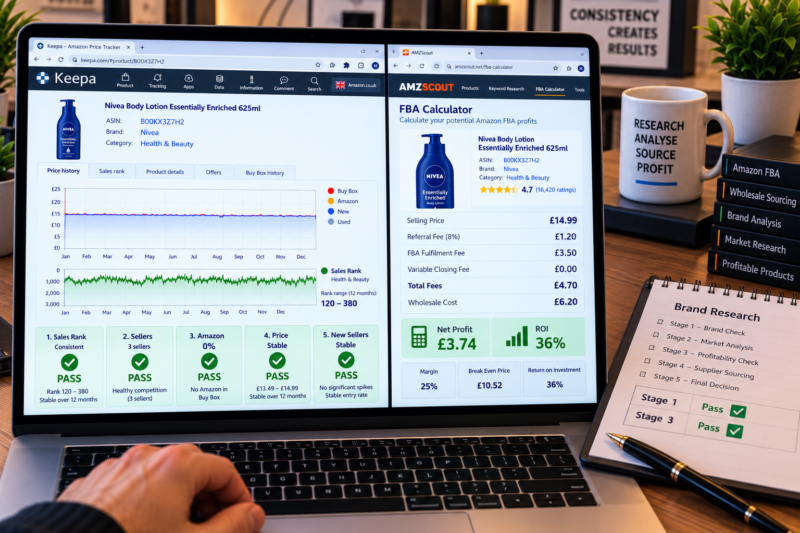
Every ASIN that passes all five Keepa checks in Stage 2 goes through a full margin calculation in Stage 3 using AMZScout. The margin calculation must use your actual confirmed wholesale cost — not an estimate — which means Stage 3 only delivers a definitive result once you have a wholesale price from a distributor. Here is the full margin calculation process:
| Margin Component | How to Calculate It | Notes |
|---|---|---|
| Selling price | Use the current Buy Box price from Keepa — not the highest price or the lowest — the actual Buy Box price at the time of your research | Use the 90-day average Buy Box price from Keepa for a more conservative estimate |
| Amazon referral fee | AMZScout calculates this automatically based on the category — typically 8% for Health and Beauty Baby and Pet — 15% for Home and Kitchen — always verify the correct category fee rate | Referral fee is a percentage of the selling price — higher price products pay more in absolute terms but the same percentage |
| FBA fulfilment fee | AMZScout calculates this based on the product’s weight and dimensions — input the actual product weight and dimensions from the Amazon listing for accuracy — especially important for pet food and heavy household products | FBA fees are weight and size based — always verify dimensions for any product that may be oversize |
| Prep centre cost | Add your prep centre’s per-unit cost — typically £0.75 to £1.20 per unit for standard labelling and preparation — confirm with your specific prep centre | Add this manually to the AMZScout calculation as a per-unit cost |
| Currency buffer for international sellers | If you pay for stock in a different currency to your Amazon disbursements add a 3% to 5% buffer to account for exchange rate movement between purchase and disbursement — use Wise to minimise currency conversion costs | International sellers should always include a currency buffer in their margin calculation |
| Wholesale cost per unit | Your confirmed wholesale cost from the distributor divided by the number of units — this is the most important input in the entire calculation — never estimate this figure — always confirm it with your distributor before calculating margin | The maximum viable wholesale cost is: Selling price minus all fees minus target profit |
| Minimum ROI threshold | Calculate ROI as net profit divided by wholesale cost — your minimum threshold should be 25% ROI for a standard FBA wholesale product — below 25% the margin is too thin to absorb any unexpected cost increase or Buy Box price movement | 25% ROI minimum — 30% or above preferred — below 20% reject the ASIN |
Stage 4 — Wholesale Accessibility Evaluation
Stage 4 confirms whether you can actually access the brand at the pricing your Stage 3 margin calculation requires. A brand can pass Stages 1 2 and 3 theoretically but if you cannot source it at the required wholesale cost it is not a viable opportunity for you. Here is how to evaluate wholesale accessibility:
| Accessibility Factor | How to Assess It |
|---|---|
| Find distributor contacts | Use the Brandhunterz Brands Directory to find verified wholesale distributors for the brand — cross-reference with reverse sourcing on Amazon — search the brand’s website for a trade or wholesale contact — use SmartScout to identify which distributors are already selling the brand on Amazon |
| Send professional outreach emails | Send a professional trade account enquiry email from a business email address — introduce your Amazon FBA business — provide your prep centre delivery address — request their wholesale price list and trade account application — follow up after 5 to 7 business days if no response |
| Confirm wholesale pricing against your threshold | Once you receive the price list check whether the wholesale cost for your target ASINs is at or below the maximum viable wholesale cost you calculated in Stage 3 — if the wholesale cost is above your maximum threshold the margin does not work at this distributor — try a second distributor or move to a different brand |
| Check distributor terms for restrictions | Read the distributor’s trade account terms carefully — check for MAP policies that may restrict your Amazon pricing — check for any clause that prohibits online marketplace reselling — only sign the trade account agreement if Amazon FBA reselling is explicitly permitted |
| Confirm minimum order requirements | Verify the minimum order quantity or minimum spend — confirm you can meet the minimum order with a realistic first order quantity for your target ASINs — never order more than you need for 30 to 45 days of cover on a first order with any new supplier |
Stage 5 — Final Brand Scoring
Stage 5 is the final decision gate. Score the brand across five criteria on a scale of one to ten — total the scores — and use the scoring guide to decide whether to proceed. This is the same scoring system used across all nine brand reviews in this series:
| Scoring Criterion | What to Score | Max Score |
|---|---|---|
| Amazon demand | How consistent and strong is the brand’s Amazon demand — how many Keepa-verified ASINs passed Stage 2 — how reliable is the year-round sales rank | 10 |
| Wholesale accessibility | How easy is it to find a distributor and open a trade account — is the category gated — are there MAP or reselling restrictions that complicate access | 10 |
| Margin potential | How many ASINs passed the Stage 3 margin calculation at 25% ROI or above — how much headroom is there between wholesale cost and maximum viable cost | 10 |
| Competition level | How manageable is the Buy Box competition — what is the average seller count on your target ASINs — is price stable or declining — are Amazon first-party sales limited | 10 |
| Suitability for your current level | Does this brand match your current account approval status capital level and operational capacity — a great brand for an advanced seller may be a poor choice for a newer seller who lacks ungating or capital | 10 |
| Total score | Sum of all five criteria | 50 |
| Total Score | Overall Rating | Decision |
|---|---|---|
| 40 to 50 | Excellent brand | Prioritise immediately — open distributor account — place first order on your highest-scoring ASINs |
| 30 to 39 | Good brand | Worth pursuing — identify the criteria where you scored lower and ensure they are understood and managed before ordering |
| 20 to 29 | Marginal brand | Proceed with caution — only if you have a specific compelling ASIN that passes Stages 2 and 3 strongly — otherwise spend your research time on higher-scoring brands |
| Below 20 | Poor brand | Do not pursue — move to next brand on your research list |
Your Complete Brand Evaluation Checklist
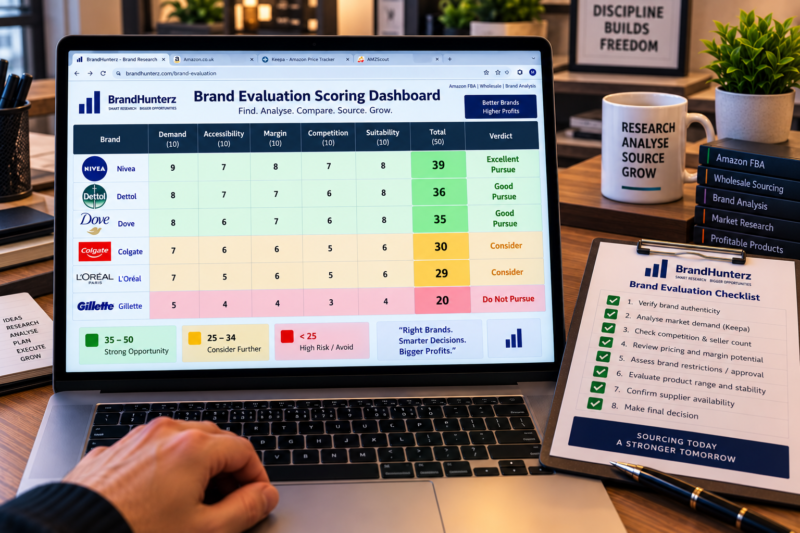
| Evaluation Step | Stage | Done |
|---|---|---|
| Parent company and distribution model identified — wholesale distribution confirmed as open not exclusive | 1 | ☐ |
| Amazon category gating status checked — ungating confirmed or planned before any stock is ordered | 1 | ☐ |
| SmartScout third-party seller count reviewed — brand confirmed as having open distribution with multiple resellers | 1 | ☐ |
| Minimum three ASINs above price threshold identified and all five Keepa checks passed on each | 2 | ☐ |
| Full AMZScout margin calculation completed for each Keepa-approved ASIN — minimum 25% ROI confirmed at confirmed wholesale cost | 3 | ☐ |
| Authorised distributor identified — outreach email sent — trade account application requested | 4 | ☐ |
| Wholesale price list received — confirmed wholesale cost below maximum viable threshold — distributor terms checked for MAP and reselling restrictions | 4 | ☐ |
| Brand scored across all five criteria — total score calculated — decision made based on scoring guide | 5 | ☐ |
| Brand fully evaluated — decision made — either proceeding with first order or moving to next brand on research list | All | ✅ Complete |
How to Apply This Framework to Find Your Next Brand
The framework is only as valuable as the quality of the brands you apply it to. Here are the three most effective methods for finding new brands to evaluate:
Start with the Brandhunterz Brands Directory
The Brandhunterz Brands Directory gives you direct access to thousands of verified wholesale brand contacts across USA and UK marketplaces — removing the most time-consuming part of brand evaluation which is finding the right distributor to contact. Use the Directory to build your target brand list — then apply the five-stage framework to each brand systematically.
Use SmartScout to Discover High-Revenue Brands
SmartScout identifies which brands generate the most revenue on Amazon and how many third-party sellers each brand has. Filter for brands with five to fifteen third-party sellers and strong revenue in your target categories — these are brands with open wholesale distribution and proven Amazon demand that have not yet been saturated by competing FBA sellers. Run every SmartScout discovery through the five-stage framework before pursuing it.
Reverse Source from Amazon Bestseller Lists
Browse Amazon’s bestseller lists in your target categories — note the brand names of products ranked in the top 100 — these brands have proven Amazon demand by definition — check each brand’s third-party seller count and price range — shortlist the ones that look promising and apply the five-stage framework. Use Keepa to verify that the bestseller rank is genuinely consistent and not a recent spike.
Conclusion — The Framework Is the Business
The most successful Amazon FBA wholesale sellers are not the ones who find a single magical brand and ride it indefinitely — they are the ones who apply a consistent evaluation framework to a continuous pipeline of brand research and build a catalogue of twenty to thirty proven products across multiple supplier relationships each one placed there because it passed every stage of the framework before a single unit was ordered. The five-stage framework in this guide — Brand Profile — Amazon Demand Analysis — Margin Calculation — Wholesale Accessibility — Final Scoring — is the same logic that underlies the nine brand reviews in this series and the same process that every serious Amazon FBA wholesale seller uses whether they call it a framework or not. Start with the Brandhunterz Brands Directory to find your brand leads — verify demand with Keepa — confirm margin with AMZScout — discover new opportunities with SmartScout — manage your currency with Wise — and apply the framework to every brand before placing a single order.
START YOUR BRAND RESEARCH TODAY
Browse 5,000+ Verified Wholesale Brands Free
Find verified wholesale brand contacts in the Brandhunterz Brands Directory — apply the five-stage evaluation framework to each brand — build your catalogue one proven brand at a time.
About the Author
This article is written by the team at Brandhunterz Ltd — a UK registered Amazon FBA wholesale sourcing company (Company No: 15342697) registered in England and Wales since 2023. Visit brandhunterz.com to learn more.