
AMAZON FBA SUPPLIER OUTREACH
How to Negotiate Better Wholesale Prices With Your Suppliers
By Brandhunterz Ltd | Company No: 15342697 | 13 minute read
Affiliate Disclosure: This article contains affiliate links. If you purchase through our links we may earn a commission at no extra cost to you. We only recommend tools we genuinely use and believe in. Read our full disclaimer.
The wholesale price you pay is the single biggest lever you have for improving your Amazon FBA profitability. Every pound you reduce your buy price by — on every unit of every product you sell — goes directly to your bottom line. A seller buying at £4.50 per unit on a product selling for £14.99 has a fundamentally more profitable business than one buying the same product at £5.50. The difference is not luck — it is the result of building strong supplier relationships and knowing exactly when and how to negotiate.
We are Brandhunterz Ltd — a UK registered wholesale sourcing company (Company No: 15342697) — and in this complete guide we explain exactly when to negotiate better pricing with your wholesale suppliers what to say in every negotiation scenario and which strategies consistently deliver lower buy prices for Amazon FBA wholesale sellers at every stage of their business growth.
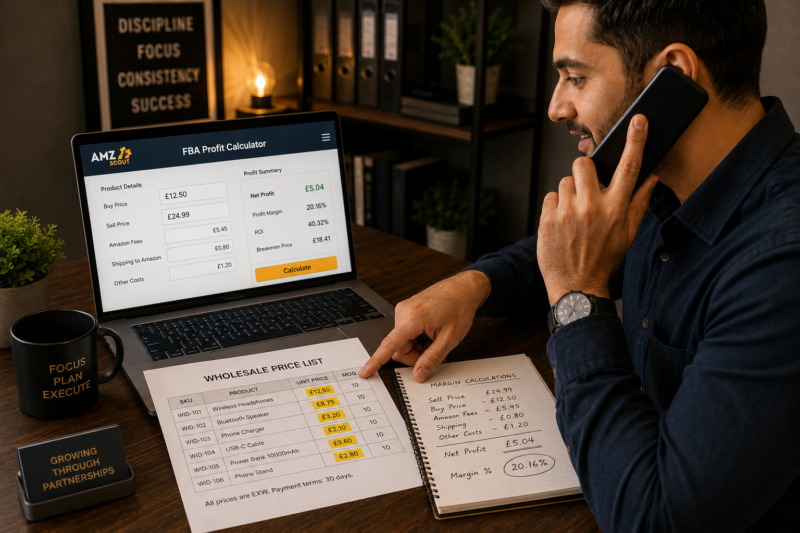
💡 Quick Summary
Never negotiate on your first or second order. Build credibility through consistent reorders first then open a pricing discussion at three to four orders in. The most effective negotiation strategies are volume commitments forward orders and broadening your product range with the same supplier. Always calculate your exact margin before negotiating so you know precisely how much lower you need your buy price to be to hit your target ROI — use AMZScout to confirm your numbers before every conversation.
Why Wholesale Price Negotiation is Different From Retail Bargaining
Wholesale price negotiation is a commercial conversation between two business partners — not a haggling exercise where you simply ask for a lower number and hope the supplier agrees. Suppliers have cost structures minimum margins and pricing policies they must protect. Successful negotiation happens when you give the supplier a business reason to reduce their price — higher volume lower admin cost or longer-term commercial certainty — rather than simply asking for a favour.
| Retail Bargaining | Wholesale Price Negotiation |
|---|---|
| Ask for a lower price with no reason given | Offer something of value in exchange for a better price |
| Based on personal preference or budget | Based on commercial data — margin calculations and volume projections |
| One-off transaction — no ongoing relationship | Long-term relationship — pricing improves as trust and volume grow |
| Emotional — can feel uncomfortable or confrontational | Professional — a normal commercial conversation between business partners |
Know Your Numbers Before Any Negotiation
Before you open any pricing negotiation with a supplier you must know exactly what your current margin is and exactly how much lower your buy price needs to be to hit your target ROI. Walking into a negotiation without this data means you cannot judge whether a supplier’s offer is genuinely better or only marginally improved.
Use AMZScout or Helium 10 to calculate your exact FBA margin at your current buy price and at your target buy price before every negotiation conversation. This gives you a precise number to negotiate toward — not a vague feeling that cheaper would be better.
NEGOTIATION MARGIN CALCULATION EXAMPLE
| Average Selling Price (from Keepa) | £14.99 |
| Amazon Fees (referral + FBA) | – £3.30 |
| Current Buy Price | – £5.50 |
| Current Net Profit | £6.19 — ROI 112% |
| Target Buy Price After Negotiation | £4.80 |
| Net Profit at Target Buy Price | £6.89 — ROI 143% ✅ |
A £0.70 reduction per unit — on 200 units per month — adds £140 to monthly profit with zero extra work.
When to Negotiate — The Right Timing
Timing is everything in wholesale price negotiation. Asking for a discount at the wrong moment — before you have earned the right or in a way that feels opportunistic rather than commercial — can damage the relationship you have worked to build. Here is the right time to open each type of pricing conversation:
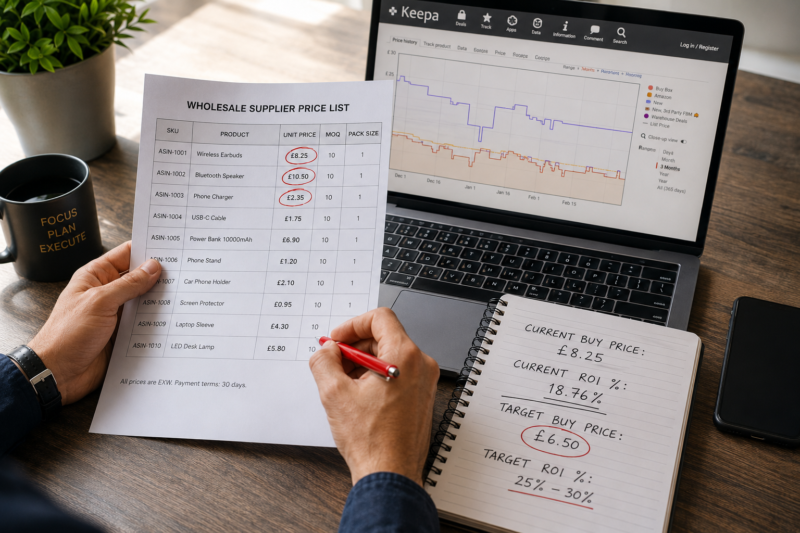
| Negotiation Trigger | When to Use It | Timing |
|---|---|---|
| After 3 to 4 consistent reorders | First volume discount conversation — reference your order history | Month 3 to 4 |
| Placing a significantly larger order | Ask directly for a per-unit reduction in exchange for higher quantity | Any time |
| Committing to a forward order | Offer a pre-committed future order in exchange for a locked better price | When scaling |
| Broadening your product range | Ask for a loyalty rate across all products as total spend grows | Month 6 to 9 |
| At the supplier’s annual price review | Contest any price increase by referencing your loyalty and growth | Annually |
The Five Most Effective Wholesale Negotiation Strategies
Strategy 1 — Volume Commitment
The simplest and most universally accepted negotiation strategy is offering to increase your order volume in exchange for a lower per-unit price. Every supplier has volume discount tiers — thresholds at which they can offer a better unit price because their per-unit cost of production packing and administration decreases at higher quantities.
Volume Commitment Email — What to Say
Dear [Name],
We have now placed [X] reorders with you and our Amazon sales for [Brand Name] products are growing consistently. We are planning to increase our next order to [X units] — approximately double our current order quantity.
Given this increased volume commitment is there a better unit price you can offer on this and future orders at this quantity? We are keen to grow our range with you and a revised price would allow us to invest more confidently in larger stock positions going forward.
Kind regards,
[Your Name] — Director, [Company Name]
Strategy 2 — Forward Order Commitment
A forward order commitment means agreeing to purchase a specified quantity over the next 3 to 6 months in exchange for a fixed better price. This gives the supplier certainty about future revenue — something extremely valuable to any brand managing stock production. In exchange you receive a price that is locked below their standard rate.
Forward Order Commitment — What to Say
Dear [Name],
We would like to discuss a forward order arrangement. Based on our current sales velocity we are confident we can commit to purchasing [X units] of [Product] over the next [3/6] months — approximately [X units] per month.
Would you be able to offer a preferential unit price in return for this committed forward volume? We are looking to formalise this arrangement in writing and begin with the first delivery in [month].
Kind regards,
[Your Name] — Director, [Company Name]
Strategy 3 — Range Expansion for Loyalty Pricing
If you are currently buying two or three products from a supplier and want to expand to five or six products use the range expansion as leverage for a loyalty rate across your entire order. Suppliers value buyers who purchase across multiple product lines — it increases their revenue from a single account and simplifies their sales administration. A buyer spending £2,000 per month across six products is worth more preferential treatment than one spending £500 on a single product.
Strategy 4 — Contesting a Price Increase
When a supplier notifies you of a price increase do not simply accept it without a conversation. Reference your order history your loyalty and the total business you have brought them over the period. Ask whether they can hold the current price for your account for a further 3 to 6 months given your track record. Many suppliers will agree to delay a price increase for their best customers — saving you margin without any volume commitment required.
Strategy 5 — Payment Terms as an Alternative to Price
If a supplier will not reduce their unit price ask for improved payment terms instead. Net 30 or net 60 payment terms — where you pay 30 or 60 days after delivery rather than on order — significantly improve your cash flow and allow you to sell stock and receive Amazon payouts before your supplier invoice falls due. This is effectively a zero-cost financing arrangement that improves your working capital position without requiring any price reduction from the supplier.
What to Say — and What Not to Say — in a Pricing Conversation
| ❌ Never Say This | ✅ Say This Instead |
|---|---|
| “Can you give me a discount?” | “If we increase our order to X units is there a volume price you can offer?” |
| “Your competitors charge less” | “We want to grow with you specifically — what can we do to unlock a better rate?” |
| “I need a lower price or I cannot afford to order” | “At our current buy price our Amazon margin is X% — at £Y per unit we could scale our order significantly” |
| “Can you just knock something off?” | “We are committing to X units per month for 3 months — does that support a loyalty rate?” |
| Negotiating on your first or second order | Wait until 3 to 4 consistent reorders before opening any pricing discussion |
How Much of a Reduction Should You Aim For?
Setting realistic negotiation targets prevents disappointment and keeps the conversation professional. Here are realistic price reduction expectations by relationship stage:

| Relationship Stage | Realistic Reduction | Strategy to Use |
|---|---|---|
| 3 to 4 orders in — growing volume | 3 to 7% | Volume commitment or range expansion |
| 6 to 9 months — consistent buyer | 5 to 12% | Forward order or loyalty rate |
| 12 months plus — strategic partner | 10 to 20% | Full commercial partnership — exclusivity discussion |
| Contesting price increase | Delay or reduce increase by 50% | Reference loyalty and growth history |
The Impact of Price Reduction on Monthly Profit
To understand why even a small buy price reduction is worth pursuing consider what it means across a month of selling at scale:
| Price Reduction Per Unit | 100 Units/Month | 200 Units/Month | 500 Units/Month |
|---|---|---|---|
| £0.25 reduction | +£25/month | +£50/month | +£125/month |
| £0.50 reduction | +£50/month | +£100/month | +£250/month |
| £1.00 reduction | +£100/month | +£200/month | +£500/month |
| £1.50 reduction | +£150/month | +£300/month | +£750/month |
Conclusion — Better Pricing is Earned Not Demanded
Wholesale price negotiation is one of the highest-leverage activities in your Amazon FBA business — and it costs you nothing except a well-timed professional conversation. Build your supplier relationships first place consistent reorders pay on time and grow your volumes. Then open the pricing conversation with data confidence and a clear commercial offer. The sellers who negotiate most effectively are those who approach the conversation as a business partner not as a buyer trying to squeeze a cheaper deal.
Use AMZScout or Helium 10 to know your exact margin target before every negotiation. Research every new product with Keepa. And find verified wholesale brands worth building long-term pricing relationships with through our Brands Directory.
FIND BRANDS WORTH NEGOTIATING WITH
Browse 5,000+ Verified Wholesale Brands Free
Every brand in the Brandhunterz Directory is verified and Amazon-compatible — giving you the right wholesale partners to build the long-term relationships that unlock the best possible pricing for your FBA business.
About the Author
This article is written by the team at Brandhunterz Ltd — a UK registered Amazon FBA wholesale sourcing company (Company No: 15342697) registered in England and Wales since 2023. Visit brandhunterz.com to learn more.