
INTERNATIONAL AMAZON SELLING
How to Scale an Amazon FBA Business Internationally — From One Marketplace to Many
By Brandhunterz Ltd | Company No: 15342697 | 15 minute read
Affiliate Disclosure: This article contains affiliate links. If you purchase through our links we may earn a commission at no extra cost to you. We only recommend tools we genuinely use and believe in. Read our full disclaimer.
Scaling an Amazon FBA wholesale business as an international seller is fundamentally different from scaling as a UK or US-based seller — not because the principles are different but because the opportunities are greater. An international seller who has built a working wholesale operation on Amazon USA or Amazon UK has already overcome the hardest barriers — identity verification international payment setup supplier relationships across time zones prep centre management from thousands of miles away and the psychological challenge of running a business in a country you have never visited. Every additional marketplace every additional supplier relationship and every additional ASIN added to a proven catalogue compounds the revenue of a business model that is already working. The question for an international seller who has reached stability on their first marketplace is not whether to scale — it is how to do it in the right order at the right pace without losing control of the business they have already built.
We are Brandhunterz Ltd — a UK registered wholesale sourcing company (Company No: 15342697) — and in this complete guide we walk through the four stages of scaling an international Amazon FBA wholesale business from a single marketplace operation to a multi-marketplace multi-supplier catalogue business — covering catalogue expansion reinvestment strategy marketplace expansion supplier relationship development systems and tools and the key metrics that tell you when you are ready to take the next step.
💡 Quick Summary
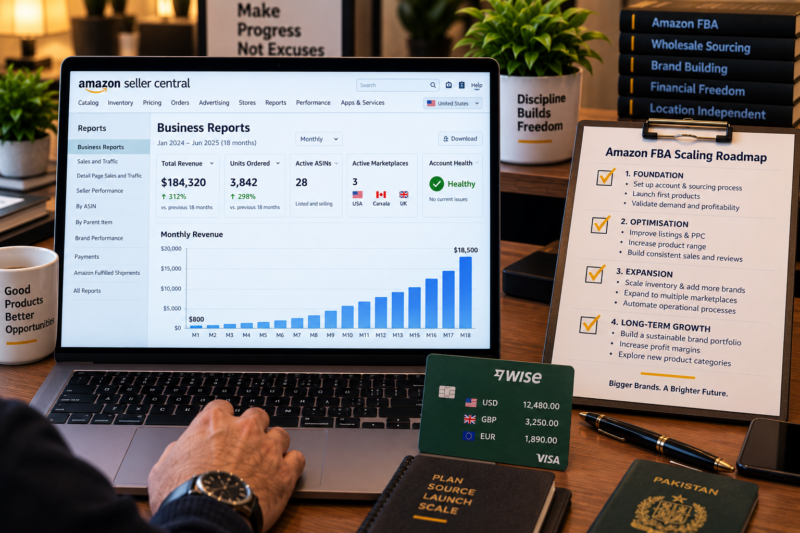
Scaling an international Amazon FBA wholesale business happens in four stages — Stage 1 is proving the model on your first marketplace with five to ten profitable ASINs — Stage 2 is catalogue expansion on the same marketplace by opening more supplier relationships and adding more ASINs using a fixed reinvestment percentage — Stage 3 is marketplace expansion using Build International Listings and Remote Fulfillment to activate Amazon Canada or Amazon UK as a second marketplace — Stage 4 is systematising operations using tools workflows and eventually a VA to handle routine tasks so you can focus on sourcing and growth. The single most important scaling principle for international sellers is consistent reinvestment — a fixed percentage of every disbursement going back into new stock regardless of other financial pressures — compounded consistently this is what turns a five-ASIN side business into a thirty-ASIN full-time income.
The Four Stages of International Amazon FBA Scaling
Every successful international Amazon FBA business moves through four distinct stages — each with its own focus metrics and natural next step. Understanding which stage you are in prevents the most common scaling mistakes — expanding to new marketplaces before the core business is stable or adding too many ASINs before you have the working capital to restock them consistently.
| Stage | Focus | Ready for Next Stage When |
|---|---|---|
| Stage 1 — Prove the Model | Register seller account — open first supplier account — source first 3 to 5 ASINs — send first FBA shipment — make first sales — confirm margins are as calculated | 3 to 5 ASINs generating consistent sales — account health green — first full reinvestment cycle completed — margins confirmed at 25% ROI or above |
| Stage 2 — Catalogue Expansion | Open more supplier accounts — add ASINs systematically — reinvest a fixed percentage of every disbursement — grow from 5 ASINs to 20 to 30 on the same marketplace | 15 to 20 active ASINs — multiple supplier relationships — monthly disbursement stable and growing — account health consistently green — prep centre workflow running smoothly |
| Stage 3 — Marketplace Expansion | Activate a second marketplace using Build International Listings and Remote Fulfillment — apply proven ASINs to new marketplace — open supplier accounts in new marketplace region if needed | Second marketplace generating consistent sales — tax compliance confirmed in new marketplace — two-marketplace operation running without additional management burden |
| Stage 4 — Systematise and Scale | Build workflows and SOPs for every repeatable task — tools to automate repricing and inventory alerts — VA to handle routine tasks — free your time for sourcing strategy and growth decisions | Business runs on documented systems — monthly revenue is predictable — growth is limited by capital and catalogue size not by management capacity |
Stage 1 — Proving the Model — What to Focus On First
The goal of Stage 1 is not to make as much money as possible as fast as possible — it is to confirm that your business model works end to end. Every system needs to be tested with real money before you scale it. Here is what Stage 1 requires:
| Stage 1 Milestone | Why It Matters |
|---|---|
| First FBA shipment received and inventory live | Confirms that your supplier to prep centre to FBA workflow functions correctly — any issues in labelling receiving or shipment creation are identified and fixed on a small first batch rather than a large one |
| First sales and first disbursement received | Confirms that your Payoneer or Wise account is correctly configured — Amazon is disbursing correctly — the full payment cycle works from sale to your local bank account |
| Actual margin confirmed against projected margin | Compare your actual net profit per unit against your AMZScout projection — any difference tells you what costs you missed or underestimated — fix your margin calculation model before adding more ASINs |
| Account health maintained green throughout | A clean account health record from the start is essential — any demerits in Stage 1 must be resolved before scaling — a compromised account health on a growing catalogue creates compounding risk |
| First restock order placed before stockout | Confirms your restock timing and inventory management process — running out of stock loses your Buy Box position and sales rank — identify your lead time from order to FBA live and set your reorder point accordingly |
Stage 2 — Catalogue Expansion — The Reinvestment Engine
Stage 2 is where international Amazon sellers build the revenue base that transforms the business from a side income into a significant primary income. The mechanism that drives Stage 2 is consistent reinvestment — putting a fixed percentage of every disbursement back into new stock rather than withdrawing it all as personal income. Here is how the reinvestment engine works:
| Reinvestment Rule | How to Apply It |
|---|---|
| Set a fixed reinvestment percentage — 60% to 80% | Every time Amazon disburses into your Wise or Payoneer account allocate 60% to 80% immediately as working capital for restock and new ASIN sourcing — withdraw only 20% to 40% as personal income — this percentage is the throttle on your growth rate |
| Restock your best performers first | Use your reinvestment capital to restock your current best-selling ASINs before sourcing new ones — losing your Buy Box on a proven product because you ran out of stock costs more than the profit from a new unproven ASIN |
| Add one to two new ASINs per month | A sustainable catalogue expansion rate for an international seller managing everything remotely — adding too many ASINs simultaneously stretches your management capacity your working capital and your prep centre’s throughput — one to two new ASINs per month compounds reliably over 12 months into a catalogue of 15 to 25 proven products |
| Open one new supplier account per month | A growing catalogue requires a growing supplier base — send outreach emails consistently throughout Stage 2 — the goal is to have five to ten active supplier relationships within 12 months — diversity of suppliers reduces dependency risk if one supplier changes their terms or closes accounts |
| Track every ASIN’s ROI monthly | Some ASINs will underperform relative to expectation — a product that looked good on Keepa at sourcing may have a declining Buy Box price six months later — review every ASIN’s actual ROI monthly and cull underperformers — capital tied up in a 10% ROI ASIN is capital that could be earning 35% in a better product |
What Does Scaling Look Like in Numbers?
Here is an illustrative picture of how consistent reinvestment compounds an international FBA wholesale business over time — starting from a $2,000 initial investment and reinvesting 70% of every disbursement:
| Month | Active ASINs | Monthly Revenue | Monthly Profit | Withdrawn (30%) |
|---|---|---|---|---|
| 3 | 3 | $800 | $240 | $72 |
| 6 | 7 | $2,400 | $720 | $216 |
| 9 | 12 | $5,200 | $1,560 | $468 |
| 12 | 18 | $9,800 | $2,940 | $882 |
| 18 | 28 | $18,500 | $5,550 | $1,665 |
Figures are illustrative — actual results depend on product selection margins supplier access and consistent reinvestment discipline. A 30% average profit margin is assumed throughout. Real results will vary.
Stage 3 — Marketplace Expansion — When and How to Add a Second Marketplace
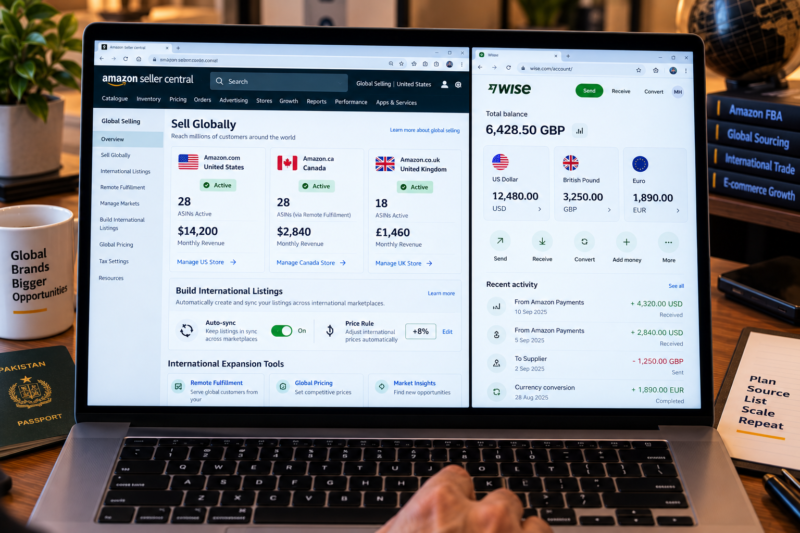
Expanding to a second marketplace is the highest-leverage growth action available to an international FBA seller who has proved their model — because it multiplies the revenue of your existing catalogue without requiring proportionally more sourcing work. Here is how to approach marketplace expansion correctly:
| Expansion Decision | Guidance |
|---|---|
| When to expand — readiness criteria | Minimum 15 active ASINs on primary marketplace — account health consistently green for 90 days — monthly profit stable — prep centre workflow running without issues — you have spare management capacity to monitor a second marketplace dashboard |
| Amazon USA sellers — expand to Canada first | Use Remote Fulfillment with FBA to sell on Amazon Canada using your existing US inventory — no additional stock required — BIL creates Canadian listings automatically — test Canadian demand before committing separate Canadian inventory — lowest effort highest speed expansion |
| Amazon USA sellers — expand to Amazon UK | Requires a separate European seller account registration — separate UK supplier accounts or checking if your US suppliers have UK distribution arms — a UK prep centre — UK VAT registration above the threshold — GBP disbursements into your Wise GBP account — more setup but the GBP earnings are very strong for PKR and INR conversion |
| Amazon UK sellers — expand to Germany | Germany is Amazon’s largest European marketplace — same EU unified account as Amazon UK — BIL auto-translates listings — Pan-European FBA or European Fulfillment Network used to fulfil German orders — German VAT registration required — EUR disbursements managed through Wise EUR account |
| Tax compliance before activating | Confirm VAT or GST obligations in the new marketplace before making your first sale — always consult a tax advisor familiar with the target marketplace — non-compliance with VAT registration in the UK and EU carries significant penalties |
Stage 4 — Systematise Operations — Tools Workflows and Your First VA
At Stage 4 the business is generating meaningful monthly income across multiple marketplaces and the bottleneck shifts from capital and supplier access to management time. The answer is systems — documented workflows automated tools and eventually a virtual assistant to handle the repeatable operational tasks that consume your time without requiring your strategic judgment. Here are the tools and systems that matter most at this stage:
| System or Tool | What It Does for You at Scale |
|---|---|
| Keepa alerts | Set price alerts on all your active ASINs — Keepa notifies you when the Buy Box price drops significantly — early warning of price erosion before it affects your margin — essential at scale when you cannot manually check 30 ASINs daily |
| Helium 10 — Alerts and Inventory Management | Helium 10’s Alerts monitors your listings for hijackers suppressed listings and Buy Box losses — Inventory Management tracks your stock levels and sends reorder notifications based on your set lead times — both are critical at Stage 4 when your catalogue is too large to monitor manually |
| Automated repricing tool | A repricing tool automatically adjusts your prices within your set floor and ceiling to maximise Buy Box share without manual intervention — at 30 ASINs across two marketplaces manual repricing is impossible — tools like BQool or Repricer.com are popular among wholesale FBA sellers |
| Standard Operating Procedures — SOPs | Document every repeatable process as a step-by-step SOP — supplier outreach process — new ASIN research checklist — prep centre notification workflow — FBA shipment creation process — inventory reorder triggers — SOPs allow you to hand tasks to a VA without briefing them from scratch every time |
| Virtual Assistant — VA | At Stage 4 a part-time VA handles supplier outreach emails — prep centre notifications — FBA shipment plan creation — Keepa research on new ASIN shortlists — account health monitoring — this frees your time for the high-judgment tasks only you can do — sourcing decisions negotiation and growth strategy |
| Zik Analytics | At Stage 4 when expanding to eBay as an additional channel alongside Amazon Zik Analytics provides the product and competitor research data needed to identify profitable wholesale eBay listings — a natural complement to your Amazon FBA catalogue using the same supplier relationships |
Key Metrics to Track at Every Stage
Scaling without tracking the right metrics leads to surprises — running out of stock overordering on slow-moving ASINs or missing that your margins have eroded. Here are the metrics every international Amazon seller must track at every stage of growth:
| Metric | What It Tells You | Target |
|---|---|---|
| ROI per ASIN | Whether each product is delivering the profit you projected — the foundation of every sourcing decision | Minimum 25% per ASIN |
| Buy Box percentage per ASIN | How much of the available sales your listing is capturing — low Buy Box percentage means your price is too high or a competitor has better metrics | Above 30% per ASIN on shared listings |
| Days of cover remaining per ASIN | How many days of stock you have left at current sales velocity — triggers your reorder decision | Reorder when 30 to 45 days of cover remain |
| Account Health — ODR IPI score | Your overall Amazon account standing — a deteriorating IPI score restricts FBA storage limits — ODR above 1% puts your account at risk | ODR below 0.5% — IPI above 500 |
| Monthly disbursement trend | Whether your overall revenue is growing flat or declining — three consecutive months of flat disbursement signals the need for new ASINs or new suppliers | Growing month on month with reinvestment |
| Working capital ratio | The ratio of capital tied up in stock and in transit versus available liquid capital — insufficient working capital creates stockout risk on your best sellers | Enough liquid capital to restock top 5 ASINs simultaneously |
Your International FBA Scaling Checklist
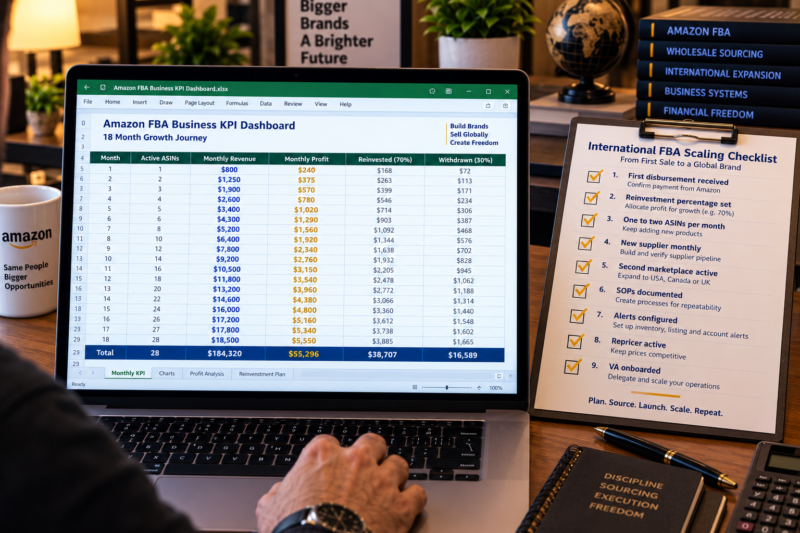
| Scaling Milestone | Stage | Done |
|---|---|---|
| First FBA shipment live — first sales — first disbursement received into Wise or Payoneer | 1 | ☐ |
| Actual margins confirmed against projected — margin calculation model corrected if needed | 1 | ☐ |
| Fixed reinvestment percentage set — 60% to 80% of each disbursement allocated to stock before withdrawal | 2 | ☐ |
| One to two new ASINs added per month — one new supplier outreach per month — catalogue growing consistently | 2 | ☐ |
| Monthly ASIN ROI review completed — underperformers identified — capital reallocated to better products | 2 | ☐ |
| Second marketplace activated — tax compliance confirmed — BIL configured — Remote Fulfillment or separate inventory sent | 3 | ☐ |
| SOPs documented for all repeatable tasks — supplier outreach — ASIN research — prep centre notification — shipment creation | 4 | ☐ |
| Keepa alerts and Helium 10 Alerts active on all ASINs — repricing tool configured — inventory reorder triggers set | 4 | ☐ |
| Multi-marketplace international FBA business operational — growing on systems — scaling sustainably from anywhere in the world | All | ✅ Scaled |
Conclusion — The International Seller Advantage Is Real and Compounding
International Amazon FBA sellers who commit to the four-stage scaling framework — prove the model then expand the catalogue then expand the marketplace then systematise — build businesses that generate USD or GBP income from home in Pakistan India or anywhere else in the world with no ceiling on how far they can grow. The exchange rate advantage means that every dollar of Amazon profit delivers more local purchasing power than it would for a US or UK seller — and the lower cost base of operating from Pakistan or India means that the same monthly profit supports a significantly higher standard of living than it would in the selling country. Start with the Brandhunterz Brands Directory to find your wholesale suppliers. Research every opportunity with Keepa. Confirm every margin with AMZScout. Discover deeper brands with SmartScout. Manage your currency with Wise. And reinvest consistently — because it is consistent reinvestment more than any other single factor that determines how far an international Amazon FBA seller goes.
BUILD YOUR INTERNATIONAL AMAZON FBA BUSINESS TODAY
Browse 5,000+ Verified Wholesale Brands Free
Find verified wholesale trade contacts in the Brandhunterz Brands Directory — start your first supplier relationship today — prove the model on your first marketplace — and scale your international Amazon FBA business one stage at a time.
About the Author
This article is written by the team at Brandhunterz Ltd — a UK registered Amazon FBA wholesale sourcing company (Company No: 15342697) registered in England and Wales since 2023. Visit brandhunterz.com to learn more.