
AMAZON FBA SUPPLIER OUTREACH
How to Scale Your Wholesale Supplier Portfolio From 1 to 10 Brands
By Brandhunterz Ltd | Company No: 15342697 | 14 minute read
Affiliate Disclosure: This article contains affiliate links. If you purchase through our links we may earn a commission at no extra cost to you. We only recommend tools we genuinely use and believe in. Read our full disclaimer.
Getting your first wholesale supplier account approved and your first product live on Amazon FBA is a significant achievement. But one supplier is not a business — it is a starting point. The difference between a seller generating £500 per month from a single brand and one generating £5,000 to £10,000 per month is almost always the same thing — the number of profitable wholesale supplier relationships they have built and the systematic process they use to find add and grow each new brand in their portfolio.
We are Brandhunterz Ltd — a UK registered wholesale sourcing company (Company No: 15342697) — and in this complete guide we lay out the exact step-by-step process for scaling your wholesale supplier portfolio from your first brand to ten active supplier relationships — covering how to research and add new brands systematically how to decide when each new brand is ready to add how to manage multiple supplier relationships simultaneously and how to reinvest your profits to accelerate growth at every stage.
💡 Quick Summary
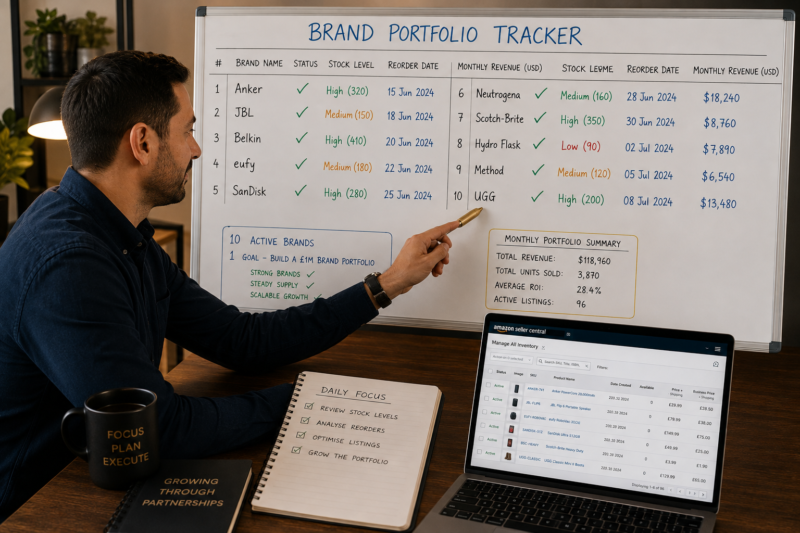
Scaling from one to ten wholesale supplier brands requires a systematic weekly outreach process consistent reinvestment of profits into new stock a clear decision framework for when to add versus drop a brand and the right research tools to identify new opportunities without slowing down your existing operations. The sellers who reach ten active brands fastest are those who treat supplier outreach as a weekly habit — not a one-off activity they do when their current supplier is not performing.
Why Ten Brands is the Right First Target
Ten active wholesale supplier relationships is the threshold at which most Amazon FBA wholesale businesses become genuinely resilient and scalable. Here is why ten brands specifically is the right first portfolio target:
| Number of Brands | Business Reality | Monthly Revenue Potential |
|---|---|---|
| 1 brand | Fragile — one supplier problem stops all revenue | £300 to £800 |
| 3 brands | Early stage — some resilience building | £800 to £2,000 |
| 5 brands | Growing — meaningful income becoming visible | £2,000 to £5,000 |
| 10 brands | Resilient — loss of any one brand has limited impact | £5,000 to £15,000+ |
At ten brands losing one supplier — through stock issues policy changes or Amazon restrictions — has a manageable impact on your total revenue. At one or two brands the same event can devastate your business overnight. Portfolio diversity is the most important risk management strategy available to any wholesale seller.
Stage 1 — Mastering Your First Brand Before Adding More
Before adding a second brand you must achieve three things with your first supplier relationship. Skipping this stage and adding new brands too quickly is one of the most common mistakes growing wholesale sellers make — spreading capital and attention across too many brands before any of them are properly established.
| Milestone to Hit Before Adding Brand 2 | Why It Matters |
|---|---|
| Minimum 2 profitable reorders placed | Confirms the product sells at the expected velocity — not just a first-order spike |
| Reorder process documented and repeatable | You can manage brand 1 on autopilot while building brand 2 |
| Profit from brand 1 available to reinvest | Fund brand 2 from profits — not from additional personal capital if possible |
Stage 2 — Your Weekly Outreach System
The sellers who reach ten brands fastest are those who treat supplier outreach as a non-negotiable weekly activity — not something they do when they remember or when business is slow. Building a consistent weekly outreach habit is the single most impactful change you can make to the speed at which your portfolio grows.
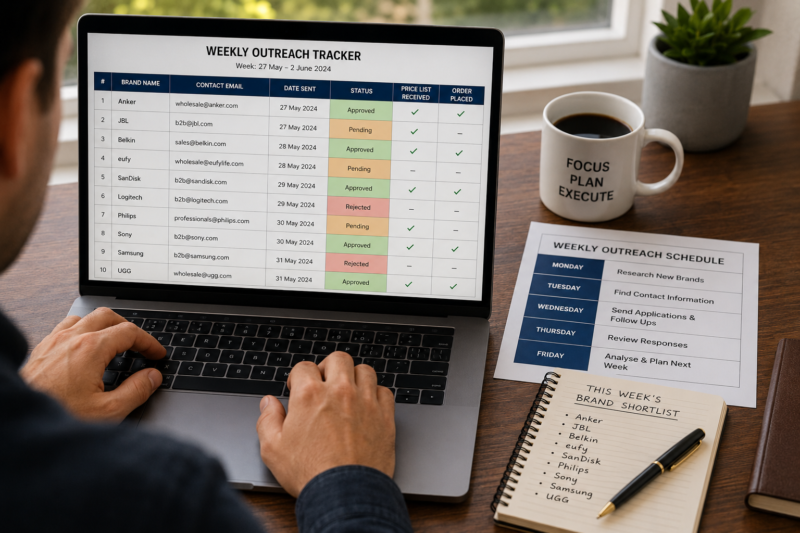
THE WEEKLY WHOLESALE OUTREACH SCHEDULE
| Monday | Research 5 to 10 new brands using Keepa and SmartScout — build your shortlist for the week |
| Tuesday | Find trade contact details for each shortlisted brand — update your outreach tracker |
| Wednesday | Send 5 to 10 personalised wholesale application emails to this week’s shortlist |
| Thursday | Follow up on applications sent 7 days ago that have not yet received a response |
| Friday | Review all supplier responses — calculate margins on any price lists received — decide next steps |
| Weekend | Review existing brand stock levels — place reorders where stock is below 21-day cover |
At 5 to 10 new applications per week and a 30 to 50 percent approval rate you will open 2 to 5 new trade accounts every week. Not every approved account will have viable products but over the course of a month this level of consistent outreach generates enough new supplier relationships to add 1 to 2 new active brands to your portfolio every 4 to 6 weeks.
Stage 3 — How to Evaluate and Add Each New Brand
Every new brand that enters your portfolio must pass the same rigorous research process as your first brand — no exceptions. The excitement of receiving an approval from a new supplier should never bypass your product research discipline. Here is the complete evaluation process for every new supplier price list you receive:
Bulk Scan the Price List
Upload the supplier’s price list to SmartScout or use the bulk ASIN scanner in Helium 10 to scan every product simultaneously. This gives you a first-pass filter of which products have Amazon demand worth investigating further — without spending time on products that clearly will not work.
Validate Shortlisted Products on Keepa
For every product that passes the bulk scan check its 12-month BSR history and price stability on Keepa. Confirm consistent sales rank drops no Amazon presence on the listing and stable Buy Box pricing. Any product failing this check is removed from your shortlist regardless of how good the wholesale price looks.
Calculate Exact Margin on Every Viable Product
Use AMZScout to calculate the exact FBA margin on every Keepa-validated product. Enter the wholesale buy price and the current Amazon selling price — confirm minimum 30 percent ROI after all Amazon fees. Any product below this threshold is cut from your order list.
Check Gating Status Before Ordering
Check every confirmed product in Seller Central for gating before placing your order. If products are gated factor the ungating timeline into your launch plan — use your supplier invoice to submit the ungating application and order enough units to meet Amazon’s minimum quantity requirement.
Place Minimum Test Order on Best Products
For every new brand always start with the minimum order quantity on your two or three best products only. A test order validates real sales velocity before you commit larger capital to the brand. If the test order sells through quickly and profitably scale up immediately on your next reorder.
Stage 4 — Managing Multiple Supplier Relationships Simultaneously
As your portfolio grows from three to five to ten brands the operational complexity of managing multiple supplier relationships simultaneously increases. The sellers who scale most efficiently use a simple supplier management system that gives them visibility across all active relationships without spending hours every week on administration.
| Supplier Tracker Column | What to Record |
|---|---|
| Brand name and contact | Named trade contact email and phone — never rely on generic inboxes |
| Active products and SKUs | Every product currently ordered from this supplier with ASIN and buy price |
| Current stock level and days cover | Units in FBA plus days of stock remaining at current sales velocity |
| Reorder trigger date | Date when stock drops to 21-day cover — reorder immediately at this trigger |
| Supplier lead time | Days from order placement to delivery — factor into reorder timing |
| Monthly revenue and ROI | Total monthly revenue and profit generated by this brand — review monthly |
| Relationship status | New trusted volume discount preferred buyer — track milestone progress |
| Next action | Reorder due follow-up needed price negotiation due new product research pending |
Stage 5 — When to Drop a Brand From Your Portfolio
Scaling your portfolio is not just about adding new brands — it is also about removing underperforming ones. Capital tied up in a brand that is not generating profitable sales is capital that could be funding a better opportunity. Here are the clear signals that a brand should be removed from your active portfolio:
| Drop the Brand When | What to Do |
|---|---|
| ROI has dropped below 20% consistently | Sell remaining stock at breakeven — reallocate capital to higher-performing brands |
| Amazon has entered the listing | Stop reordering immediately — sell through remaining stock and exit the product |
| Supplier has raised prices above your margin threshold | Negotiate first — if unsuccessful sell through stock and move on |
| Stock is not selling — accumulating storage fees | Reduce price to sell through — remove from FBA before long-term storage fees apply |
| Supplier stops permitting Amazon selling | Immediately stop listing — sell through existing stock and close the account |
How to Reinvest Profits to Accelerate Portfolio Growth
The speed at which you reach ten brands is directly determined by your reinvestment rate. Sellers who withdraw all profits from their business slow their growth significantly compared to those who reinvest a meaningful percentage back into new stock and new supplier relationships. Here is a reinvestment framework that balances business growth with personal income:
| Business Stage | Reinvestment Rate | What to Reinvest In |
|---|---|---|
| Month 1 to 3 — getting started | 100% | All profit back into stock and new supplier outreach |
| Month 3 to 6 — building momentum | 80% | New brands larger reorders growing stock buffer |
| Month 6 to 12 — scaling to 10 brands | 60 to 70% | New brands volume growth tools and education |
| Month 12 plus — established portfolio | 40 to 50% | Ongoing growth plus meaningful personal income withdrawal |
Your Portfolio Growth Timeline — Realistic Targets
Every seller’s timeline is different — but here is a realistic portfolio growth timeline for a seller who follows the weekly outreach system consistently and reinvests profits aggressively in the early stages:
| Timeline | Active Brands | Monthly Revenue Target | Key Focus |
|---|---|---|---|
| Month 1 to 2 | 1 | £300 to £800 | Master the process — validate first brand |
| Month 2 to 4 | 2 to 3 | £800 to £2,000 | Weekly outreach habit established |
| Month 4 to 7 | 4 to 6 | £2,000 to £5,000 | Portfolio diversity — drop underperformers |
| Month 7 to 12 | 7 to 10 | £5,000 to £15,000+ | Pricing negotiation credit terms volume growth |
The Complete Scaling Checklist — Brand 1 to Brand 10
| Scaling Action | When to Do It |
|---|---|
| Set up weekly outreach tracker spreadsheet | Before sending first application |
| Place minimum test orders on every new brand | Every new supplier approved |
| Validate all products with Keepa before ordering | Every price list received |
| Send 5 to 10 new applications every week | Every week without exception |
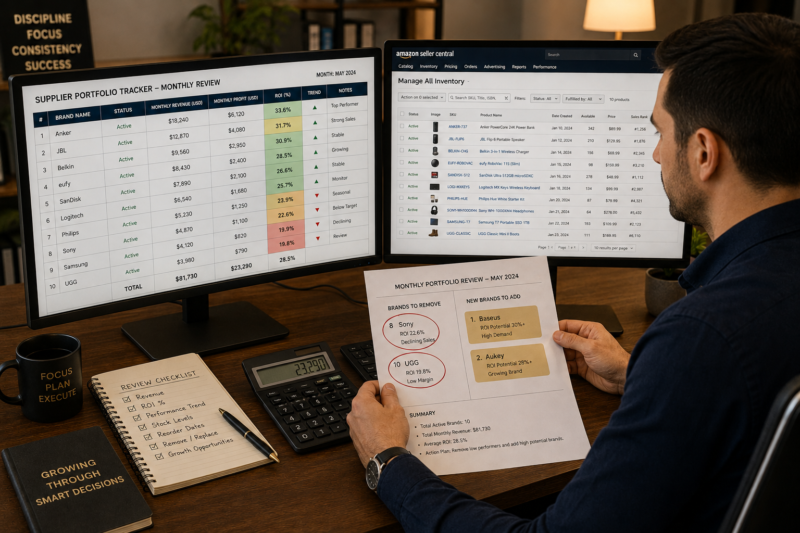
| Review all brands monthly — drop underperformers | First Monday of every month |
| Negotiate pricing at 3 to 4 order milestone | Each supplier individually |
| Reinvest minimum 60% of profits into new stock | Every payout cycle |
| Use SmartScout to find new brand opportunities | Weekly research session |
Conclusion — Consistency Builds the Portfolio
Scaling from one brand to ten brands is not complicated — but it requires consistency discipline and the willingness to keep applying to new suppliers every single week even when your existing brands are performing well. The sellers who reach ten active supplier relationships fastest are the ones who never stop their outreach activity regardless of how busy their current business feels.
Use our Brands Directory as your primary source of new verified wholesale brands to approach every week. Research every product with Keepa. Identify new brand opportunities with SmartScout. Calculate every margin with AMZScout. And treat every week’s outreach as an investment in the business you will have six months from now.
START BUILDING YOUR WHOLESALE SUPPLIER PORTFOLIO TODAY
Browse 5,000+ Verified Wholesale Brands Free
Every brand in the Brandhunterz Directory is verified as authentic and Amazon-compatible — giving you an endless pipeline of new wholesale supplier opportunities to approach every single week as you scale from one brand to ten and beyond.
About the Author
This article is written by the team at Brandhunterz Ltd — a UK registered Amazon FBA wholesale sourcing company (Company No: 15342697) registered in England and Wales since 2023. Visit brandhunterz.com to learn more.