
AMAZON FBA WHOLESALE TIPS
How to Win the Amazon Buy Box as a Wholesale Seller — Complete Guide
By Brandhunterz Ltd | Company No: 15342697 | 13 minute read
Affiliate Disclosure: This article contains affiliate links. If you purchase through our links we may earn a commission at no extra cost to you. We only recommend tools we genuinely use and believe in. Read our full disclaimer.
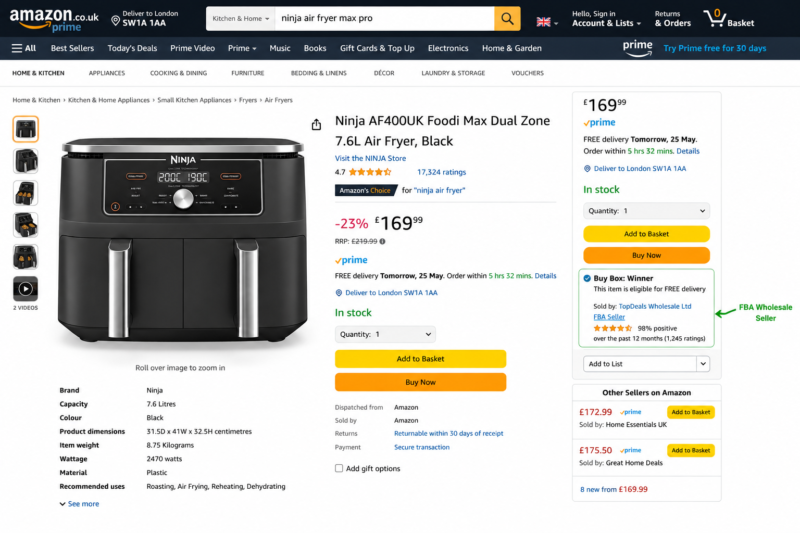
The Amazon Buy Box is the most valuable piece of real estate in ecommerce. It is the white box on the right-hand side of every Amazon product listing containing the Add to Cart and Buy Now buttons. Approximately 82 percent of all Amazon sales go through the Buy Box — meaning if you are not winning it you are not making sales regardless of how good your product or price is.
For Amazon FBA wholesale sellers the Buy Box is both the biggest opportunity and the biggest challenge. You are selling the same product as other sellers on the same listing — which means you cannot compete on product differentiation. Everything comes down to understanding exactly how Amazon decides who wins the Buy Box and optimising every factor within your control.
We are Brandhunterz Ltd — a UK registered wholesale sourcing company (Company No: 15342697) — and in this complete guide we explain exactly how the Amazon Buy Box algorithm works for wholesale sellers, which factors matter most and the specific strategies that consistently win Buy Box share across competitive listings.
💡 Quick Summary
The three most important Buy Box factors for wholesale FBA sellers are fulfilment method (FBA wins over FBM every time), competitive pricing at or near the lowest FBA price on the listing and account health metrics kept consistently in the green. On MAP-enforced listings where all sellers price identically Amazon rotates the Buy Box based on stock availability, account health and fulfilment performance.
What is the Amazon Buy Box and Why Does It Matter?
When multiple sellers offer the same product on Amazon only one seller wins the Buy Box at any given moment — the seller whose offer appears in the main purchase box with the prominent Add to Cart button. All other sellers are listed in the Other Sellers section which very few customers ever click. The Buy Box winner gets the sale. The others get almost nothing.
On listings with multiple competitive sellers Amazon rotates the Buy Box between eligible sellers rather than giving any single seller permanent control. The percentage of time you hold the Buy Box is called your Buy Box percentage — and maximising this percentage across your product portfolio is one of the most impactful things you can do to grow your Amazon FBA wholesale revenue.
| Buy Box Scenario | What Happens to Your Sales |
|---|---|
| You hold Buy Box 100% of time | You receive all sales from the listing |
| You hold Buy Box 50% of time | You receive roughly half of all sales |
| You are not Buy Box eligible | You receive almost zero sales |
| Amazon holds the Buy Box | Third-party sellers rarely get sales |
The Amazon Buy Box Algorithm — How It Actually Works
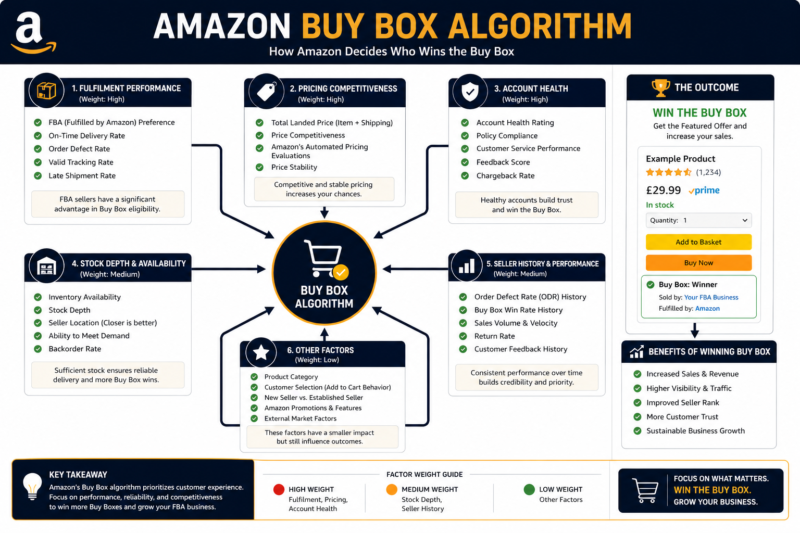
Amazon does not publicly reveal the exact weighting of every Buy Box factor but through extensive seller experience and data analysis the key factors are well understood. Amazon’s goal is simple — give the Buy Box to the seller most likely to deliver the best customer experience at a competitive price. Every factor in the algorithm relates to this core objective.
Factor 1 — Fulfilment Method (Highest Weighting)
Fulfilment method is the single most important Buy Box factor for wholesale sellers. FBA sellers receive a massive algorithmic advantage over FBM (Fulfilled by Merchant) sellers because Amazon’s own fulfilment network guarantees faster delivery, consistent packaging quality and streamlined returns — all of which directly improve customer experience.
| Fulfilment Type | Buy Box Advantage | Recommendation |
|---|---|---|
| Amazon FBA | Highest — Prime badge included | Always use FBA for wholesale |
| Seller Fulfilled Prime | High — Prime eligible but harder to maintain | Only for large established operations |
| FBM Standard | Low — significant disadvantage vs FBA | Avoid for competitive wholesale listings |
Factor 2 — Competitive Pricing
Price is the second most important Buy Box factor. Amazon wants customers to get the best available price — so sellers with lower prices all else being equal receive more Buy Box share. However pricing strategy for wholesale sellers depends heavily on whether the listing has MAP enforcement.
On non-MAP listings you need to price at or very close to the lowest FBA price on the listing to remain competitive for Buy Box share. On MAP-enforced listings where all sellers must price at or above MAP pricing becomes less of a differentiator and other factors like account health and stock availability carry more weight.
💡 The MAP Pricing Buy Box Advantage
On MAP-enforced listings where all sellers price identically Amazon cannot use price as the primary Buy Box factor. Instead it rotates the Buy Box based on fulfilment method, account health, stock depth and seller history. This makes MAP-enforced products particularly attractive for wholesale sellers — you compete on operational excellence rather than on racing to the lowest price.
Factor 3 — Account Health Metrics
Your Amazon seller account health metrics are a critical Buy Box factor. Amazon measures your account health across multiple performance indicators — and sellers with poor metrics are penalised in Buy Box allocation regardless of price or fulfilment method. Keep all of these metrics consistently in the target range:
| Metric | Target | At Risk Below |
|---|---|---|
| Order Defect Rate (ODR) | Under 1% | Above 1% |
| Late Shipment Rate | Under 4% | Above 4% |
| Valid Tracking Rate | Above 95% | Below 95% |
| Seller Feedback Rating | Above 95% positive | Below 90% |
| Pre-Fulfilment Cancel Rate | Under 2.5% | Above 2.5% |
FBA Sellers Have a Major Account Health Advantage
When you fulfil through FBA Amazon handles the picking packing shipping and customer service for every order. This means late shipment rates, valid tracking rates and customer delivery complaints are Amazon’s responsibility — not yours. FBA sellers almost never have account health problems related to fulfilment which gives them a significant structural advantage in Buy Box competition.
Factor 4 — Stock Availability and Depth
Amazon will not give the Buy Box to a seller who is about to run out of stock. If your inventory level drops below a threshold Amazon considers risky your Buy Box share decreases — and if you stock out completely you lose the Buy Box entirely until you restock. Sellers who maintain consistently healthy inventory levels receive proportionally more Buy Box time than those who regularly run low.
Use Keepa to track your sales velocity accurately and set reorder points that ensure you never drop below 21 days of stock cover. A stockout on a competitive wholesale listing can take weeks of consistent selling to recover from in terms of Buy Box allocation — the cost of a stockout is far greater than just the lost sales during the out-of-stock period.
Factor 5 — Seller Experience and History
Amazon gives preferential Buy Box treatment to sellers with longer established trading histories and higher overall sales volumes on the platform. New seller accounts with limited history are at a disadvantage in Buy Box competition against established sellers — even when all other factors are equal. This disadvantage diminishes over time as your account accumulates positive sales history and feedback. Building your account age and sales volume consistently is part of a long-term Buy Box strategy.
Buy Box Strategies for Wholesale Sellers
Strategy 1 — Always Use FBA (Non-Negotiable)
For wholesale sellers the decision to use FBA over FBM is not optional — it is the foundation of your entire Buy Box strategy. The FBA fulfilment advantage is so significant that an FBA seller at slightly higher price will almost always win more Buy Box share than an FBM seller at a lower price. Never ship wholesale orders as FBM on competitive listings.
Strategy 2 — Target MAP-Enforced Products
When sourcing wholesale products prioritise brands with strong MAP enforcement. On MAP-enforced listings you compete on operational factors rather than price — and as an FBA seller with healthy account metrics you are well-positioned to win a fair share of Buy Box rotation without engaging in margin-destroying price wars. Use Keepa price history to identify listings with consistently stable prices — the hallmark of effective MAP enforcement.
Strategy 3 — Price at the Lowest FBA Price
On non-MAP listings match or beat the lowest FBA price on the listing to remain competitive for Buy Box share. You do not need to be the absolute cheapest — you need to be within a small percentage of the lowest FBA price. Amazon’s algorithm considers what it calls the landed price which includes the product price plus shipping. FBA sellers always show free shipping so your landed price equals your listing price.
Strategy 4 — Maintain Inventory Before You Need To
Set automatic reorder triggers at 21 days of stock cover — not when you are almost out. Factor in the full lead time from placing your wholesale order to stock arriving at Amazon FBA — typically 10 to 21 days. Sellers who reorder reactively frequently experience stockouts that cost them Buy Box position. Sellers who reorder proactively maintain consistent Buy Box presence throughout the year. Use AMZScout or Helium 10 to monitor sales velocity and calculate reorder quantities accurately.
Strategy 5 — Monitor and Report MAP Violations
When other sellers violate MAP pricing on your listings they artificially suppress the price and steal Buy Box share by pricing below the floor you are required to maintain. Report MAP violations directly to the brand as soon as you spot them. Most brands have a compliance process and will contact the violating seller — often resulting in the price being corrected within days. This directly restores fair Buy Box rotation for MAP-compliant sellers including yourself.
Strategy 6 — Build Seller Feedback Consistently
Seller feedback directly influences Buy Box eligibility and share. As an FBA seller most negative feedback relates to product issues rather than fulfilment since Amazon handles the shipping. Proactively manage your feedback by monitoring it weekly and responding to any negative reviews promptly and professionally. If a negative review relates to Amazon’s fulfilment rather than the product itself you can request removal as it violates Amazon’s feedback guidelines.
When Amazon Holds the Buy Box — What to Do
The worst Buy Box scenario for a wholesale seller is when Amazon itself holds the Buy Box as both a retailer and the platform operator. Amazon almost never loses the Buy Box to third-party sellers when it is actively selling a product — which is why identifying products that Amazon does not sell is so critical in wholesale product research.
| Amazon Status | What to Do |
|---|---|
| Amazon in stock and holding Buy Box | Avoid this product for wholesale — you will rarely make sales |
| Amazon occasionally goes out of stock | Opportunity — stay stocked and capture Buy Box during Amazon stockouts |
| Amazon not selling — third parties only | Ideal wholesale scenario — compete for Buy Box with other third-party FBA sellers |
Always use Keepa to check whether Amazon is active on any listing before placing a wholesale order. The orange line on a Keepa chart represents Amazon’s price history. A consistently absent orange line means Amazon does not sell this product directly — one of the most positive indicators for a wholesale opportunity you can find.
How to Check Your Buy Box Percentage
Monitoring your Buy Box percentage for each product you sell is essential for identifying underperforming listings and diagnosing why. Here is how to find your Buy Box data in Seller Central:
Go to Seller Central Reports
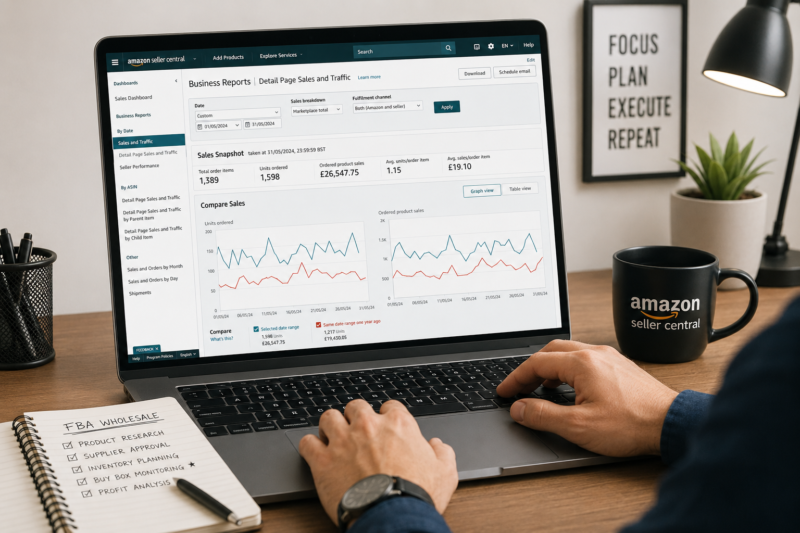
In Seller Central navigate to Reports then Business Reports then Detail Page Sales and Traffic by ASIN. This report shows your Buy Box percentage for each product alongside your sessions conversion rate and units ordered.
Review Buy Box Percentage Column
Your Buy Box percentage is shown as a percentage of page views where you held the Buy Box. A healthy competitive wholesale seller should aim for Buy Box percentage proportional to their share of active sellers on the listing — if there are 4 FBA sellers with similar metrics 25 percent Buy Box share each is a reasonable baseline.
Investigate Low Buy Box Percentages
Any product showing significantly lower Buy Box percentage than expected needs investigation. Check whether Amazon has entered the listing, whether another seller has dropped below MAP, whether your account health has any issues and whether your inventory level has dropped low enough to reduce your Buy Box eligibility.
Repricing for Wholesale Sellers — Should You Use It?
Repricing tools automatically adjust your selling price to remain competitive for the Buy Box. For wholesale sellers the answer to whether you should use repricing depends entirely on whether your products have MAP enforcement.
| Listing Type | Repricing Recommendation | Why |
|---|---|---|
| MAP-enforced listing | Use with floor at MAP price | Prevents accidental MAP violations while staying competitive |
| Non-MAP competitive listing | Yes — recommended | Keeps you competitive without constant manual monitoring |
| Any listing without floor set | Dangerous — never use | Can race to the bottom destroying your margin completely |
Frequently Asked Questions
Can a New Seller Win the Buy Box?
Yes — new FBA sellers can win Buy Box share relatively quickly by pricing competitively, maintaining healthy account metrics and keeping stock available. However new accounts with limited history will receive less Buy Box allocation than established sellers with identical metrics in the early months. This disadvantage reduces as your account accumulates trading history and positive feedback. Focus on building your account during the first 90 days rather than expecting immediate 50 percent plus Buy Box share on competitive listings.
How Long Does it Take to Recover Buy Box After a Stockout?
Recovery time varies by listing competitiveness and the length of your stockout. A brief 1 to 3 day stockout on a listing where you have a strong established history typically recovers within 48 to 72 hours of restocking. A longer stockout of 2 weeks or more on a competitive listing can take 2 to 4 weeks to fully recover as Amazon redistributes your previous Buy Box share to other sellers during your absence.
Does Amazon Always Tell You Your Buy Box Percentage?
Amazon shows Buy Box percentage data in the Business Reports section of Seller Central for products where you are eligible for the Buy Box. However on some listings — particularly those where no third-party seller is currently Buy Box eligible — this data may show as zero or not display at all. Check your Business Reports weekly to monitor Buy Box performance across your product catalogue and use this data to prioritise which listings need intervention.
Can I Win the Buy Box Against Amazon?
In practice no. When Amazon is actively selling a product and has stock available they almost always hold the Buy Box regardless of other sellers’ prices or metrics. The only exception is when Amazon temporarily goes out of stock — at which point third-party FBA sellers can win the Buy Box. This is why the most important wholesale product research criteria is confirming Amazon does not sell the product directly. Use the orange line in Keepa to check Amazon’s historical presence on any listing before ordering.
Related Articles — Keep Learning
- How to Read a Keepa Chart — Complete Beginner’s Guide
- What is MAP Pricing and Why It Matters for Amazon FBA Wholesale Sellers
- How to Calculate Amazon FBA Profit Margins for Wholesale Products
- How to Find Authentic Wholesale Suppliers for Amazon FBA in the UK
- Top 10 Wholesale Product Categories on Amazon UK Right Now
- Browse the Brandhunterz Brands Directory — Free Access
- Amazon FBA and eBay Wholesale Courses by Brandhunterz
FIND BUY BOX WINNING WHOLESALE PRODUCTS
Browse Verified Wholesale Brands — Free Access
The best Buy Box strategy starts with finding the right products. Browse our directory of 5,000+ verified wholesale brands — all FBA-compatible with no Amazon direct selling presence confirmed.
About the Author
This article is written by the team at Brandhunterz Ltd — a UK registered Amazon FBA wholesale sourcing company (Company No: 15342697) registered in England and Wales since 2023. Visit brandhunterz.com to learn more.