HOW TO START AMAZON FBA · 2026
How to Find Your First Wholesale Product to Sell on Amazon FBA
By Brandhunterz Ltd | Company No: 15342697 | 13 minute read
Affiliate Disclosure: This article contains affiliate links. If you purchase through our links we may earn a commission at no extra cost to you. We only recommend tools we genuinely use and believe in. Read our full disclaimer.
Finding your first wholesale product to sell on Amazon FBA is the most exciting and most nerve-wracking step in your journey as a new seller. Get it right and you have a proof of concept — a real profitable product generating real revenue and building your confidence for everything that follows. Get it wrong and you end up with a garage full of stock that will not sell and a lesson in the importance of proper product research that costs you both money and time.
We are Brandhunterz Ltd — a UK registered wholesale sourcing company (Company No: 15342697) — and in this complete guide we walk you through exactly how to find your first profitable wholesale product for Amazon FBA in 2026. This is the exact research process experienced wholesale sellers use — applied step by step for complete beginners starting from scratch.
💡 Quick Summary
Finding your first wholesale product requires three things working together — a category with strong repeat purchase demand, a brand with an active wholesale programme, and product-level data confirming consistent Amazon sales history. Use Keepa to validate sales history, Helium 10 to size the revenue opportunity, and the Brandhunterz Brands Directory to find verified wholesale trade contacts for the brands you identify.
What Makes a Good First Wholesale Product?
Not every product is suitable as a first wholesale sourcing opportunity — especially for a new seller with limited capital and no established brand relationships. The ideal first product for a wholesale Amazon FBA seller has a specific combination of characteristics that minimise risk while maximising your chance of a profitable first experience on the platform.
| Characteristic | Why It Matters for Beginners | Ideal Range |
|---|---|---|
| Sale Price | Too cheap and fees eat your margin. Too expensive and you need large capital investment per unit. | £8 to £25 |
| Sales Rank | Lower rank means more frequent sales. Too low and competition is extreme. Too high and demand is weak. | Under 50,000 in category |
| Number of Sellers | Too few sellers suggests no demand or brand restrictions. Too many means fierce Buy Box competition. | 3 to 15 active sellers |
| Net Margin After FBA | Minimum threshold to justify capital investment and opportunity cost for new sellers. | Minimum 20 percent |
| Product Size | Small standard-size products incur lower FBA fees and are easier to handle and ship to FBA. | Small standard size |
| Repeat Purchase Demand | Consumable products with loyal customers reorder consistently giving you predictable revenue. | Every 4 to 8 weeks |
| Amazon Not Selling Direct | When Amazon sells a product as first-party seller it almost always wins the Buy Box regardless of price. | No Amazon 1P seller |
Step 1 — Choose Your Target Category
The first decision in finding your first wholesale product is choosing which product category to focus on. Trying to research every category simultaneously is one of the most common beginner mistakes — it leads to analysis paralysis and inconsistent sourcing decisions. Pick one category focus your research and build expertise before expanding.
For new wholesale sellers the following categories consistently offer the strongest combination of repeat purchase demand manageable competition accessible minimum order values and a wide range of ungated brands:
⭐ Top Categories for First Wholesale Products
- Health and Beauty — Skincare haircare vitamins oral care deodorants. Outstanding repeat purchase rates and wide brand range with accessible MOQs.
- Household Cleaning — Cleaning sprays washing up liquid laundry detergents. Consistent year-round demand from every household in the UK.
- Vitamins and Supplements — Monthly repeat purchase frequency premium margins and strong brand loyalty. Ideal for building a reliable recurring revenue base.
- Pet Supplies — Dog food treats and accessories. Emotionally driven brand loyalty creating exceptional repeat purchase demand.
- Baby and Childcare — Nappies wipes baby food. Daily consumption products with extremely high purchase frequency.
Step 2 — Research Brands Using Amazon Best Sellers
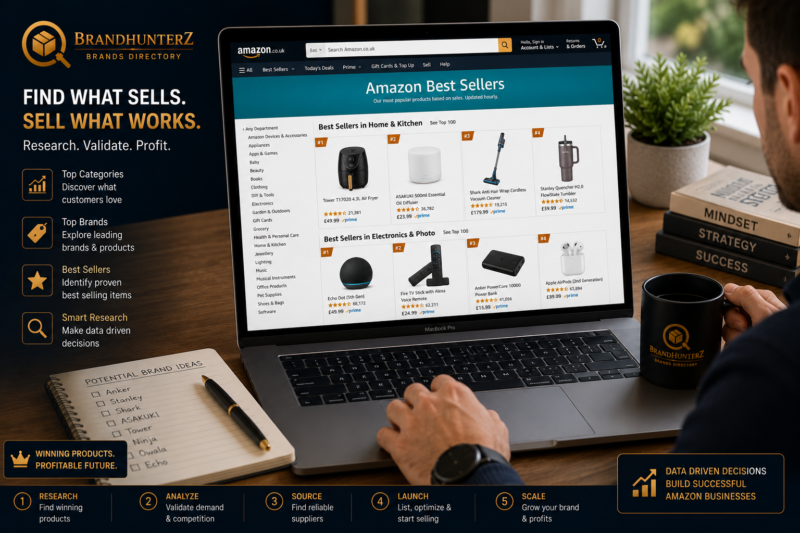
With your target category chosen start building a list of brand names to research. The Amazon Best Sellers list is your most powerful free research tool at this stage. It shows you exactly which brands and products consumers are already buying in the highest volumes — verified by real sales data updated hourly.
Navigate to the Amazon UK Best Sellers Page
Go to amazon.co.uk and click Best Sellers in the top navigation. Select your target category from the left-hand subcategory list. Drill down into specific subcategories — for example within Health and Beauty go into Vitamins and Supplements then into specific product types like Vitamin C or Omega 3.
Note Every Brand in the Top 50
Work through the top 50 products in your target subcategory and note the brand name for every product. Some brands will appear multiple times — this is a strong signal of a brand with broad consumer demand and multiple popular SKUs. Build a list of 20 to 30 brand names to research further.
Filter Out Private Label and Amazon Basics Products
Remove any products sold by Amazon itself under its own brands (Amazon Basics Solimo Morrisons own label etc.) and any obvious private label products with no established brand identity. You are looking for established third-party consumer brands with a history of wholesale distribution — not Amazon’s own products or small seller private labels.
Check Each Brand Against the Brandhunterz Directory
Cross-reference your brand shortlist against the Brandhunterz Brands Directory to instantly confirm which brands have verified wholesale programmes and available trade contact details. This step filters your shortlist down to brands you can actually approach immediately — saving hours of manual research into brands with no trade programme.
Step 3 — Validate Demand With Keepa
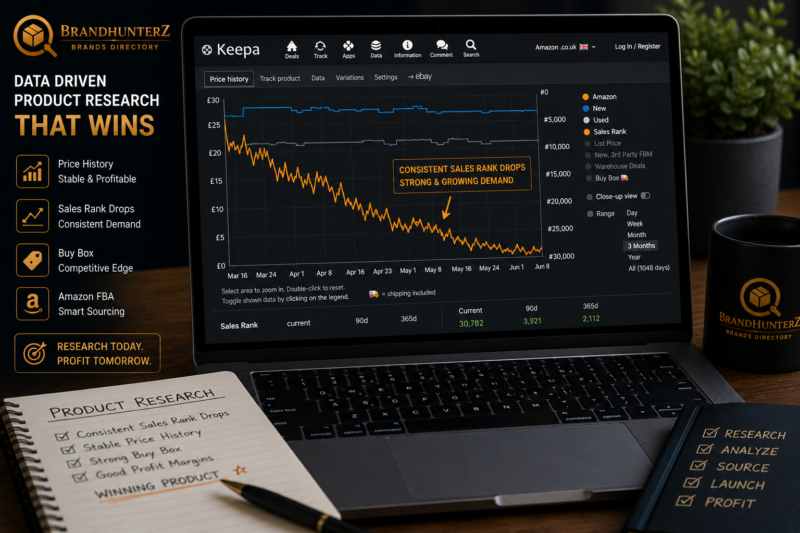
Keepa is the non-negotiable tool for validating product demand before you source any wholesale stock. It shows you the complete sales history of every Amazon product going back months or years — giving you the data to confirm genuine consistent demand rather than guessing based on a snapshot of the Best Sellers list.
For each brand on your shortlist pull up the top 3 to 5 products on Keepa and analyse the following data points:
Sales Rank History
The orange sales rank line on the Keepa graph shows how a product’s position in its category has changed over time. Every drop in the line represents a sale event. Look for consistent regular drops across all 12 months — this confirms genuine repeat purchase demand rather than seasonal spikes or one-off viral moments. A product with consistent drops every 2 to 5 days is selling steadily. A product with occasional spikes and long flat periods is not.
Buy Box Price History
The Buy Box price line shows how the product’s selling price has moved over the past 12 months. You want to see a stable or slowly increasing price — this indicates a healthy selling environment where sellers are not undercutting each other into a race to the bottom. A product with a declining price trend over the past 6 months is in a deteriorating competitive environment and should be avoided for your first product.
New Seller Count
The number of new sellers graph shows how many third-party sellers are offering the product and how that number has changed over time. Between 3 and 15 active sellers is the sweet spot for wholesale products — enough competition to confirm the product is genuinely available to resellers but not so many that Buy Box time is spread impossibly thin. If Amazon itself holds the Buy Box as a first-party seller treat that as a red flag and remove the product from your shortlist.
💡 The Keepa Green Light Checklist
Before adding any product to your active sourcing list it must pass all five of these Keepa checks: (1) Consistent rank drops over 12 months, (2) Stable or rising Buy Box price over 12 months, (3) Between 3 and 15 active third-party sellers, (4) Amazon not holding Buy Box as first-party seller, (5) Sales rank under 50,000 in its subcategory. Any product that fails even one of these checks should be removed from your shortlist and replaced with a better opportunity.
Step 4 — Size the Revenue Opportunity With Helium 10
Once a product passes your Keepa validation check the next step is understanding the total revenue opportunity. Helium 10 gives you estimated monthly revenue and unit sales data for any Amazon product — helping you understand whether the market is large enough to justify the time and capital investment required to open a wholesale account and source the product.
Use the Helium 10 Chrome Extension on Amazon
Install the Helium 10 Chrome extension and open it on the Amazon product page for your shortlisted product. The X-Ray tool shows you estimated monthly revenue monthly unit sales review count and other key metrics for every seller on the listing — giving you a complete picture of the market size for that specific product.
Check the Total Monthly Revenue for the Listing
Look at the total estimated monthly revenue shown for the top sellers on the listing. For wholesale products you need the total market size to be large enough to justify your participation. As a general guide the top sellers on a product listing should collectively be generating at least £3,000 to £5,000 per month in revenue — confirming enough demand for multiple sellers to share profitably.
Use Cerebro to Check Keyword Demand Depth
Run a Cerebro reverse ASIN search on the product’s ASIN to see which keywords are driving its sales. A product with 10 to 20 high search volume keywords confirms broad organic search demand — meaning its sales are not dependent on a single keyword that could disappear from search results. Strong keyword diversity confirms sustainable long-term demand.
Set a Minimum Revenue Threshold
Only shortlist products where the top 3 ASINs for a brand collectively show combined estimated monthly revenue of at least £3,000 per month. This ensures the market is large enough for a new third-party seller to capture a meaningful share of Buy Box time and generate a return worth the effort of opening the wholesale account.
Step 5 — Calculate Your Profit Margin
Before you contact any brand to apply for a wholesale trade account you must calculate your expected profit margin based on the product’s current Amazon selling price and the estimated wholesale cost. Never contact a brand without first confirming the margin makes sense — you do not want to open a trade account invest time in a brand relationship and then discover the margin is too thin after receiving the price list.
For most wholesale brands you can estimate the wholesale cost by working backwards from the retail price. Typical wholesale prices for branded consumer goods are 35 to 55 percent below the recommended retail price (RRP). Use this estimate to run your margin calculation before approaching the brand — and then refine the calculation with the actual wholesale price once you receive the brand’s price list.
| Worked Example | Amount |
|---|---|
| Current Amazon Buy Box Price | £14.99 |
| Estimated Wholesale Cost (50% off RRP) | £5.50 |
| Amazon Referral Fee (15%) | – £2.25 |
| FBA Fulfilment Fee (small standard) | – £2.85 |
| Inbound Shipping Cost | – £0.30 |
| Estimated Net Profit Per Unit | £4.09 (27% margin) |
| Verdict | ✓ Worth pursuing — above 20% threshold |
Step 6 — Contact the Brand and Apply for a Trade Account
With your Keepa data validated your Helium 10 revenue check passed and your margin calculation confirming a viable opportunity the next step is contacting the brand to apply for a wholesale trade account. This is where the Brandhunterz Brands Directory becomes invaluable — it gives you the verified direct trade contact details for hundreds of brands without the hours of manual research required to find the right contact person at each brand.
When writing your trade account application email keep it concise professional and focused on what you can offer the brand rather than what you need from them. Include your company name and registration number your Amazon seller profile URL your target sales channels and a specific question about their wholesale application process or minimum order requirements.
Do Not Mention Amazon in Your First Application Email
Many brands have reservations about their products being sold on Amazon because of pricing control concerns. In your first trade account application email focus on your business your customer base and your sales channels generally — rather than specifically mentioning Amazon. Once you have established a trade relationship and opened an account you can clarify the specific channels you intend to use.

Common First Product Mistakes to Avoid
Choosing a Product Because You Personally Like It
Your personal preferences are completely irrelevant in wholesale product research. A product you love but that Keepa shows selling poorly is a bad product. A product you have never heard of but that Keepa shows with consistent drops every 48 hours and a stable price is an excellent product. Let the data guide you — not your gut.
Sourcing Seasonal Products as Your First Product
Seasonal products — Christmas decorations Halloween costumes garden furniture — look like strong opportunities when you research them in their peak season. But Keepa data will show the full picture including the long flat periods when the product barely sells. For your first wholesale product choose something with consistent 12-month demand that generates revenue every week of the year.
Ordering Too Much Stock on Your First Order
Even with solid Keepa data validating demand always place a conservative first order at or close to the minimum order value. Keepa shows historical demand — not a guarantee of future performance for your specific listing. Validate your actual sales velocity before committing to larger repeat orders. You can always reorder quickly once a product proves itself.
Skipping the Margin Calculation and Guessing
Running a proper margin calculation before every order is not optional — it is the most important financial discipline you can build as an Amazon FBA seller. Use the Amazon FBA Revenue Calculator for every product before ordering. Many experienced sellers have lost money on products they assumed were profitable without checking the actual fee structure. Never guess your margins.
Frequently Asked Questions
How Many Products Should I Source in My First Month?
Focus on getting 2 to 3 products right in your first month rather than spreading your research budget across 10 products simultaneously. The discipline of doing deep research on a small number of high-confidence opportunities builds better habits and produces better results than chasing volume before you have validated your process. Once your first products are selling profitably scale your sourcing activity.
What Sales Rank Should My First Product Have?
A sales rank under 50,000 in its main category is a good starting benchmark for wholesale products. However sales rank numbers vary significantly by category — a rank of 5,000 in Vitamins means something very different to a rank of 5,000 in Books. Focus on consistent rank drops on the Keepa graph rather than the absolute rank number and use Helium 10 to confirm monthly revenue regardless of where the rank sits.
Should I Focus on One Brand or Multiple Brands for My First Order?
Apply to multiple brands simultaneously — aim for 10 to 15 applications per week — but only place actual orders with brands where you have completed the full research process. Applying to one brand at a time is extremely inefficient because most brands take 1 to 4 weeks to respond and many will decline your application. Casting a wide net in applications while being selective in ordering decisions is the right balance for new sellers.
Is It Better to Focus on High-Margin Low-Volume or Low-Margin High-Volume Products?
For beginners high-margin products are generally safer because they give you more room for error. A 30 percent margin product remains profitable even if your actual sales velocity is 30 percent lower than expected. A 15 percent margin product becomes a loss-maker if anything goes slightly wrong. Always prioritise margin quality over volume in your early sourcing decisions and add volume as your experience and confidence grows.
Related Articles — Keep Learning
- How to Start Amazon FBA in 2026 — Complete Beginner Guide
- Amazon FBA vs FBM — Which Model is Right for You in 2026
- How to Calculate Amazon FBA Fees and Profit Margins
- How to Send Your First Shipment to Amazon FBA Warehouses
- How to Read a Keepa Graph for Amazon FBA Wholesale Research
- How to Get Ungated on Amazon — A Beginner’s Guide
- Browse the Brandhunterz Brands Directory — Free Access
- Amazon FBA and eBay Wholesale Courses by Brandhunterz
START YOUR PRODUCT RESEARCH TODAY
Find Verified Wholesale Brands — Free Access
The Brandhunterz Brands Directory gives you instant free access to verified wholesale brands with real trade contacts minimum order values and confirmed Amazon FBA approval status — everything you need to shortlist your first wholesale brand today.
About the Author
This article is written by the team at Brandhunterz Ltd — a UK registered Amazon FBA wholesale sourcing company (Company No: 15342697) registered in England and Wales since 2023. Visit brandhunterz.com to learn more.