
AMAZON FBA PRODUCT RESEARCH
How to Research Amazon FBA Products — Complete Beginner’s Guide
By Brandhunterz Ltd | Company No: 15342697 | 14 minute read
Affiliate Disclosure: This article contains affiliate links. If you purchase through our links we may earn a commission at no extra cost to you. We only recommend tools we genuinely use and believe in. Read our full disclaimer.
Product research is the single most important skill you will develop as an Amazon FBA wholesale seller. Every profitable product in your FBA business starts with a research decision — made before a single pound of capital is committed. Get the research right and your stock sells consistently at healthy margins. Get it wrong and your capital sits in slow-moving inventory generating storage fees and eroding your confidence. The difference between these two outcomes is not luck — it is a systematic research process applied without exception to every product before every order.
We are Brandhunterz Ltd — a UK registered wholesale sourcing company (Company No: 15342697) — and in this complete beginner’s guide we explain exactly how to research Amazon FBA products from scratch. We cover the full research process step by step — from identifying candidate products through to validating demand confirming margins checking competition and making a final go or no-go decision — using the same tools and criteria we apply to every product we source.
💡 Quick Summary
Amazon FBA product research for wholesale sellers has five stages — identifying candidate products from Amazon Best Sellers or brand catalogues validating 12-month sales history on Keepa confirming Amazon is not active on the listing checking competitor seller count and calculating your exact margin using AMZScout or Helium 10. Every product must pass all five stages before you place an order. Skip any stage and you are gambling with your capital rather than making a data-driven sourcing decision.
Why Product Research is Non-Negotiable for Wholesale FBA Sellers
Unlike private label sellers who can pivot a listing wholesale FBA sellers are tied to existing Amazon listings. When you order wholesale stock you are committing capital to a specific product on a specific listing at a specific price point. If the listing has declining sales Amazon competition or price erosion you have no ability to change the product — only to sell through your stock as fast as possible and cut your losses. This is why thorough research before ordering is not optional — it is the foundation of every profitable wholesale sourcing decision.
| Research Outcome | Business Impact |
|---|---|
| Thorough research before ordering | Stock sells at target velocity — capital recycled into next order — business grows |
| Skipped or rushed research | Slow-moving stock — storage fees accumulate — capital locked up — cashflow damaged |
| No Amazon presence check | Amazon enters listing — Buy Box lost — stock sold at breakeven or loss |
| No margin calculation before ordering | FBA fees exceed expectations — selling at a loss without realising it |
The Five Stage Amazon FBA Product Research Process
Every Amazon FBA product you consider sourcing must pass through all five research stages in sequence. These stages are ordered deliberately — each one narrows your shortlist further so you only invest time in products that have already passed the earlier filters.
| Stage | Research Stage | Tool Used | Pass Criteria |
|---|---|---|---|
| 1 | Product Discovery | Amazon Best Sellers — SmartScout | BSR under 50,000 in main category |
| 2 | Sales History Validation | Keepa | 12 months consistent BSR drops |
| 3 | Amazon Presence Check | Keepa | Orange line absent — Amazon not selling |
| 4 | Competition Analysis | AMZScout | Under 5 active FBA sellers on listing |
| 5 | Margin Calculation | AMZScout or Helium 10 | Minimum 30% ROI after all FBA fees |
Stage 1 — Product Discovery
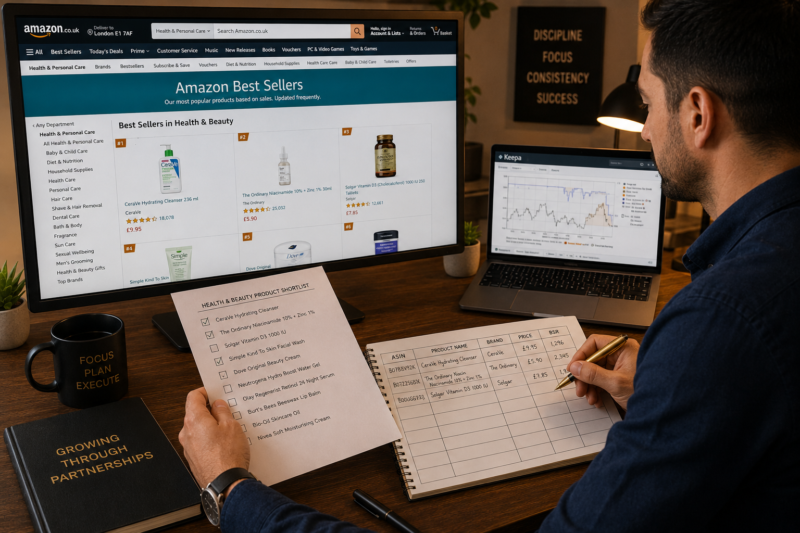
Product discovery is the process of identifying which products on Amazon are worth investigating further. For wholesale FBA sellers discovery always starts with Amazon’s own data — the Best Sellers list — which gives you a ranked list of the highest-selling products in every category updated hourly. A product in the Amazon Best Sellers list already has confirmed demand. Your job at this stage is not to validate demand — it is simply to build a shortlist of products worth putting through the full research process.
How to Use Amazon Best Sellers for Product Discovery
Go to Amazon Best Sellers in Your Target Category
Navigate to amazon.co.uk then click Best Sellers in the top navigation. Select your target category — Health and Beauty Pet Supplies Home and Kitchen Grocery or whichever category aligns with your sourcing focus. Browse the top 100 products and note the brand names on products ranked between position 20 and 100 — these have strong demand but are less likely to be Amazon-own products than the top 10.
Filter by Product Characteristics
At the discovery stage filter out products that are clearly unsuitable for wholesale FBA sourcing — branded electronics requiring authorised dealer status oversized items with high FBA fees products under £7 selling price where margins are structurally too thin and consumables with very short shelf lives that carry high FBA storage risk. Focus on products priced between £10 and £40 that are small to medium size and from recognisable branded manufacturers.
Build Your Research Shortlist
Record the ASIN product name brand and current selling price for each shortlisted product in a simple spreadsheet. Aim for 10 to 20 products per research session. This shortlist feeds directly into Stage 2 — never commit to any product from the shortlist until it has passed all five stages.
Stage 2 — Sales History Validation on Keepa
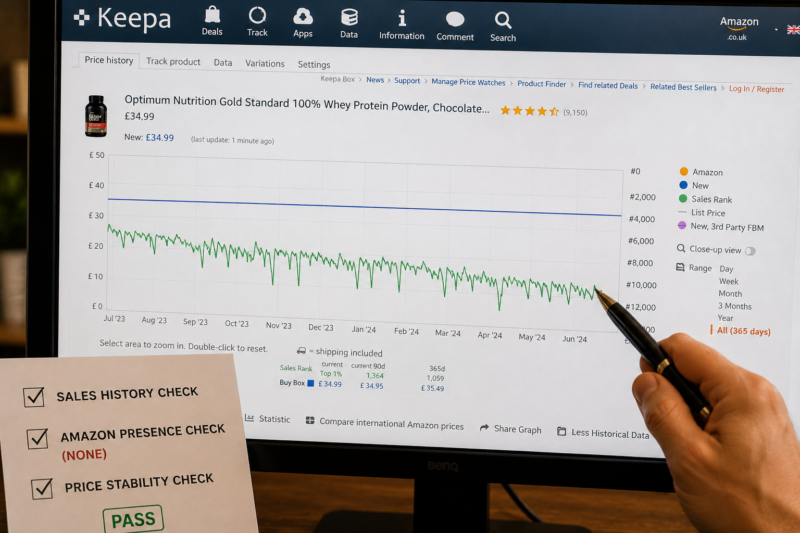
Keepa is the most important tool in the Amazon FBA product research process. It tracks the complete price and sales rank history of every product on Amazon — giving you up to two years of historical data that shows exactly how consistently a product has been selling long before you invest any capital in it.
For every product on your discovery shortlist open its Keepa chart and check the following three things in this exact order:
Keepa Check 1 — The Sales Rank History
The green line on the Keepa chart shows the product’s Amazon Best Seller Rank over time. Every time the rank drops — a lower number means higher sales — it indicates the product has sold. The pattern you are looking for is regular consistent rank drops across the entire 12-month period — confirming the product sells reliably year-round not just occasionally.
| BSR Pattern | What it Means | Action |
|---|---|---|
| Regular drops every few days — 12 months consistent | Strong consistent demand | ✅ Proceed to Check 2 |
| Drops only in November and December — flat rest of year | Seasonal product — Q4 only | ⚠️ Source for Q4 only |
| Mostly flat line — occasional single spike then flat again | Very slow seller | ❌ Remove from shortlist |
| Declining rank trend — fewer drops month on month | Losing popularity | ❌ Remove from shortlist |
Keepa Check 2 — The Amazon Presence Line
The orange line on the Keepa chart shows when Amazon itself is actively selling on the listing. When Amazon holds the Buy Box on a listing third-party sellers receive almost no sales — making it commercially unviable to stock that product through wholesale. This is the single most important check in the entire product research process.
🚫 The Orange Line Rule — Non-Negotiable
If the orange line appears consistently on the Keepa chart — even for part of the year — do not order that product regardless of how attractive the margin or sales velocity looks. Amazon entering the listing later after you have committed stock is one of the most common and most painful experiences in wholesale FBA. The Keepa history tells you whether Amazon has a habit of entering this listing. Trust the data not your optimism.
Keepa Check 3 — Price Stability
The blue line on the Keepa chart shows the Buy Box price history. What you want to see is a stable or gently rising blue line over the past 12 months — indicating that the selling price has held firm and that seller competition has not driven prices down over time. A declining blue line — prices falling month over month — signals margin compression that will continue to erode your profitability with every passing month.
Stage 3 — Competition Analysis
Once a product passes the Keepa validation checks the next step is analysing how many sellers are competing on the listing and what their pricing strategies look like. The goal is to find products where you can enter the Buy Box rotation without being squeezed out by an oversaturated seller pool driving prices below your margin threshold.
| Active FBA Sellers on Listing | Competition Level | Recommendation |
|---|---|---|
| 1 to 3 sellers | Low — excellent opportunity | ✅ Strong go |
| 4 to 6 sellers | Manageable — viable | ✅ Go — check pricing |
| 7 to 12 sellers | High — proceed with caution | ⚠️ Only if margins strong |
| 13 or more sellers | Saturated — avoid | ❌ Remove from shortlist |
Stage 4 — Margin Calculation
Every product that passes Stages 1 through 3 must have its full FBA margin calculated before you approach any supplier. Use the Amazon FBA Revenue Calculator inside Seller Central or a dedicated tool like AMZScout to input the expected wholesale buy price and calculate your exact net profit after every Amazon fee.
FULL MARGIN CALCULATION — EVERY COST INCLUDED
| Average Buy Box Selling Price (from Keepa) | £16.99 |
| Amazon Referral Fee (8% Health and Beauty) | – £1.36 |
| FBA Fulfilment Fee (small standard size) | – £2.40 |
| FBA Storage Fee (monthly allocation per unit) | – £0.15 |
| Inbound Shipping to FBA (per unit estimate) | – £0.25 |
| Estimated Wholesale Buy Price | – £5.50 |
| NET PROFIT PER UNIT | £7.33 — ROI 133% ✅ |
💡 The 30% ROI Minimum Rule
Never order a product where your calculated ROI is below 30 percent. This buffer accounts for unexpected costs — price competition forcing small price reductions storage fees on slower months and the occasional return or damaged unit. A product showing exactly 30 percent ROI in research will often deliver 20 to 25 percent in practice. A product showing 20 percent in research will often break even or make a loss. The 30 percent minimum is not conservative — it is the minimum required to run a resilient wholesale business.
Stage 5 — Final Go or No-Go Decision
Once all four previous stages are complete you make your final decision. This decision is binary — you either proceed to find and contact the wholesale supplier or you remove the product from your shortlist entirely. There is no grey area. Use this final checklist to make a clean data-driven decision every time:
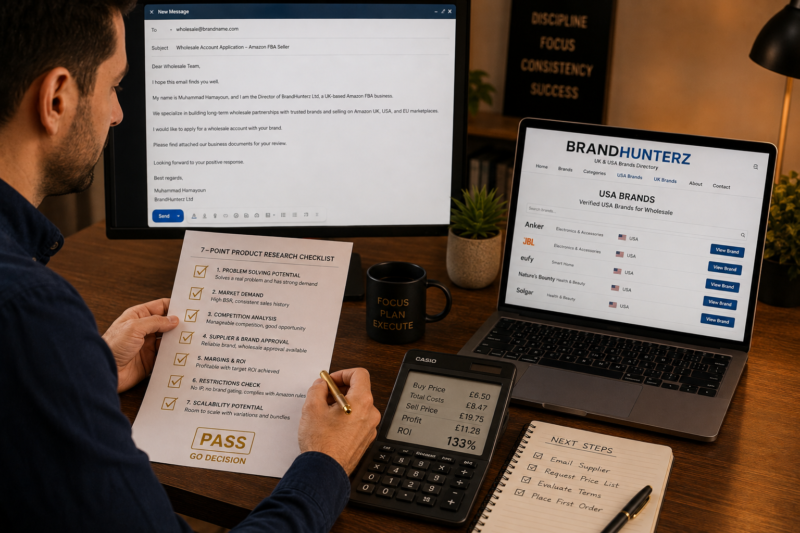
| Final Research Checklist | Pass Required |
|---|---|
| BSR under 50,000 in main category confirmed | ✅ Yes |
| 12 months consistent Keepa BSR drops confirmed | ✅ Yes |
| Amazon orange line absent on Keepa — not selling on listing | ✅ Yes |
| Buy Box price stable or rising — no downward trend | ✅ Yes |
| Under 6 active FBA sellers on listing confirmed | ✅ Yes |
| Minimum 30% ROI confirmed after all FBA fees | ✅ Yes |
| Gating status checked in Seller Central | ✅ Yes |
| All 7 checks passed — proceed to supplier outreach | ✅ GO |
How Many Products Should You Research to Find One Winner?
New sellers are often surprised by how many products they need to research to find one that passes all five stages. This is entirely normal — and understanding the realistic conversion rate through your research funnel helps you build the right weekly research habit:
| Research Funnel Stage | Products Remaining | Drop-Off Reason |
|---|---|---|
| Discovery shortlist | 20 products | Starting point |
| After Keepa BSR check | 10 to 12 products | Inconsistent or seasonal sales |
| After Amazon presence check | 5 to 7 products | Amazon active on listing |
| After competition check | 3 to 4 products | Too many sellers — saturated |
| After margin calculation | 1 to 3 products | Margin below 30% threshold |
| Viable products to pursue with suppliers | 1 to 3 from 20 | Normal and expected conversion rate |
Conclusion — Research Every Product Without Exception
The five-stage research process described in this guide is not optional and it is not something you apply only to products you are unsure about. It applies to every single product you consider sourcing — every time — without exception. The sellers who lose money on wholesale FBA are almost always those who cut corners in their research believing their instinct is more reliable than the data. It is not. The data is always more reliable.
Subscribe to Keepa for sales history validation. Use AMZScout or Helium 10 for margin calculations. Find the wholesale brands behind the products you discover through our Brands Directory. And apply this research process to every product every time.
START RESEARCHING YOUR FIRST WHOLESALE PRODUCT TODAY
Browse 5,000+ Verified Wholesale Brands Free
Once you have identified a product that passes all five research stages find the wholesale supplier behind it in the Brandhunterz Brands Directory — verified authentic contacts ready for your trade account application today.
About the Author
This article is written by the team at Brandhunterz Ltd — a UK registered Amazon FBA wholesale sourcing company (Company No: 15342697) registered in England and Wales since 2023. Visit brandhunterz.com to learn more.