
AMAZON FBA WHOLESALE TIPS
Amazon FBA vs FBM — Which is Better for Wholesale Sellers?
By Brandhunterz Ltd | Company No: 15342697 | 13 minute read
Affiliate Disclosure: This article contains affiliate links. If you purchase through our links we may earn a commission at no extra cost to you. We only recommend tools we genuinely use and believe in. Read our full disclaimer.
When you start selling on Amazon as a wholesale seller one of the first decisions you face is whether to fulfil your orders through Amazon FBA — Fulfilled by Amazon — or FBM — Fulfilled by Merchant. This decision has a profound impact on your Buy Box eligibility, your margins, your time investment and ultimately how fast your wholesale business can scale.
We are Brandhunterz Ltd — a UK registered wholesale sourcing company (Company No: 15342697) — and in this complete guide we break down both fulfilment models honestly so you can make the right decision for your wholesale business from day one.
💡 Quick Summary
For Amazon wholesale sellers FBA is almost always the better choice. FBA gives you Buy Box eligibility, Prime badge, hands-free fulfilment and higher customer trust — all critical for competing on shared wholesale listings. FBM makes sense only in specific situations such as large oversize products, very slow-moving items or as a temporary backup during FBA stock transfers.
What is Amazon FBA?
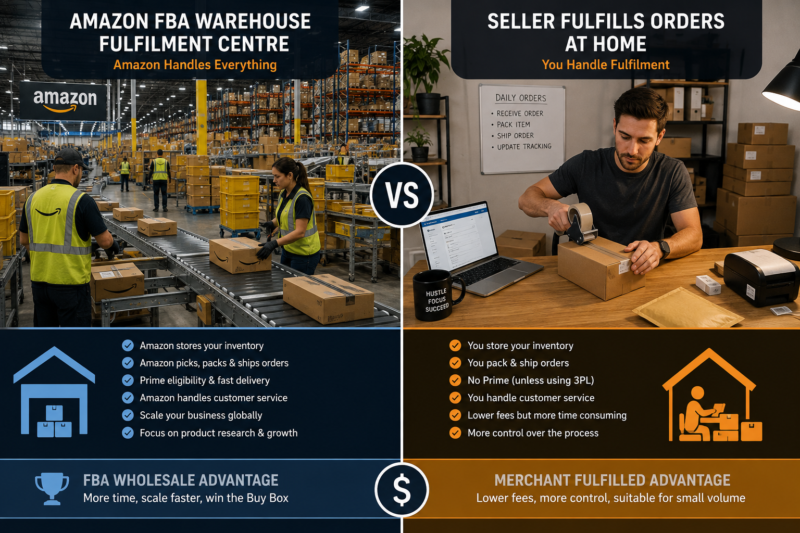
Fulfilled by Amazon (FBA) means you ship your wholesale inventory to Amazon’s fulfilment centres and Amazon handles everything else — storage, picking, packing, shipping, customer service and returns for every order. When a customer places an order Amazon dispatches the product directly from their warehouse, typically with next-day or two-day Prime delivery.
You pay Amazon a fulfilment fee per unit sold and a monthly storage fee based on the space your inventory occupies. In return you get access to Amazon’s entire logistics network, the Prime badge on your listings and the significant Buy Box advantage that comes with FBA fulfilment.
What is Amazon FBM?
Fulfilled by Merchant (FBM) means you store your wholesale inventory yourself — at your home, office or a third-party warehouse — and ship each order to the customer directly when it is placed. You handle all pick, pack and ship operations yourself or through a third-party logistics provider. Amazon charges no fulfilment or storage fees under FBM but you bear all the cost and time of fulfilment yourself.
Head to Head — FBA vs FBM for Wholesale Sellers
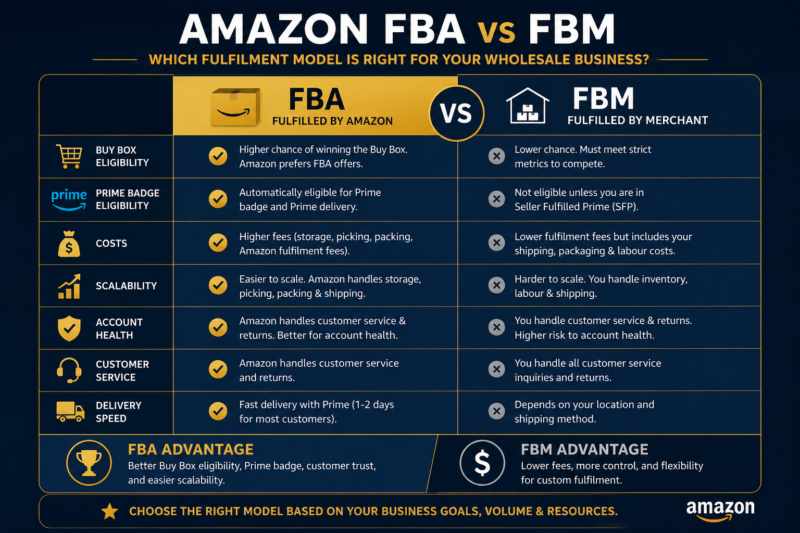
| Factor | FBA | FBM |
|---|---|---|
| Buy Box Eligibility | Strong advantage | Significant disadvantage |
| Prime Badge | Yes — automatic | No — unless SFP |
| Time Investment | Minimal after shipment sent | High — pack and ship every order |
| Storage Cost | Amazon storage fees apply | Your own — often cheaper |
| Fulfilment Cost | FBA fee per unit sold | Your postage and packaging |
| Scalability | Unlimited — Amazon scales with you | Limited by your capacity |
| Customer Service | Handled by Amazon | Handled by you |
| Returns Handling | Handled by Amazon | Handled by you |
| Account Health Risk | Low — Amazon controls fulfilment | Higher — late shipments damage metrics |
| Oversize Products | Very expensive fees | Can be more cost effective |
Why FBA Wins for Wholesale Sellers — The Critical Reasons
Reason 1 — The Buy Box Advantage is Non-Negotiable
In Amazon FBA wholesale you share every listing with other sellers. The Buy Box — the Add to Cart button that generates over 80 percent of all sales — is won primarily by FBA sellers. FBM sellers are at a massive structural disadvantage in Buy Box competition against FBA sellers even when pricing lower. On a competitive wholesale listing with 3 FBA sellers and 1 FBM seller the FBM seller may receive as little as 2 to 5 percent of total sales regardless of their price.
Always verify this dynamic before choosing any wholesale product. Use Keepa to check historical Buy Box ownership and pricing patterns on any listing you are considering. Products where the Buy Box has been consistently held by FBA sellers at stable prices are the ideal wholesale opportunities.
Reason 2 — The Prime Badge Drives Conversion
FBA listings automatically display the Amazon Prime badge — signalling to customers that the product will be delivered quickly and reliably with free returns. Prime members — who account for a significant proportion of Amazon UK buyers — strongly prefer Prime-eligible listings and often filter specifically for Prime products. An FBM listing without the Prime badge loses a significant portion of potential buyers before they even see the price.
Reason 3 — FBA Frees Your Time to Focus on Sourcing
The most valuable activity in your Amazon FBA wholesale business is finding and securing new wholesale supplier relationships — not packing individual customer orders. FBM requires you to personally pick pack and ship every customer order within the promised dispatch time. At 10 orders per day this is manageable. At 50 or 100 orders per day it becomes a full-time job that prevents you from doing any sourcing research at all.
FBA eliminates this entirely. Once you send a shipment to Amazon you spend your time researching new products with Helium 10 and AMZScout, contacting new wholesale brands and managing your supplier relationships — the activities that actually grow your business.
Reason 4 — Account Health is Protected
With FBM your account health is directly tied to your fulfilment performance — late shipments, invalid tracking numbers and customer service response times all affect your metrics and therefore your Buy Box eligibility. One bad week of fulfilment can damage account health that takes months to recover. With FBA Amazon handles all fulfilment — meaning your late shipment rate is essentially zero and your tracking rate is always 100 percent. FBA sellers almost never experience account health problems related to fulfilment performance.
Reason 5 — FBA Scales Infinitely
As your wholesale business grows from 10 orders per day to 100 to 500 FBA handles every additional unit without any additional effort or infrastructure on your part. FBM scales poorly — each additional order requires proportionally more time, space and staff. The wholesale sellers who reach five and six figure monthly revenues almost universally use FBA because it is the only fulfilment model that scales at the pace wholesale growth demands.
When FBM Makes Sense for Wholesale Sellers
While FBA is the right choice for the overwhelming majority of wholesale products there are specific situations where FBM is the more practical or cost-effective option:
Large or Heavy Oversize Products
Amazon FBA fees for oversize products — anything heavier than 1.8kg or larger than standard dimensions — can be extremely expensive, sometimes exceeding your entire profit margin on certain products. For large wholesale items like furniture garden equipment or bulky home goods FBM with your own courier arrangement can be significantly more cost-effective. Always calculate the exact FBA fee for any oversize product using the Amazon FBA calculator before committing to FBA fulfilment.
Very Slow-Moving Products
Products that sell fewer than 2 to 3 units per month accumulate monthly storage fees at Amazon FBA that can erode your margin significantly — particularly during the higher-rate Q4 storage period. If a product sells very slowly and storage fees are eating your profit FBM keeps the stock at your location at no ongoing storage cost until it sells. Always check expected sales velocity using Keepa before deciding on fulfilment method.
Temporary Bridge During FBA Stock Transfer
When your FBA stock runs out and your next shipment is in transit but not yet received at Amazon’s warehouse you can temporarily list the same product as FBM from your own stock to maintain sales continuity. This prevents a complete stockout and maintains your listing’s sales history and rank — even though your FBM Buy Box share will be very low. Switch back to FBA-only once your new stock is checked in at Amazon.
Hazardous or Restricted Category Products
Certain product categories — including some aerosols, lithium batteries and flammable items — are subject to FBA hazmat restrictions that make FBA storage either complex or unavailable. For these products FBM may be the only practical fulfilment option. Always check Amazon’s FBA product restrictions before sourcing any product in potentially restricted categories.
The Real Cost Comparison — FBA vs FBM
Many sellers assume FBM is cheaper than FBA because there are no Amazon fulfilment fees. This is often incorrect when you account for all the real costs of self-fulfilment. Here is a worked cost comparison for a typical standard-size wholesale product:
| Cost Component | FBA Per Unit | FBM Per Unit |
|---|---|---|
| Amazon Fulfilment Fee | £2.50 | £0.00 |
| Your Postage Cost | £0.00 | £2.80 |
| Packaging Materials | £0.00 | £0.25 |
| Your Time (packing at £12/hr) | £0.00 | £0.40 |
| Storage Fee (monthly allocation) | £0.10 | £0.00 |
| Total Fulfilment Cost Per Unit | £2.60 | £3.45 |
In this example FBA is actually £0.85 cheaper per unit than FBM when you account for the real cost of self-fulfilment — and FBA gives you substantially better Buy Box eligibility, the Prime badge and completely hands-free operations. The perception that FBM saves money is frequently wrong for standard-size products.
How to Send Your First FBA Shipment — Overview
Once you have your wholesale stock and have decided to fulfil through FBA here is the process for getting your inventory into Amazon’s fulfilment centres:
List Your Products in Seller Central
Search for each product by ASIN or EAN in Seller Central and add yourself as a seller on the existing listing. Set your price at or above MAP and select Fulfilled by Amazon as your fulfilment method. Do not set a quantity yet — this gets confirmed during the shipment creation process.
Create an FBA Shipment Plan
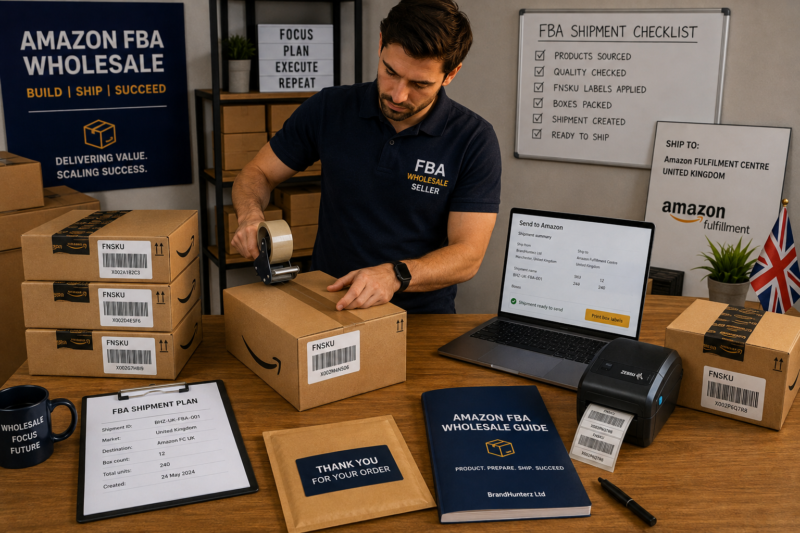
Go to Manage FBA Inventory and select Send to Amazon. Follow the shipment creation workflow — enter your product quantities, confirm your product preparation requirements and apply FNSKU labels to each unit. Amazon will assign your shipment to one or more fulfilment centres based on their current capacity and your product category.
Book Your Courier and Ship
Use Amazon’s Partnered Carrier Programme for discounted UPS rates directly through Seller Central — the most cost-effective shipping option for most FBA sellers. Pack your products carefully in appropriate outer cartons, affix the Amazon shipment labels and drop your parcels at the nearest UPS collection point or arrange a collection.
Monitor Check-In and Go Live
Track your shipment in Seller Central. Once Amazon receives and checks in your inventory your listings go live and sales can begin. Check-in typically takes 2 to 5 business days after your shipment arrives at the fulfilment centre. Monitor your inventory levels weekly and set reorder reminders at 21 days of stock cover remaining.
Frequently Asked Questions
Can I Switch From FBM to FBA on the Same Listing?
Yes — you can change the fulfilment method on any of your listings at any time. Go to Manage Inventory in Seller Central, find the listing and edit the fulfilment channel from Merchant to Amazon. You can also run both FBA and FBM simultaneously on the same product using separate SKUs — though this is generally only recommended as a temporary bridge during stock replenishment as described above.
What Happens to My FBM Listings When I Switch to FBA?
When you switch from FBM to FBA your existing listing history — reviews, ranking, sales history — remains intact. You are simply changing how your specific offer on that listing is fulfilled. Your sales history and the listing’s overall performance data are separate from your individual fulfilment method so switching to FBA does not reset or affect the listing’s performance metrics.
Does FBM Ever Win the Buy Box Over FBA?
In rare circumstances FBM sellers can win the Buy Box — typically when all FBA sellers on a listing are out of stock, when the FBM seller is offering a significantly lower price with fast dispatch times or when the product has very low overall competition. However these are exceptions not the rule. For competitive wholesale listings with multiple FBA sellers active the FBM seller will almost never win meaningful Buy Box share.
What is Seller Fulfilled Prime (SFP)?
Seller Fulfilled Prime is a programme that allows FBM sellers to display the Prime badge on their listings by committing to Amazon’s strict delivery performance standards — including same-day or next-day dispatch, specific carrier requirements and high tracking validity. SFP is difficult to qualify for and maintain and is generally only suitable for large operations with professional logistics infrastructure. For most wholesale sellers FBA is a far simpler and more reliable path to the Prime badge and Buy Box eligibility.
Related Articles — Keep Learning
- How to Win the Amazon Buy Box as a Wholesale Seller
- How to Open an Amazon Seller Account in the UK — Step by Step
- How to Calculate Amazon FBA Profit Margins for Wholesale Products
- How to Read a Keepa Chart — Complete Beginner’s Guide
- Top 10 Wholesale Product Categories on Amazon UK Right Now
- Browse the Brandhunterz Brands Directory — Free Access
- Amazon FBA and eBay Wholesale Courses by Brandhunterz
READY TO SOURCE YOUR FIRST FBA WHOLESALE PRODUCT?
Browse 5,000+ Verified Wholesale Brands Free
With your fulfilment model decided find the right wholesale brands to source. Browse our free directory of verified FBA-compatible brands with direct trade contact details across UK and USA.
About the Author
This article is written by the team at Brandhunterz Ltd — a UK registered Amazon FBA wholesale sourcing company (Company No: 15342697) registered in England and Wales since 2023. Visit brandhunterz.com to learn more.