
WHOLESALE BUSINESS FINANCE · 2026
How to Calculate Your True Amazon FBA Profit Margin
By Brandhunterz Ltd | Company No: 15342697 | 13 minute read
Affiliate Disclosure: This article contains affiliate links. If you purchase through our links we may earn a commission at no extra cost to you. We only recommend tools we genuinely use and believe in. Read our full disclaimer.
Most Amazon FBA sellers think they know their profit margin. In reality most sellers are calculating an incomplete version of their margin — one that accounts for the obvious costs like wholesale price and Amazon referral fees but misses several less visible costs that can reduce their actual profit by 30 to 50 percent compared to their estimate. The gap between what sellers think they are making and what they are actually making is one of the most common and dangerous financial blind spots in the FBA wholesale business model.
We are Brandhunterz Ltd — a UK registered wholesale sourcing company (Company No: 15342697) — and in this complete guide we walk you through exactly how to calculate your true Amazon FBA profit margin — accounting for every cost that actually impacts your profitability across both Amazon USA and Amazon UK marketplaces. By the end of this article you will have a complete margin calculation framework you can apply to every product in your wholesale portfolio.
💡 Quick Summary
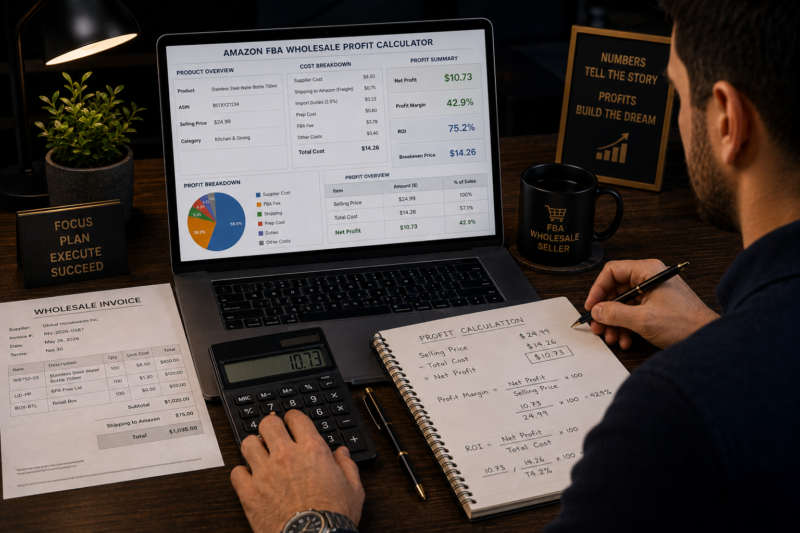
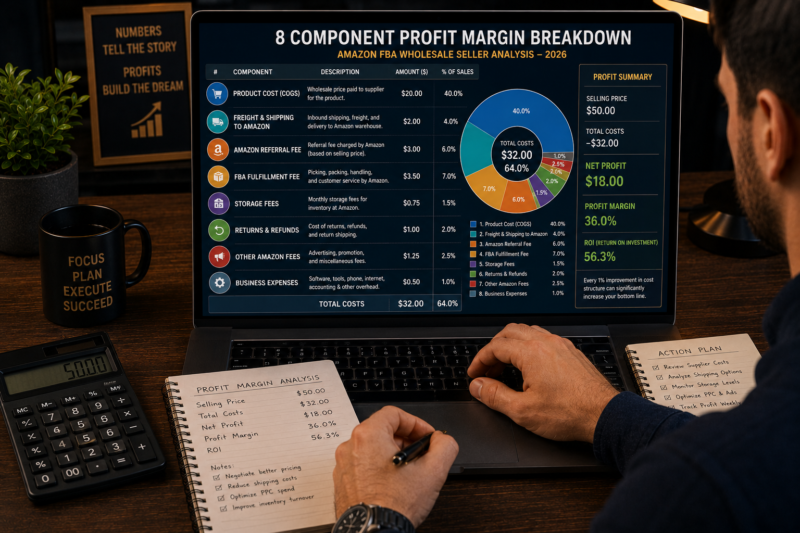
Your true Amazon FBA profit margin includes eight cost components — wholesale cost, Amazon referral fee, FBA fulfilment fee, FBA storage fee, inbound shipping cost, return rate allowance, advertising cost per unit, and business overhead allocation. Most sellers only account for the first three. Use the Amazon FBA Revenue Calculator for exact fee data and Keepa for accurate 90-day average selling price before calculating any margin.
Why Most FBA Sellers Overestimate Their Profit Margin
The standard margin calculation most new FBA sellers use looks like this — selling price minus wholesale cost minus referral fee minus FBA fee equals profit. This calculation is correct as far as it goes but it misses several real costs that every FBA wholesale business incurs — costs that are just as real as the referral fee but are less visible because they are not charged directly per unit at the point of sale.
Here is a direct comparison between the simplified calculation most sellers use and the complete calculation that reflects actual profitability:
| Cost Component | Simplified Calculation | True Margin Calculation |
|---|---|---|
| Wholesale Cost | ✓ Included | ✓ Included |
| Amazon Referral Fee | ✓ Included | ✓ Included |
| FBA Fulfilment Fee | ✓ Included | ✓ Included |
| FBA Storage Fee | ✗ Missed | ✓ Included |
| Inbound Shipping Cost | ✗ Missed | ✓ Included |
| Return Rate Allowance | ✗ Missed | ✓ Included |
| Advertising Cost Per Unit | ✗ Missed | ✓ Included |
| Business Overhead Allocation | ✗ Missed | ✓ Included |
The Eight Cost Components of True FBA Profit
Cost 1 — Wholesale Cost Per Unit
Your wholesale cost per unit is the price you pay the brand or distributor divided by the number of units in the order. For most wholesale orders this is straightforward — the price list price per unit. However several factors can affect the true per-unit cost that sellers sometimes overlook. Volume discounts reduce your per-unit cost on larger orders. Shipping costs from the supplier to your premises add to your effective per-unit cost before FBA inbound shipping. Any inspection or preparation costs at your premises add further. Always calculate your fully loaded wholesale cost — not just the invoice price per unit.
Cost 2 — Amazon Referral Fee
The Amazon referral fee is charged as a percentage of the total selling price for every item sold. Referral fee rates vary by category — most consumer goods categories charge between 8 and 15 percent. Health and Beauty, Toys and Games, Pet Supplies, and Clothing all attract a 15 percent referral fee on Amazon USA. Electronics attract a lower 8 percent rate. Always verify the exact referral fee for your specific product category using the Amazon fee schedule in Seller Central — never estimate or assume the rate.
| Amazon USA Category | Referral Fee Rate |
|---|---|
| Health and Beauty | 15% |
| Grocery and Gourmet Food | 8% or 15% |
| Toys and Games | 15% |
| Pet Supplies | 15% |
| Home and Kitchen | 15% |
| Electronics | 8% |
| Sports and Outdoors | 15% |
| Office Products | 15% |
Cost 3 — FBA Fulfilment Fee
The FBA fulfilment fee is charged per unit sold and covers picking packing and shipping to the customer. The fee is determined by the product’s size tier — calculated from its packaged dimensions and weight. On Amazon USA small standard-size products typically incur fulfilment fees of $3.22 to $4.50 per unit. Standard-size products cost $4.50 to $7.00 per unit. Oversized items attract significantly higher fees. Always use the Amazon FBA Revenue Calculator to obtain the exact fulfilment fee for each specific ASIN rather than estimating from size tier ranges.
Cost 4 — FBA Storage Fee
Amazon charges monthly storage fees based on the cubic foot volume your inventory occupies in their fulfilment centres. On Amazon USA the standard storage rate is $0.87 per cubic foot from January to September rising to $2.40 per cubic foot from October to December during peak season. For most small standard-size products the monthly storage cost per unit works out to $0.05 to $0.20 — small per unit but significant in aggregate across a large portfolio especially for any inventory that sits unsold for extended periods.
Cost 5 — Inbound Shipping Cost
The inbound shipping cost is what you pay to send your stock from your supplier or premises to Amazon’s fulfilment centre. This cost is often overlooked in margin calculations because it is paid separately from the supplier invoice and feels like a logistics expense rather than a product cost. In reality it is a direct product cost that must be allocated per unit. For most domestic US shipments using Amazon’s Partnered Carrier Programme (UPS) the per-unit inbound shipping cost works out to $0.30 to $1.00 depending on the product’s weight and the quantity per carton.
Cost 6 — Return Rate Allowance
Every Amazon FBA product experiences some level of customer returns. The return rate varies significantly by category — electronics and clothing have high return rates of 10 to 20 percent while consumable grocery and health products typically have return rates of 1 to 3 percent. Each return costs you the original wholesale cost of the unit plus the return processing fee Amazon charges — typically $5 to $15 per returned unit depending on size. Build a return rate allowance into your margin calculation based on the typical return rate for your category.
💡 Typical Return Rates by Category — Amazon USA
- Grocery and Food: 1 to 2 percent
- Health and Beauty: 2 to 4 percent
- Toys and Games: 3 to 5 percent
- Home and Kitchen: 5 to 8 percent
- Electronics: 8 to 15 percent
- Clothing and Footwear: 15 to 25 percent
Cost 7 — Advertising Cost Per Unit
If you run Sponsored Products advertising campaigns — which most serious FBA sellers do — your advertising spend is a real product cost that must be allocated against your margin. Calculate your advertising cost per unit sold by dividing your total monthly advertising spend for each ASIN by the number of units that ASIN sold in the same month. If you spent $50 on advertising for an ASIN that sold 100 units your advertising cost per unit is $0.50 — a real cost that reduces your effective margin on every unit sold regardless of whether that specific unit was purchased through an ad click or organically.
Cost 8 — Business Overhead Allocation
Your business overheads — tool subscriptions professional fees accountant costs and any staff costs — are real costs of running your FBA business that must be recovered through your product margins. Divide your total monthly overhead costs by your total monthly units sold to calculate your overhead allocation per unit. For a seller spending $150 per month on tools and accountant fees and selling 300 units per month the overhead allocation is $0.50 per unit — a small but real cost that must be factored into your true margin calculation.
The Complete True Margin Calculation — Three Worked Examples
Example 1 — Health and Beauty Product (Amazon USA)
| Cost Item | Amount |
|---|---|
| Selling Price (90-day average Buy Box) | $19.99 |
| Wholesale Cost per unit | – $7.00 |
| Amazon Referral Fee (15%) | – $3.00 |
| FBA Fulfilment Fee (small standard) | – $3.22 |
| FBA Storage Fee (monthly per unit) | – $0.10 |
| Inbound Shipping Cost per unit | – $0.40 |
| Return Rate Allowance (3% of selling price) | – $0.60 |
| Advertising Cost per unit | – $0.50 |
| Overhead Allocation per unit | – $0.50 |
| True Net Profit Per Unit | $4.67 (23% true margin) ✓ |
| Simplified Estimate (3 costs only) | $6.77 (34% — overstated by 11%) |
Example 2 — Grocery Product With Low Return Rate (Amazon USA)
| Cost Item | Amount |
|---|---|
| Selling Price (90-day average Buy Box) | $12.99 |
| Wholesale Cost per unit | – $4.50 |
| Amazon Referral Fee (8%) | – $1.04 |
| FBA Fulfilment Fee (small standard) | – $3.22 |
| FBA Storage Fee (monthly per unit) | – $0.08 |
| Inbound Shipping Cost per unit | – $0.35 |
| Return Rate Allowance (1.5%) | – $0.20 |
| Advertising Cost per unit | – $0.30 |
| Overhead Allocation per unit | – $0.50 |
| True Net Profit Per Unit | $2.80 (22% true margin) ✓ |
Example 3 — Low-Price Product Below Viability Threshold
| Cost Item | Amount |
|---|---|
| Selling Price (90-day average Buy Box) | $7.99 |
| Wholesale Cost per unit | – $2.50 |
| Amazon Referral Fee (15%) | – $1.20 |
| FBA Fulfilment Fee (small standard) | – $3.22 |
| FBA Storage Fee | – $0.08 |
| Inbound Shipping Cost | – $0.35 |
| Return Rate Allowance (3%) | – $0.24 |
| Advertising and Overhead | – $0.80 |
| True Net Profit Per Unit | – $0.40 (Loss) ✗ Do Not Source |
Building Your Margin Calculation Spreadsheet
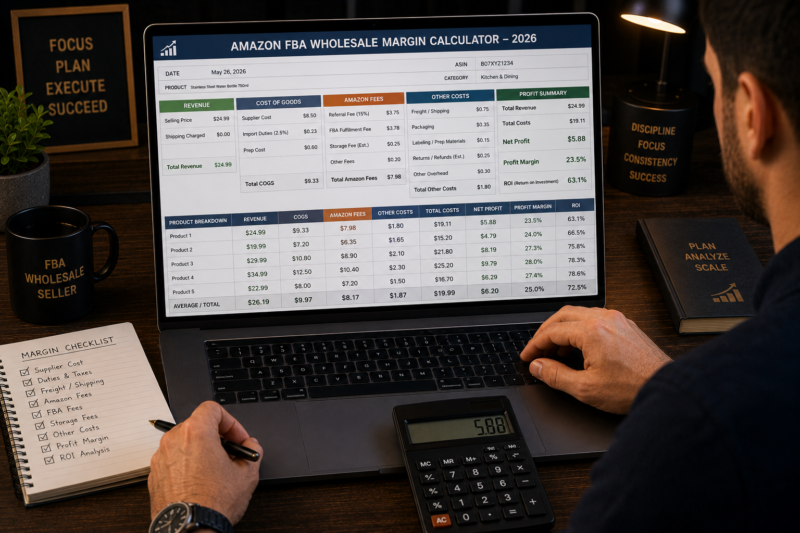
The most effective way to implement the true margin calculation process is to build a dedicated margin calculation spreadsheet that you complete for every product before placing any wholesale order. This spreadsheet becomes your single most important financial decision-making tool — ensuring no product enters your portfolio without a complete and accurate profitability assessment.
📋 Margin Calculation Spreadsheet — Essential Columns
- Product Name and ASIN
- Current Buy Box Price
- 90-Day Average Buy Box Price (from Keepa)
- Wholesale Cost Per Unit
- Amazon Referral Fee (from Revenue Calculator)
- FBA Fulfilment Fee (from Revenue Calculator)
- Estimated Monthly Storage Fee Per Unit
- Inbound Shipping Cost Per Unit
- Return Rate Allowance (category average)
- Advertising Cost Per Unit (estimate or actual)
- Overhead Allocation Per Unit
- True Net Profit Per Unit (auto-calculated)
- True Net Margin Percentage (auto-calculated)
- Decision — Source / Monitor / Reject
Frequently Asked Questions
What is a Good Profit Margin for Amazon FBA Wholesale?
Using the true eight-component margin calculation a minimum true net margin of 20 percent is the professional standard for wholesale FBA sourcing decisions. The strongest wholesale products generate true margins of 25 to 35 percent. Anything below 20 percent true margin leaves insufficient buffer for price competition unexpected fee changes increased return rates and any operational inefficiencies that emerge at scale. Never source a product showing a true margin below 20 percent regardless of how strong the demand looks.
How Do I Get the Most Accurate Selling Price for My Calculation?
Use the 90-day average Buy Box price from Keepa as your selling price in your margin calculation — not today’s price. Today’s Buy Box price may be temporarily elevated due to competitor stock-outs or depressed due to aggressive pricing. The 90-day average gives you a statistically robust price estimate that reflects the realistic price you will achieve across your entire selling period for that stock order.
Should I Include Sales Tax in My Margin Calculation?
For Amazon USA sellers in states where Amazon acts as the marketplace facilitator and collects and remits sales tax on your behalf you do not need to include sales tax in your margin calculation — Amazon handles it automatically and it does not affect your net disbursement. However if you have nexus obligations in states where you must file and remit tax yourself consult a tax professional to ensure your tax obligations are correctly accounted for in your overall business finances.
How Frequently Should I Recalculate My Margins?
Recalculate the margin for every active product in your portfolio whenever Amazon announces fee changes — typically annually in January or February. Also recalculate immediately if you notice the Buy Box price declining on any listing by more than 10 percent from your original calculation price. A product that was profitable at $19.99 may become marginal or loss-making at $15.99 — catching price declines early allows you to stop reordering before committing additional capital to a deteriorating product.
Related Articles — Keep Learning
- How to Manage Cash Flow in Your Amazon FBA Wholesale Business
- How to Calculate Amazon FBA Fees and Profit Margins
- How to Find Your First Wholesale Product to Sell on Amazon FBA
- How to Read a Keepa Graph for Amazon FBA Wholesale Research
- How to Scale Your Amazon FBA Business from $0 to $10,000 Monthly
- Best Amazon FBA Tools for Beginners in 2026 — Complete Guide
- Browse the Brandhunterz Brands Directory — Free Access
- Amazon FBA and eBay Wholesale Courses by Brandhunterz
FIND HIGH-MARGIN WHOLESALE BRANDS TODAY
Browse Verified Wholesale Brands — Free Access
Strong margins start with strong wholesale brands. The Brandhunterz Brands Directory gives you instant free access to verified wholesale brands with real trade contacts across USA and UK marketplaces — giving you the sourcing foundation to build a profitable high-margin FBA business.
About the Author
This article is written by the team at Brandhunterz Ltd — a UK registered Amazon FBA wholesale sourcing company (Company No: 15342697) registered in England and Wales since 2023. Visit brandhunterz.com to learn more.