
WHOLESALE BUSINESS FINANCE · 2026
How to Manage Cash Flow in Your Amazon FBA Wholesale Business
By Brandhunterz Ltd | Company No: 15342697 | 13 minute read
Affiliate Disclosure: This article contains affiliate links. If you purchase through our links we may earn a commission at no extra cost to you. We only recommend tools we genuinely use and believe in. Read our full disclaimer.
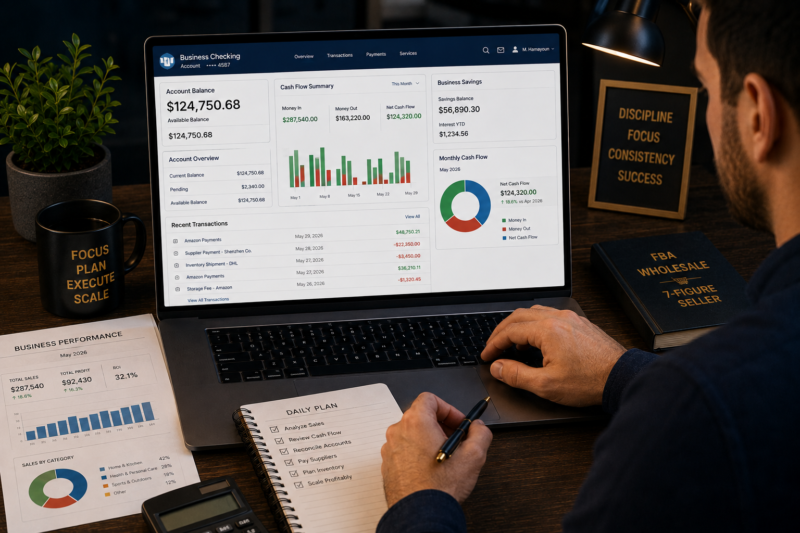
Cash flow is the single most common reason profitable Amazon FBA wholesale businesses fail. Not poor product research. Not bad supplier relationships. Not account suspensions. Cash flow. A seller can have excellent margins on paper strong Keepa-validated products and a growing brand portfolio — and still run out of money to reorder stock because the timing between paying suppliers and receiving Amazon disbursements creates a cash gap that compounds as the business grows. Understanding and managing cash flow is not an advanced skill for experienced sellers — it is a foundational discipline every wholesale seller must master from their very first order.
We are Brandhunterz Ltd — a UK registered wholesale sourcing company (Company No: 15342697) — and in this complete guide we explain exactly how cash flow works in an Amazon FBA wholesale business, why it creates unique challenges compared to other business models, and the specific strategies experienced sellers use to manage their cash flow effectively across both Amazon USA and Amazon UK marketplaces.
💡 Quick Summary
Amazon FBA wholesale cash flow is challenging because you pay suppliers upfront before receiving Amazon disbursements 14 days after sales. The gap between capital outlay and payment receipt creates a working capital cycle that must be actively managed. The four key strategies for healthy FBA cash flow are maintaining a working capital reserve of at least 60 days of stock cost, negotiating extended payment terms with suppliers, using business credit facilities strategically, and monitoring your cash position weekly using a simple cash flow spreadsheet.
Why Amazon FBA Wholesale Cash Flow is Uniquely Challenging
Amazon FBA wholesale has a cash flow structure that is more demanding than most other retail business models. Understanding exactly why requires mapping the complete timeline from when money leaves your account to when it returns — a cycle that is longer and more complex than most new sellers anticipate.
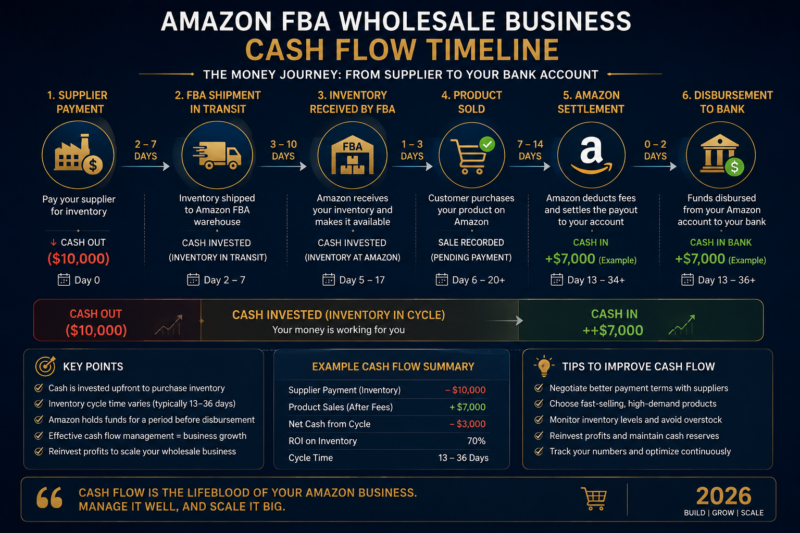
The Complete Cash Flow Timeline
| Day | Event | Cash Impact |
|---|---|---|
| Day 0 | Place wholesale order with supplier — pay upfront or on short terms | Cash OUT — full order value |
| Day 3 to 7 | Stock arrives — check and prepare for FBA shipment | No cash movement |
| Day 7 to 10 | Ship to Amazon FBA — pay inbound shipping cost | Cash OUT — shipping cost |
| Day 14 to 17 | Amazon receives and processes inventory — stock goes live | No cash movement |
| Day 17 to 45 | Products begin selling — Amazon collects payment from customers | Revenue accumulating — not yet paid to you |
| Day 31 to 45 | Amazon disburses payment — every 14 days after 14-day holding period | Cash IN — revenue minus Amazon fees |
The critical insight from this timeline is that from the moment you pay your supplier to the moment Amazon pays you can be 31 to 45 days or longer. During this entire period your capital is tied up in inventory — unavailable for new orders tools subscriptions or any other business expense. As your business grows and you place larger orders with more brands simultaneously this tied-up capital multiplies rapidly — creating the cash flow squeeze that catches so many growing FBA sellers off guard.
The Working Capital Cycle — Understanding Your Cash Position
Working capital is the money available to fund your day-to-day business operations — specifically the capital available to purchase new wholesale stock. For FBA wholesale sellers working capital is consumed by stock purchases and replenished by Amazon disbursements. The gap between these two events is your working capital cycle — and managing this cycle effectively is the core of FBA cash flow management.
Calculating Your Working Capital Requirement
To calculate how much working capital your business needs at any given stage multiply your average monthly stock cost by the number of months your cash is typically tied up in the working capital cycle. For most FBA wholesale sellers this cycle runs 45 to 60 days — meaning you need approximately 1.5 to 2 months of stock cost available as working capital at all times.
| Business Stage | Monthly Stock Cost | Working Capital Needed (60 days) |
|---|---|---|
| New Seller — 3 brands | $500 to $1,000 | $1,000 to $2,000 |
| Growing Seller — 15 brands | $3,000 to $6,000 | $6,000 to $12,000 |
| Scaled Seller — 35 brands | $15,000 to $25,000 | $30,000 to $50,000 |
These figures illustrate why scaling an FBA wholesale business requires either significant reinvested profits or access to external capital facilities — the working capital requirement grows proportionally with revenue and must be funded before Amazon disbursements arrive to replenish it.
Strategy 1 — Build and Maintain a Working Capital Reserve
The most fundamental cash flow strategy for FBA wholesale sellers is maintaining a working capital reserve — a dedicated pool of cash set aside specifically to fund new stock purchases without waiting for Amazon disbursements. This reserve is separate from your personal emergency fund and separate from your operating expenses budget. It exists solely to ensure you can always reorder your best-selling products on time without creating a stock-out gap that damages your sales rank and Buy Box position.
Building your working capital reserve requires discipline in the early months of your business. The rule is simple — every Amazon disbursement received goes straight back into the business before any personal withdrawal. Sellers who draw personal income from their FBA business in the first 6 to 12 months consistently struggle with cash flow because they are removing the capital the business needs to fund its own growth.
✅ Working Capital Reserve Rules
- Keep a minimum of 60 days of stock cost in your business bank account at all times
- Reinvest 100 percent of profit for the first 6 to 12 months without exception
- Never use your working capital reserve for personal expenses or tool subscriptions
- Set a separate operating expenses account for tools subscriptions and overheads
- Review your reserve level monthly — increase it as your stock cost grows
- Only begin drawing personal income when your reserve exceeds 90 days of stock cost
Strategy 2 — Negotiate Extended Payment Terms With Suppliers
Most wholesale suppliers require payment upfront or within 7 to 14 days of invoice — creating the cash gap that strains FBA sellers’ working capital. However suppliers value consistent reliable wholesale customers and many are willing to extend payment terms for sellers who have established a solid trading history with them. Extended payment terms — 30 days net or 60 days net — effectively bridge the gap between paying your supplier and receiving your Amazon disbursement, dramatically improving your working capital position without requiring any additional external capital.
Build Your Payment Track Record First
Pay every invoice on time without exception for the first 3 to 6 months with every supplier. Suppliers extend credit terms to customers they trust — and trust is built through a consistent track record of prompt payment. Never request extended terms before you have at least 3 to 6 months of on-time payment history with the supplier.
Request Terms at Your Next Trade Review
Request a trade review meeting with your account manager at each of your key suppliers after 6 months. Come prepared with your order history data showing consistent volume and on-time payment. Request 30-day net payment terms as a starting point — this alone can bridge most of the cash gap between paying for stock and receiving Amazon disbursements.
Leverage Volume Growth for Better Terms
As your order volume grows with each supplier your negotiating position for extended terms and volume discounts strengthens significantly. A supplier receiving $2,000 per month from you in consistent orders is highly motivated to support your business growth with better payment terms — because losing your account means losing a significant portion of predictable recurring revenue.
Strategy 3 — Use Business Credit Facilities Strategically
Business credit facilities — credit cards, business overdrafts, and short-term business loans — are powerful cash flow tools when used strategically. The key word is strategically. Using credit to fund stock purchases at margins that generate more revenue than the cost of borrowing is smart business. Using credit to fund stock purchases at margins too thin to cover borrowing costs — or using credit to cover operating losses — leads to unsustainable debt that compounds quickly.
Business Credit Card — The Most Flexible Option
A business credit card with a $5,000 to $20,000 limit is the most accessible and flexible credit facility for FBA wholesale sellers. Used wisely it effectively extends your payment terms by 30 to 56 days — the period between charging your supplier invoice to the card and the card’s payment due date. If your Amazon disbursements arrive before the card payment is due you use them to pay the card balance in full — paying zero interest while effectively bridging your entire working capital gap with the card’s interest-free period.
The Golden Rule — Only Carry a Balance You Can Clear With Your Next Disbursement
Business credit cards are powerful cash flow tools at zero interest. They become expensive liabilities the moment you carry a balance beyond the interest-free period. Only use your business credit card for stock purchases where your projected Amazon revenue from that stock will arrive in time to clear the card balance before interest is charged. Never use credit to fund stock you are not confident will sell within the card’s interest-free window.
Amazon Lending — Platform-Native Financing
Amazon offers its own lending programme — Amazon Lending — to eligible Seller Central accounts. Amazon Lending provides short-term business loans of $1,000 to $750,000 repaid through automatic deductions from your Amazon disbursements. The interest rates are typically competitive with traditional business loans and the application process is significantly faster — often approved within 24 hours for eligible sellers. If you receive an Amazon Lending offer in Seller Central it is worth evaluating as a growth capital option at your current stage of business.
Strategy 4 — Build a Simple Weekly Cash Flow Tracker
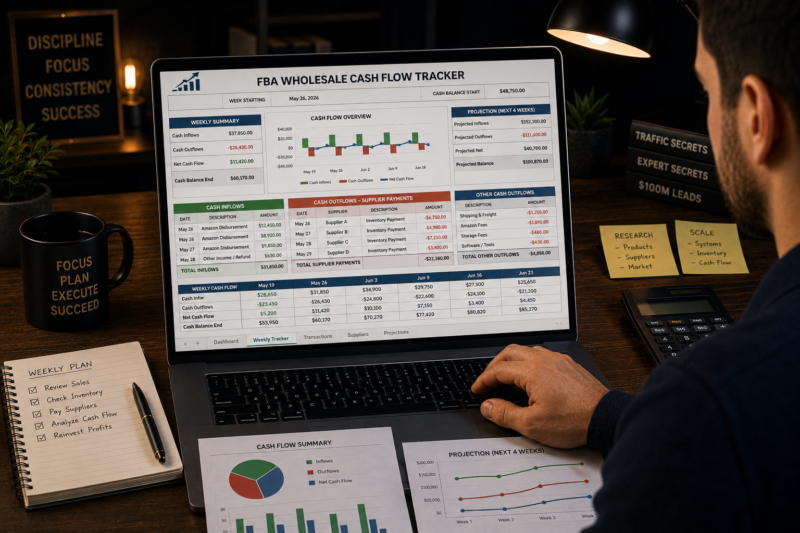
You cannot manage what you do not measure. The most effective tool for FBA wholesale cash flow management is a simple weekly cash flow tracker — a spreadsheet that shows your current cash position projected supplier payments and expected Amazon disbursements for the next 60 days. This forward-looking view lets you identify cash shortfalls before they happen — giving you time to adjust order timing negotiate with suppliers or draw on credit facilities before you run out of stock ordering capacity.
📋 Weekly Cash Flow Tracker — Essential Columns
- Opening Cash Balance: Total cash in business bank account at start of week
- Expected Amazon Disbursements: Amazon payments due this week based on settlement cycle
- Supplier Payments Due: Invoice amounts due to suppliers this week
- Operating Expenses: Tool subscriptions staff costs and other overheads due this week
- Planned Stock Orders: New wholesale orders planned for placement this week
- Closing Cash Balance: Opening balance plus disbursements minus all outflows
- 60-Day Projection: Roll the calculation forward 8 weeks to identify future shortfalls
Review this tracker every Monday morning before making any new stock ordering decisions. If the 60-day projection shows your closing cash balance approaching zero in any future week you have time to act — delaying a planned order renegotiating supplier payment terms drawing on a credit facility or accelerating a disbursement cycle by repricing a slow-moving product to generate faster cash recovery.
Cash Flow Mistakes That Kill FBA Businesses
Drawing Personal Income Before the Business is Self-Sustaining
The most common cash flow mistake new FBA sellers make is paying themselves too early. Every dollar withdrawn from the business in the first 6 to 12 months is a dollar that cannot be reinvested in stock — directly limiting how fast the business can grow. Wait until your working capital reserve exceeds 90 days of stock cost before taking any personal income from the business.
Over-Ordering on New Products Before Velocity is Confirmed
Placing a large initial order on a new product before its actual sales velocity is confirmed ties up disproportionate working capital in unproven stock. Even with excellent Keepa research the actual velocity you achieve as a new seller on a listing may differ from historical data. Always place conservative first orders of 24 to 48 units and scale reorder quantities once velocity is confirmed over 30 to 60 days.
Ignoring Q4 Working Capital Planning
The fourth quarter — October through December — is the highest-revenue period on Amazon but also the highest working capital demand period. Successful sellers pre-order significantly larger quantities in August and September to have stock in FBA before the Q4 surge. This requires having the working capital available 8 to 10 weeks before the revenue is generated — something that catches sellers unprepared every year. Plan your Q4 capital requirements in July and August.
Mixing Personal and Business Finances
Running your FBA business through a personal bank account makes it impossible to accurately track your business cash position monitor working capital levels or claim business expenses for tax purposes. Open a dedicated business bank account before placing your first wholesale order and run every business transaction exclusively through it. This single discipline makes cash flow management dramatically simpler and more accurate.
Frequently Asked Questions
How Often Does Amazon Pay FBA Sellers?
Amazon disburses payments to FBA sellers every 14 days — but with a 14-day holding period on funds before disbursement. This means the effective payment cycle is 14 days of sales plus a 14-day hold — so sales made today will typically be included in a disbursement approximately 14 to 28 days from now. New seller accounts may face an extended disbursement period of up to 60 days in their first few months before their account history is established. Plan your working capital requirements around a 30 to 45 day disbursement cycle to be safe.
What is the Best Bank Account for an Amazon FBA Business?
For US sellers a dedicated business checking account with a major bank — Chase, Bank of America, or Wells Fargo — provides the stability and credibility needed for wholesale supplier relationships and Amazon disbursements. For UK sellers business accounts from Starling Bank, Monzo Business, or HSBC Business are all strong options. Choose an account with no minimum balance requirements low monthly fees and a debit card compatible with international supplier payments.
Should I Use an Accountant for My FBA Business?
Yes — an accountant experienced with ecommerce businesses is strongly recommended from your first year of trading. FBA wholesale businesses have specific accounting complexities including inventory valuation cost of goods sold calculations Amazon fee categorisation sales tax obligations across multiple states or countries and business expense identification. An experienced ecommerce accountant pays for themselves many times over through tax savings and compliance assurance. Fees typically range from $500 to $2,000 per year for small FBA businesses.
How Do I Handle Sales Tax on Amazon FBA?
For US sellers Amazon automatically collects and remits sales tax in states where it has established marketplace facilitator laws — which now covers the majority of US states. However you may still have nexus obligations in states where your FBA inventory is stored — which can be multiple states simultaneously as Amazon distributes inventory across its fulfilment network. Consult a tax professional familiar with Amazon FBA nexus requirements to ensure full compliance. For UK sellers Amazon handles VAT collection and remittance on marketplace sales — but you remain responsible for VAT registration and filing if your taxable turnover exceeds the registration threshold.
Related Articles — Keep Learning
- How to Calculate Amazon FBA Fees and Profit Margins
- How to Scale Your Amazon FBA Business from $0 to $10,000 Monthly
- How to Start Amazon FBA in 2026 — Complete Beginner Guide
- How to Find Your First Wholesale Product to Sell on Amazon FBA
- Best Amazon FBA Tools for Beginners in 2026 — Complete Guide
- Amazon FBA Seller Central — A Complete Beginner’s Walkthrough
- Browse the Brandhunterz Brands Directory — Free Access
- Amazon FBA and eBay Wholesale Courses by Brandhunterz
FIND PROFITABLE WHOLESALE BRANDS TODAY
Browse Verified Wholesale Brands — Free Access
Strong cash flow starts with strong margins. The Brandhunterz Brands Directory gives you instant free access to verified wholesale brands with real trade contacts across USA and UK marketplaces — giving you the sourcing foundation to build a profitable cash-generative FBA business.
About the Author
This article is written by the team at Brandhunterz Ltd — a UK registered Amazon FBA wholesale sourcing company (Company No: 15342697) registered in England and Wales since 2023. Visit brandhunterz.com to learn more.