
WHOLESALE BUSINESS FINANCE · 2026
How to Reinvest Amazon FBA Profits for Maximum Growth
By Brandhunterz Ltd | Company No: 15342697 | 13 minute read
Affiliate Disclosure: This article contains affiliate links. If you purchase through our links we may earn a commission at no extra cost to you. We only recommend tools we genuinely use and believe in. Read our full disclaimer.
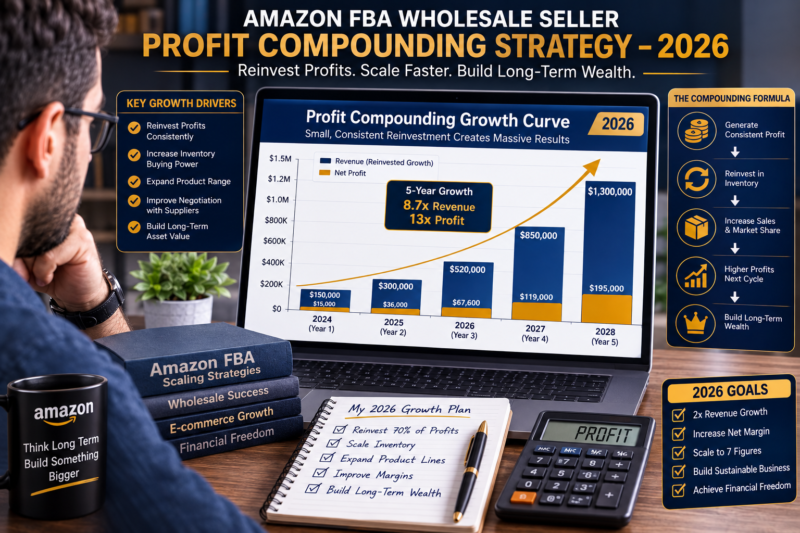
The difference between Amazon FBA wholesale sellers who reach $10,000 per month in profit within 18 to 24 months and those who plateau at $1,000 to $2,000 per month and never break through is rarely about the quality of their product research or the strength of their supplier relationships. It is almost always about one financial decision — how they choose to use their profits. Sellers who reinvest aggressively and strategically compound their growth at a rate that makes the gap between their business and a casual seller’s business wider every single month. Sellers who draw profits too early or reinvest them inefficiently cap their own growth ceiling and wonder why they cannot scale past a certain revenue level.
We are Brandhunterz Ltd — a UK registered wholesale sourcing company (Company No: 15342697) — and in this complete guide we cover exactly how to think about reinvestment as a growth strategy how to allocate profits across competing priorities and the specific reinvestment decisions that generate the highest return on capital for Amazon FBA wholesale sellers at every stage of business across both Amazon USA and Amazon UK.
💡 Quick Summary
The highest-return reinvestment for FBA wholesale sellers is always more inventory in proven products — every dollar reinvested in stock that sells at a 25 percent margin generates $0.25 of profit in the next 30 to 45 days. Secondary reinvestment priorities in order of return are expanding your brand portfolio through new supplier applications, upgrading your research tools to unlock better sourcing decisions, hiring a virtual assistant to scale your brand application volume, and adding eBay as a second sales channel. Delay personal salary withdrawals until your working capital reserve exceeds 90 days of stock cost.
The Compounding Power of Profit Reinvestment
The mathematical case for aggressive profit reinvestment in the early stages of your FBA wholesale business is compelling. Consider two sellers who both start with $3,000 and generate a 25 percent true net margin on their sales. Seller A reinvests 100 percent of profits for 12 months. Seller B withdraws 50 percent of profits each month as personal income. After 12 months assuming a 45-day working capital cycle their financial positions look like this:
| Metric | Seller A — 100% Reinvest | Seller B — 50% Reinvest |
|---|---|---|
| Starting Capital | $3,000 | $3,000 |
| Working Capital at Month 6 | ~$7,500 | ~$4,500 |
| Working Capital at Month 12 | ~$22,000 | ~$8,500 |
| Monthly Revenue at Month 12 | ~$29,000 | ~$11,000 |
| Monthly Profit at Month 12 | ~$7,250/month | ~$2,750/month |
| Total Personal Withdrawals Year 1 | $0 | ~$15,000 |
Seller B withdrew $15,000 in personal income during year one. But by month 12 Seller A is generating $7,250 per month in profit — $4,500 more than Seller B every single month going forward. Within 4 months of year two Seller A’s monthly profit advantage exceeds the total personal income Seller B withdrew across all of year one. The patience of full reinvestment in year one creates a permanent and growing income advantage in year two and beyond.
The Profit Reinvestment Hierarchy — Where to Put Every Dollar
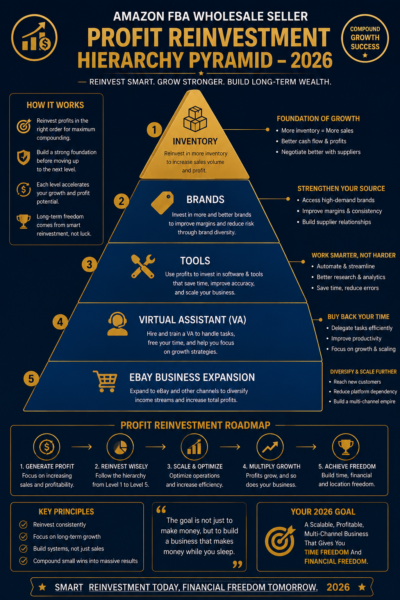
Not all reinvestment decisions generate equal returns. The hierarchy below ranks reinvestment options by their expected return on capital for a growing FBA wholesale seller — from highest to lowest return. Always fill the highest-priority bucket before moving to the next level.
Priority 1 — Reorder Proven Products (Highest ROI)
The highest-return use of every dollar of profit is reordering products with confirmed sales velocity and proven margins. A product generating 25 percent true net margin that you have been selling consistently for 60 days returns $0.25 of profit for every $1.00 reinvested in the next 30 to 45 days. No other investment in your business — not tools not marketing not education — generates this level of near-certain short-term return.
Before allocating any profit to other reinvestment priorities ensure every proven product in your portfolio has its next reorder fully funded. A stock-out on a high-velocity product costs you both the lost sales and the sales rank recovery time — a double cost that outweighs almost any other alternative use of the same capital.
Scale Up Reorder Quantities on Best Performers
As your working capital grows increase your reorder quantities on your top-performing products. Larger reorders reduce your per-unit inbound shipping cost improve your working capital cycle by reducing reorder frequency and often unlock volume discount tiers with suppliers that reduce your per-unit COGS — improving your margin on every subsequent unit sold without sourcing a single new product.
Priority 2 — New Brand Portfolio Expansion
Once all proven products are fully reordered the next highest-return use of profits is funding first orders with new approved wholesale brands. Every new brand added to your portfolio is a new revenue stream that compounds independently — and the first order with a new brand is the lowest-risk capital commitment you can make because you have already validated the product through research and confirmed the supplier relationship through the approval process.
For new brand first orders always apply the conservative first order principle — order at or near the minimum order value regardless of your available capital. Your goal with a first order is to validate actual sales velocity on your account specifically — not to commit maximum capital to an unproven seller-product relationship. Scale up on reorder once velocity is confirmed.
Priority 3 — Building Your Working Capital Reserve
Simultaneously with inventory reinvestment build your working capital reserve toward the 60-day stock cost target outlined in our cash flow guide. This reserve is not idle cash — it is the buffer that allows you to respond to unexpected opportunities place emergency reorders when stock approaches zero and absorb the occasional slow month without compromising your brand application activity or your existing reorder commitments.
Priority 4 — Tool Stack Upgrades
As your revenue grows upgrade your research tool subscriptions to unlock capabilities that make your sourcing decisions more data-driven and your operations more efficient. The upgrade sequence for most FBA sellers follows a natural progression — from Keepa paid plus AMZScout in months 1 to 3 to Helium 10 Starter in months 4 to 6 to Helium 10 Platinum once your portfolio exceeds 10 active brands. Add Zik Analytics when you launch on eBay. Add accounting software and A2X when monthly revenue exceeds $5,000.
Priority 5 — Hiring a Virtual Assistant
At the point where your monthly profit consistently exceeds $3,000 to $5,000 your time becomes the binding constraint on growth — specifically the time required to maintain 15 to 20 brand applications per week alongside product research reorder management and Seller Central operations. A trained virtual assistant handling your brand application pipeline at $300 to $600 per month frees 8 to 15 hours per week of your time that can be redirected to higher-value activities — while also increasing your application volume beyond what you could achieve alone.
Priority 6 — eBay Channel Expansion
Adding eBay as a second sales channel for your existing wholesale stock is one of the highest-return expansion investments available to growing FBA sellers. The same products you source for Amazon sell on eBay to a largely separate buyer pool — doubling the revenue potential of every wholesale order without increasing your stock purchasing costs. The incremental cost of launching on eBay is minimal — a few hours of listing setup and Zik Analytics for market research. The revenue upside on your existing stock portfolio can be significant.
The Profit Allocation Framework — Every Disbursement
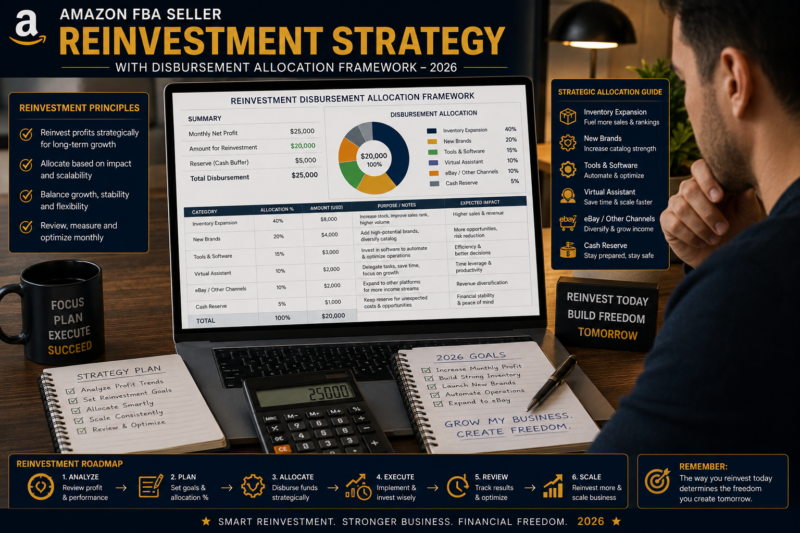
Rather than making ad hoc reinvestment decisions with each Amazon disbursement establish a consistent profit allocation framework that automatically directs every dollar of incoming revenue to its highest-value use. Here is the recommended framework for FBA wholesale sellers at each stage of business:
Stage 1 — New Seller (Monthly Revenue Under $5,000)
📈 Every Amazon Disbursement — Stage 1 Allocation
- 70% — Inventory Reinvestment: Proven product reorders and new brand first orders
- 25% — Tax Reserve: Transferred to dedicated tax reserve account immediately
- 5% — Working Capital Reserve: Building the 60-day stock cost buffer
- 0% — Personal Salary: No withdrawals until reserve target is reached
Stage 2 — Growing Seller (Monthly Revenue $5,000 to $20,000)
📈 Every Amazon Disbursement — Stage 2 Allocation
- 60% — Inventory Reinvestment: Scaled reorders plus new brand expansion
- 25% — Tax Reserve: Maintained consistently every disbursement
- 5% — Working Capital Reserve: Maintaining 60-day buffer as stock costs grow
- 10% — Personal Salary: Modest sustainable personal draw begins
Stage 3 — Scaled Seller (Monthly Revenue Above $20,000)
📈 Every Amazon Disbursement — Stage 3 Allocation
- 50% — Inventory Reinvestment: Maintaining and growing established portfolio
- 25% — Tax Reserve: Consistent tax provisioning every disbursement
- 5% — Working Capital Reserve: Growing buffer proportionally with revenue
- 20% — Personal Salary: Sustainable personal income from established business
Reinvestment Mistakes That Stall Growth
Withdrawing Personal Income Before Hitting Revenue Milestones
The most growth-limiting reinvestment mistake is beginning personal salary withdrawals before your working capital reserve reaches 90 days of stock cost and before monthly profit consistently exceeds $2,000. Every dollar withdrawn in the first 6 to 12 months directly reduces the capital available for inventory reinvestment — slowing compound growth at the stage where compounding is most powerful. The patience to delay personal income for 6 to 12 months creates a business that pays you significantly more in years two and three than you sacrificed in year one.
Over-Investing in Unproven Products
Reinvesting aggressively in new products before they have proven their sales velocity on your specific account ties capital in unconfirmed opportunities at the expense of scaling proven performers. The best use of reinvestment capital is always more of what is already working — not maximum commitment to what might work. Keep first orders conservative and scale up only after velocity confirmation.
Reinvesting in Tools and Courses at the Expense of Inventory
Tools and courses generate returns only indirectly — by improving your decisions about inventory. Inventory generates returns directly — by selling at a margin. A seller who spends $500 on a course instead of $500 on inventory in month two has bought knowledge but not stock — and stock is what generates the Amazon revenue that funds everything else. Buy the tools and education you genuinely need at each stage but never at the expense of inventory budget adequacy.
Failing to Reserve for Tax on Every Disbursement
The tax reserve is non-negotiable — yet many sellers treat it as optional and reinvest everything including the portion owed to their tax authority. When the annual tax bill arrives these sellers either face a cash flow crisis that forces stock liquidation to pay the bill or they carry forward a tax debt that accumulates interest and penalties. Transfer 25 to 30 percent of every disbursement to a dedicated tax reserve account immediately — every time without exception.
Reinvestment Beyond Inventory — Strategic Growth Investments
Once your working capital reserve is fully funded and your proven product portfolio is consistently stocked consider these strategic reinvestment opportunities that generate compounding long-term returns beyond the immediate inventory cycle.
Investing in Exclusive Brand Relationships
As your brand portfolio grows identify your top 3 to 5 performing brands and invest in deepening those relationships beyond the standard wholesale account level. Commit to larger minimum orders negotiate exclusivity for specific product ranges or geographic areas and offer to represent the brand at trade shows or marketing events. Exclusive or semi-exclusive wholesale relationships create a competitive moat that protects your revenue from other Amazon sellers attempting to enter the same listings.
Investing in Private Label Development
At a more advanced stage many successful wholesale sellers use a portion of their profits to develop a private label product line alongside their wholesale business. Private label products eliminate the Buy Box competition dynamic entirely — as the brand owner you own the listing and all sales on it. The capital required for product development manufacturing and initial inventory is significant — typically $3,000 to $10,000 per product — but the long-term margin and revenue potential on a successful private label product exceeds what wholesale can deliver on the same capital. Only pursue this path once your wholesale business generates consistent monthly profit above $5,000.
Investing in Amazon USA Expansion
For UK sellers whose wholesale business is generating consistent profit above $5,000 per month expanding to Amazon USA is one of the highest-return strategic investments available. The US market is 5 to 8 times larger than the UK market for most consumer product categories — meaning the same research discipline and brand relationship approach that works in the UK can generate proportionally larger revenue in the USA. Use the Brandhunterz USA brands directory to identify verified US wholesale contacts for the brands you are already selling successfully in the UK.
Frequently Asked Questions
How Do I Know When I Can Afford to Start Paying Myself?
You can sustainably begin paying yourself a personal salary when three conditions are consistently met for at least 3 consecutive months — your working capital reserve exceeds 90 days of stock cost, your monthly net profit consistently exceeds $2,000, and your revenue shows a stable or growing trend rather than volatile month-to-month swings. Starting with a modest fixed monthly salary of $500 to $1,000 — rather than a percentage of variable monthly profit — maintains budget predictability and prevents the temptation to withdraw more in high-revenue months at the expense of reinvestment.
Should I Pay Off Business Debt Before Reinvesting in Stock?
The answer depends on the interest rate on your debt versus your inventory margin. If your business credit card charges 24 percent APR and your stock generates 25 percent margin the financial return from paying off the debt and the return from reinvesting in stock are roughly equivalent. However if your stock consistently generates 30 to 35 percent margin and your debt carries a 15 to 18 percent APR it makes mathematical sense to prioritise inventory reinvestment while making minimum debt payments — the margin advantage exceeds the interest cost. Always calculate the net return of each option before deciding.
How Should I Reinvest During Q4 Preparation?
Q4 preparation requires a significant shift in your reinvestment allocation starting in August and September. Redirect 85 to 90 percent of all available capital to inventory during these months — building up 2 to 3 times your normal stock level across your best-performing products ahead of the October to December peak. Reduce your working capital reserve contributions temporarily to fund the Q4 stock build and defer any non-essential tool upgrades or VA hiring until after Q4 when the increased revenue provides capital for those investments without competing with your Q4 stock requirements.
What is the Best Way to Track My Reinvestment Decisions?
Maintain a simple reinvestment decision log alongside your monthly budget — a record of every capital allocation decision made with each Amazon disbursement. Note the disbursement amount the allocation to each category and the specific inventory purchases made. Reviewing this log monthly reveals patterns in your reinvestment behaviour — identifying whether you are consistently following your allocation framework or drifting toward sub-optimal spending patterns. The discipline of logging decisions also makes you more deliberate about each allocation choice rather than spending reactively as disbursements arrive.
Related Articles — Keep Learning
- How to Manage Cash Flow in Your Amazon FBA Wholesale Business
- How to Calculate Your True Amazon FBA Profit Margin
- How to Build a Wholesale FBA Budget from Scratch
- How to Use Business Credit to Scale Your Amazon FBA Business
- How to Track Amazon FBA Inventory Costs and COGS
- How to Scale Your Amazon FBA Business from $0 to $10,000 Monthly
- Browse the Brandhunterz Brands Directory — Free Access
- Amazon FBA and eBay Wholesale Courses by Brandhunterz
FIND THE BRANDS WORTH REINVESTING IN
Browse Verified Wholesale Brands — Free Access
Profit reinvestment compounds fastest when directed into the highest-margin brands. The Brandhunterz Brands Directory gives you instant free access to verified wholesale brands with real trade contacts across USA and UK marketplaces — ensuring every reinvested dollar goes into brands worth growing.
About the Author
This article is written by the team at Brandhunterz Ltd — a UK registered Amazon FBA wholesale sourcing company (Company No: 15342697) registered in England and Wales since 2023. Visit brandhunterz.com to learn more.