
UK AMAZON SELLERS
How to Scale Your Amazon UK FBA Business — From First Order to Full Time
By Brandhunterz Ltd | Company No: 15342697 | 14 minute read
Affiliate Disclosure: This article contains affiliate links. If you purchase through our links we may earn a commission at no extra cost to you. We only recommend tools we genuinely use and believe in. Read our full disclaimer.
Scaling an Amazon UK FBA wholesale business from a first order to a full-time income is a structured and repeatable process — not a matter of luck or timing. The sellers who achieve significant scale consistently do so by following a logical progression — validating their first products thoroughly reinvesting their profits into expanding their catalogue building a reliable supplier network and systematically removing the bottlenecks that limit growth at each stage. The wholesale FBA model is one of the most capital-efficient ways to build a scalable online business because it does not require you to create products negotiate manufacturing contracts or manage complex fulfilment logistics — Amazon handles the fulfilment and the UK wholesale market provides the products. Your role is to find the right products at the right price list them correctly and keep them in stock.
We are Brandhunterz Ltd — a UK registered wholesale sourcing company (Company No: 15342697) — and in this complete scaling guide we walk through every stage of growing an Amazon UK wholesale FBA business — from validating your first product and understanding your numbers through to reinvesting profits expanding your product catalogue building supplier relationships and reaching the revenue levels that justify transitioning to full-time selling.
💡 Quick Summary
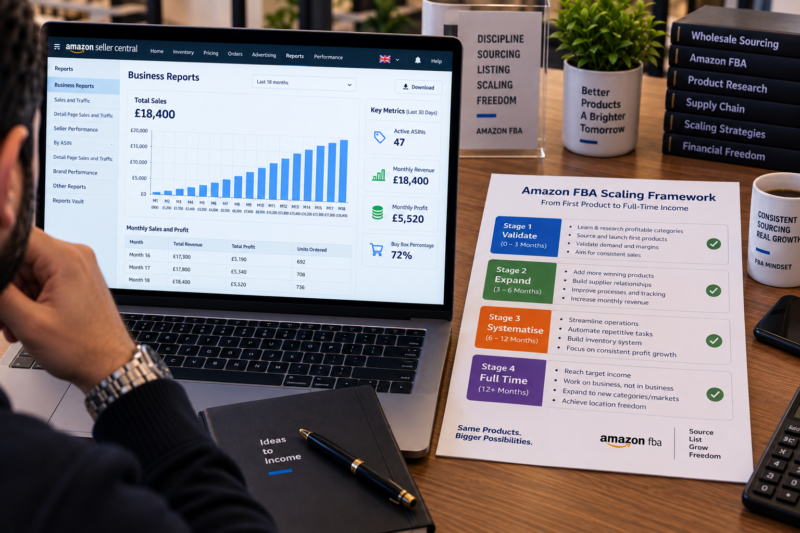
Scaling an Amazon UK FBA wholesale business follows four stages — Stage 1 validate your first products and understand your true numbers — Stage 2 reinvest profits to expand your product count and supplier relationships — Stage 3 systematise your sourcing prep and restocking processes to remove your time from routine tasks — Stage 4 reach the revenue and profit levels that justify transitioning from part-time to full-time. At each stage the limiting factor is different — in Stage 1 it is product knowledge — in Stage 2 it is capital — in Stage 3 it is systems — in Stage 4 it is decision making about when to make the leap. Most UK wholesale FBA sellers reach a full-time income within 12 to 24 months of their first order when following a disciplined reinvestment strategy.
Stage 1 — Validate Your First Products and Know Your Numbers
The first stage of scaling begins before you even have a full-time business in mind — it begins the moment you place your first wholesale order. The goal at this stage is not to maximise revenue but to validate that your product research process works that your supplier relationships are reliable and that your numbers are accurate. Most new FBA sellers overestimate their margins at this stage because they undercount fees or miscalculate their cost of goods — and then they scale a flawed model rather than fixing it first.
What to Validate in Your First 60 to 90 Days
| Validation Check | What a Passing Result Looks Like |
|---|---|
| Products are selling at or above expected velocity | Units selling consistently — not sitting in FBA for more than 30 to 60 days without movement |
| Actual net profit per unit matches pre-purchase calculation | Real disbursement figures match your AMZScout pre-purchase calculation within 10% — no surprise fees or deductions |
| Buy Box percentage is healthy | Winning 30% or more of Buy Box time on listings with multiple sellers — confirming FBA and pricing are competitive |
| Account Health is clean | AHR score 200 or above — zero policy violations — ODR under 0.5% — no IP complaints |
| Supplier relationship is reliable | Orders fulfilled on time — correct products received — VAT invoices provided — supplier responsive to queries |
Do not move to Stage 2 until every validation check passes. A product that is not selling at expected velocity or generating the margins you calculated is a signal to investigate and fix — not to add more products alongside it. The foundation of scaling is a validated and profitable model — not a large product count built on untested assumptions.
Stage 2 — Reinvest Profits and Expand Your Catalogue
Once your first products are validated and generating consistent profit the second stage is systematic reinvestment and catalogue expansion. This is where the compounding nature of wholesale FBA becomes visible — each profitable product generates cash that funds the next product which generates more cash that funds more products. The rate at which you can scale is directly determined by how much of your profit you reinvest rather than withdraw.
REINVESTMENT GROWTH MODEL — HOW COMPOUNDING WORKS IN WHOLESALE FBA
| Period | Starting Capital | Monthly Revenue | Monthly Profit — 30% margin |
| Month 1 to 3 | £1,000 | £500 to £1,500 | £150 to £450 |
| Month 4 to 6 | £2,000 to £3,000 | £2,000 to £4,000 | £600 to £1,200 |
| Month 7 to 12 | £5,000 to £10,000 | £5,000 to £15,000 | £1,500 to £4,500 |
| Month 12 to 24 | £15,000 to £30,000+ | £15,000 to £50,000+ | £4,500 to £15,000+ |
Figures are illustrative — actual results depend on product selection margins and reinvestment rate — higher reinvestment accelerates growth significantly
How to Expand Your Product Catalogue Systematically
Rather than adding new products randomly add new products in a structured way that builds depth in your most profitable areas and supplier relationships before broadening into new categories:
Add More Products From Your Existing Suppliers First
Before approaching new suppliers request the full product catalogue from your existing approved trade accounts. Your supplier already trusts your account — adding more of their products requires no new approval process and often qualifies you for better trade terms as your order volume increases. Deepening your existing supplier relationships is the fastest and lowest-risk way to expand your catalogue in the early stages.
Open New Supplier Accounts in Your Strongest Category
Once you have exhausted the profitable products from existing suppliers approach new suppliers in the same category you have already validated. Your growing order history and account health record make you a more attractive trade account applicant — use your track record to access suppliers who may have been hesitant to work with you as a new business with no purchase history.
Add New Categories Only After Your First Is Profitable and Stable
Expanding into a second category should happen only when your first category is generating consistent monthly profit and your processes within it are stable enough to run without constant daily attention. Entering a second category prematurely splits your research time your capital and your supplier development effort — all three of which are better concentrated in your first category until it is genuinely running well.
Stage 3 — Systematise Your Operations
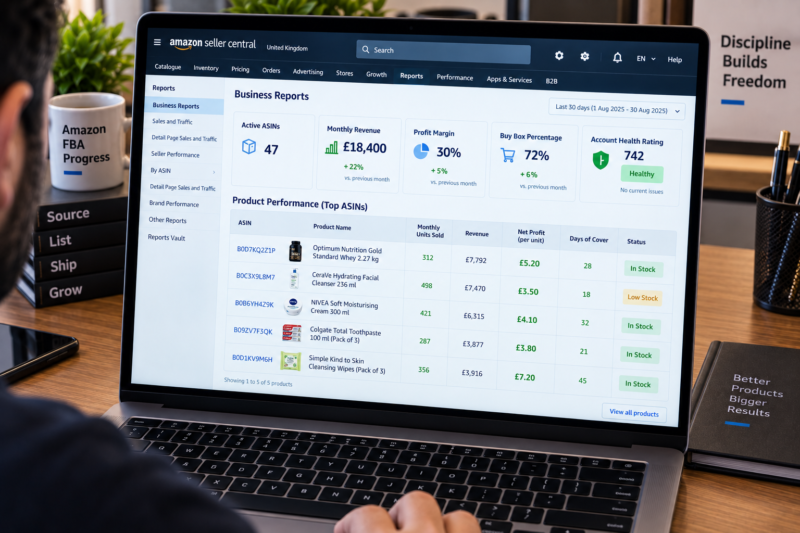
As your catalogue grows the bottleneck shifts from finding products and capital to time. A seller with 50 active ASINs cannot manage restocking account health monitoring supplier orders and product research manually without the business consuming their entire day. The solution is systematisation — building repeatable processes and eventually delegating tasks to remove the founder from routine operations. Here is what to systematise at each growth stage:
| Task | How to Systematise It | When to Delegate |
|---|---|---|
| Repricing | Set up an automated repricer with minimum price floors — removes daily manual pricing adjustments | Automate from 10+ active ASINs — too many to manually monitor daily |
| Inventory replenishment | Build a weekly reorder spreadsheet — days of cover calculation — automated low-stock alerts from Seller Central | Delegate order placement to a VA from 30+ active ASINs |
| FBA prep and shipment | Create a written prep SOP — standard operating procedure — and use it consistently for every product | Move to a UK prep centre when monthly volume justifies the per-unit cost |
| Account health monitoring | Build a weekly 20-minute account health review routine — same day each week — never skipped | Keep this task with the business owner — account health decisions require judgment |
| Product research | Create a written product research SOP using Keepa criteria — teachable to a VA with product research training | Delegate initial product research screening to a VA — final buying decisions stay with the owner |
Using a UK Prep Centre to Remove Yourself From Fulfilment
One of the most significant operational leverage points for scaling an Amazon UK FBA business is transitioning from self-prep to a third-party UK prep centre. A prep centre receives your wholesale deliveries directly from your suppliers inspects and labels each unit creates your FBA shipment plans and dispatches your boxes to Amazon’s UK fulfilment centres — entirely without your involvement. The per-unit cost of using a prep centre — typically £0.50 to £1.50 per unit depending on the service level — is offset by the time it saves and the operational freedom it creates. For sellers spending 10 to 20 hours per week on receiving inspecting labelling and shipping stock the transition to a prep centre is often the single change that makes scaling from part-time to full-time possible.
Stage 4 — When to Transition to Full Time
The decision to transition your Amazon UK FBA business from a side operation to a full-time business is both financial and personal — and it should be made on the basis of clear criteria rather than emotion or impatience. Here are the benchmarks that indicate a seller is ready to make the transition:
| Full-Time Readiness Benchmark | Why It Matters |
|---|---|
| Monthly net profit covers your personal income requirement with buffer | Never transition when your FBA profit just matches your current salary — you need a buffer for quiet months and unexpected costs |
| Profit has been consistent for at least 3 consecutive months | One strong month is not a trend — three consistent months confirms your model is stable not a temporary spike |
| You have working capital beyond your current inventory value | FBA requires continuous stock reinvestment — if all your capital is tied in inventory a slow period can stop restocking and halt revenue |
| Your account health is consistently Healthy — AHR 200 or above | A business dependent on a single Amazon account needs that account to be robustly healthy before you remove your employment safety net |
| You have more than 10 active profitable ASINs | Diversification across multiple products reduces the impact of any single listing going out of stock or facing increased competition |
| Systems are in place — prep is delegated or automated — research process documented | Going full time into a business that requires 60 hours per week to run is not sustainable — systems must be in place first |
Your Scaling Progress Checklist
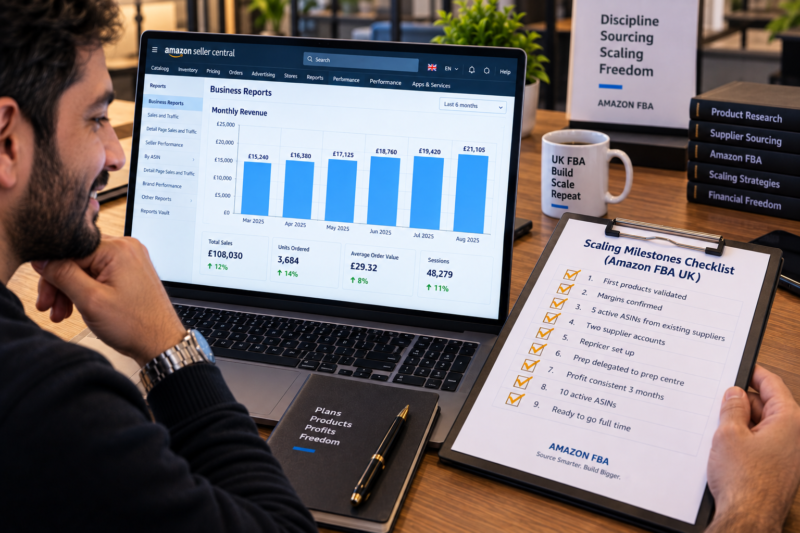
| Scaling Milestone | Stage | Achieved |
|---|---|---|
| First wholesale order placed and received | Stage 1 | ☐ |
| First products selling consistently — velocity confirmed | Stage 1 | ☐ |
| Actual margins match pre-purchase calculation — numbers validated | Stage 1 | ☐ |
| 5 or more active profitable ASINs from existing suppliers | Stage 2 | ☐ |
| Two or more approved supplier accounts in primary category | Stage 2 | ☐ |
| Automated repricer set up with minimum price floors | Stage 3 | ☐ |
| Prep delegated to prep centre or VA — time freed from fulfilment tasks | Stage 3 | ☐ |
| Monthly net profit consistent for 3 months — covers personal income with buffer | Stage 4 | ☐ |
| 10 or more active profitable ASINs — revenue diversified across multiple products | Stage 4 | ☐ |
| All scaling milestones achieved — ready to transition to full time | Stage 4 | ✅ Ready |
Conclusion — Scaling Is a Process Not an Event
The sellers who scale their Amazon UK FBA businesses most successfully are not those who move fastest — they are those who move most methodically. Validating before expanding systematising before delegating and transitioning to full time only when the financial and operational foundations are genuinely solid. The wholesale FBA model is exceptionally well suited to the UK market — the supply chain is developed the marketplace is less saturated than the US and the infrastructure Amazon provides means that scaling is limited only by your ability to find more profitable products and fund their purchase. Build the foundation correctly from day one and scaling becomes a matter of consistently applying a proven process — not a constant search for the next breakthrough.
Find your next wholesale product through our Brands Directory. Research every opportunity with Keepa. Confirm every margin with AMZScout. And follow the four-stage scaling framework in this guide to grow your Amazon UK FBA business from first order to full time.
SCALE YOUR AMAZON UK FBA BUSINESS WITH THE RIGHT PRODUCTS
Browse 5,000+ Verified UK Wholesale Brands Free
Find verified wholesale trade contacts in the Brandhunterz Brands Directory — source more profitable products expand your catalogue and scale your Amazon UK FBA business stage by stage using the framework in this guide.
About the Author
This article is written by the team at Brandhunterz Ltd — a UK registered Amazon FBA wholesale sourcing company (Company No: 15342697) registered in England and Wales since 2023. Visit brandhunterz.com to learn more.