
AMAZON FBA ACCOUNT HEALTH
Amazon FBA Account Health Rating — What It Means and How to Improve It
By Brandhunterz Ltd | Company No: 15342697 | 13 minute read
Affiliate Disclosure: This article contains affiliate links. If you purchase through our links we may earn a commission at no extra cost to you. We only recommend tools we genuinely use and believe in. Read our full disclaimer.
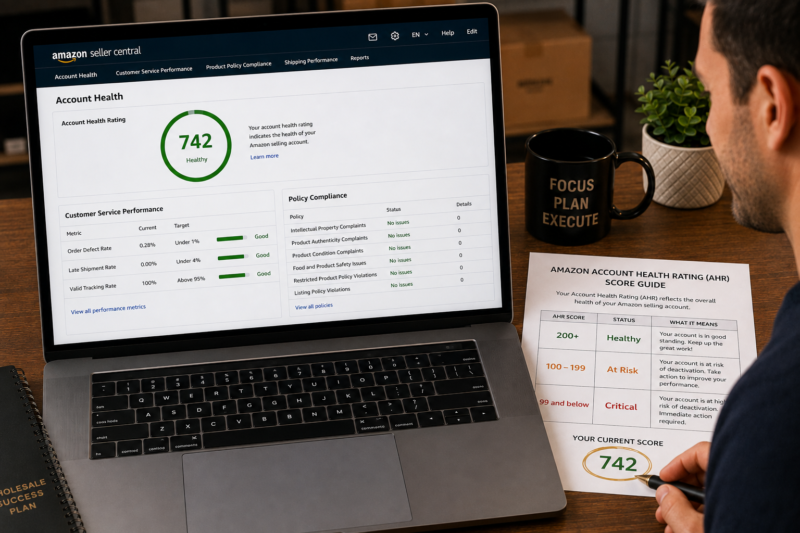
The Amazon Account Health Rating — known as the AHR — is the single most important number on your Seller Central account health dashboard. It is a composite score that summarises your account’s overall standing across every performance metric and policy compliance dimension Amazon tracks. Unlike individual metrics such as your Order Defect Rate or your Late Shipment Rate — which each measure one specific aspect of your selling behaviour — the AHR gives Amazon and sellers a single at-a-glance indicator of how healthy the account is overall and how much risk it currently carries of enforcement action. Understanding what the AHR score actually measures how it is calculated and what actions have the greatest impact on improving it is essential knowledge for every wholesale FBA seller who wants to protect the long-term security of their selling account.
We are Brandhunterz Ltd — a UK registered wholesale sourcing company (Company No: 15342697) — and in this complete guide we explain exactly what the Amazon Account Health Rating is what factors drive it up and down what the three status bands mean for your account security and the specific actions wholesale FBA sellers can take to build and maintain a high AHR score consistently.
💡 Quick Summary
The Account Health Rating is a score from zero to over 1000 that reflects your account’s overall compliance with Amazon’s performance standards and policies. Scores of 200 and above are Healthy — 100 to 199 are At Risk — and 99 and below are Critical. The score is primarily driven by your policy compliance record — each unresolved policy violation reduces it significantly — and secondarily by your customer service metrics including Order Defect Rate. To improve your AHR resolve all open policy violations promptly keep your Order Defect Rate well under 1 percent and build order volume consistently with no new defects over time.
What the Account Health Rating Actually Measures
Amazon has not published the exact formula used to calculate the AHR score — but based on how the score responds to different account events it is clear that the score is weighted across two primary dimensions and that policy compliance carries more weight than customer service performance for most sellers:
| AHR Dimension | What It Covers | Relative Weight |
|---|---|---|
| Policy Compliance | Number and severity of open policy violations — IP complaints product authenticity restricted product and listing violations | Primary driver |
| Customer Service Performance | Order Defect Rate — Late Shipment Rate — Valid Tracking Rate — customer complaint patterns | Secondary driver |
A single unresolved policy violation can drop an AHR score from Healthy to At Risk or from At Risk to Critical — a much larger single-event impact than any realistic customer service metric movement. This means that for wholesale FBA sellers the most powerful account health protection action is preventing and promptly resolving policy violations — not just keeping your defect rate low.
The Three AHR Status Bands — What Each One Means for Your Account
The AHR score is grouped into three status bands — Healthy At Risk and Critical. Each band has a different practical implication for your account security and for how Amazon is likely to treat any new violations or metric breaches that occur while you are in that band:
| Status Band | Score Range | Account Security Implication |
|---|---|---|
| 🟢 Healthy | 200 and above | Full account security — Amazon is unlikely to suspend for a single new violation — appeal opportunity more likely before enforcement |
| 🟡 At Risk | 100 to 199 | Elevated suspension risk — one new violation could push account to Critical — immediate remediation required on all open issues |
| 🔴 Critical | 99 and below | Immediate suspension risk — Amazon may deactivate the account without prior warning — urgent action required today |
💡 Why a High Healthy Score Provides More Than Just Peace of Mind
Amazon uses the AHR score as a factor in determining how it responds to new violations and metric breaches. A seller with an AHR score of 750 who receives a new intellectual property complaint is more likely to receive a warning notification with an opportunity to respond before any action is taken. A seller with an AHR score of 150 who receives the same complaint is much more likely to have their listing immediately suppressed or their account placed under review. The Healthy band is not just a target — a score in the upper Healthy range is a real buffer that gives you time to respond to problems before they escalate into enforcement.
What Decreases Your AHR Score
Understanding what pushes your AHR score down is the starting point for protecting it. These are the events and conditions that reduce your score — in order of typical impact severity:
| Score Reduction Event | Typical Score Impact | How Long It Affects Score |
|---|---|---|
| New unresolved policy violation — any category | Large immediate drop — can move band | Until resolved — then gradual recovery |
| A-to-Z Guarantee claim filed against your account | Moderate drop — impacts ODR | 60-day rolling window — fades after 60 days |
| Negative seller feedback — 1 or 2 star rating | Moderate drop — impacts ODR | 60-day rolling window — fades after 60 days |
| ODR breaching or approaching 1 percent threshold | Significant sustained drop | While ODR remains elevated — recovers as defects age out |
| Multiple violations across different policy categories | Compounding large drop | Each violation impacts independently — simultaneous violations severely compress score |
What Increases Your AHR Score
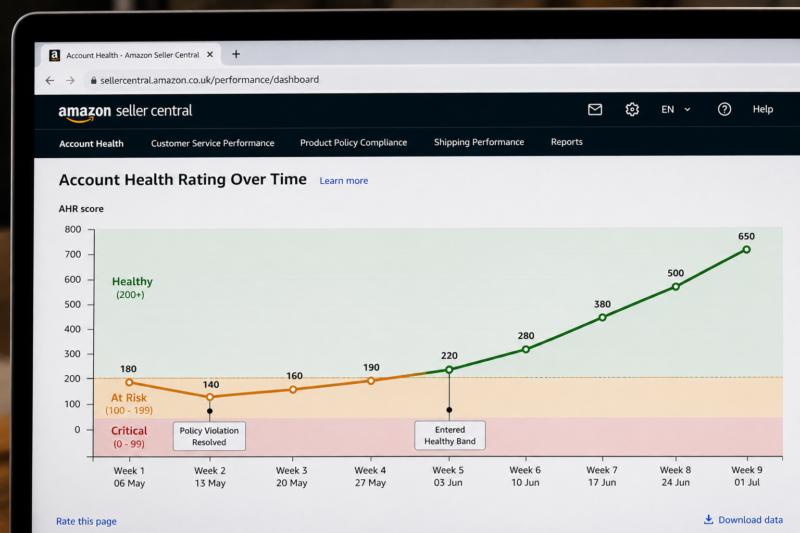
Improving your AHR score is not as fast as dropping it — the score recovers more slowly than it falls. Here are the factors that increase your score over time and the actions that accelerate that recovery:
| Score Improvement Factor | How It Improves Your Score | Timeline |
|---|---|---|
| Successfully resolving a policy violation | Removes the violation’s negative weight from your score — single most impactful recovery action | Score begins recovering within days of resolution |
| Time passing without new violations or defects | Amazon’s algorithm rewards clean periods — the longer your account runs cleanly the higher your score climbs | Gradual improvement — weeks to months depending on starting score |
| Consistent low Order Defect Rate — well under 1% | Clean ODR maintained across a rolling 60-day window builds the performance dimension of your score steadily | Continuous — improves month over month with clean selling |
| High order volume with no defects | More orders successfully fulfilled without issue signals reliable selling behaviour and pushes score higher | Accelerates score improvement — higher volume = faster score build |
| Old defects and violations aging out of rolling windows | Customer service defects drop out of the 60-day ODR window automatically — policy violations have longer tails | 60 days for ODR components — longer for resolved policy violations |
The Fastest Way to Improve a Dropping AHR Score
When your AHR score drops — whether from a new policy violation a spike in A-to-Z claims or a deteriorating ODR — the order of priority for recovery actions is clear. Follow these steps in sequence and do not wait to act on any of them:
Identify Every Open Violation and Complaint on the Dashboard
Open your Account Health dashboard and read every entry in the Policy Compliance section. For each open violation or complaint click through to the full detail — read the specific allegation the ASIN affected and the action Amazon is requesting. Do not attempt to respond to any violation without first fully understanding what it alleges and what Amazon is asking you to do.
Respond to Policy Violations With Documentation — Not Just Explanations
Amazon’s policy teams respond to evidence not to assurances. When responding to any policy violation provide documentation — your supplier invoices showing you purchased the products legitimately your supplier’s authorisation letter if applicable photographs of the products and their packaging and any relevant brand authorisation or distributor agreement. A response that says the products are genuine without supporting documentation is unlikely to resolve the violation and may result in escalation.
Address the Root Cause — Not Just the Symptom
When responding to a policy violation Amazon expects you to not only resolve the current complaint but also to explain what you have done to prevent it recurring. If a product authenticity complaint has been filed against an ASIN you must explain in your response what sourcing change or supplier verification step you have implemented to ensure product authenticity going forward. Responses that address only the immediate complaint without a credible preventive action plan have a lower resolution rate.
Reduce Your ODR If It Is Contributing to the Score Drop
If your ODR is elevated identify which orders generated the defects — negative feedback A-to-Z claims or chargebacks — and determine the root cause. For FBA sellers most ODR issues stem from product quality or product description accuracy problems. If customers are receiving products that do not match the listing review your listing content carefully and remove any inaccurate claims. If products are arriving damaged review your packaging prep standards and your supplier’s quality control process.
Continue Selling Cleanly While Score Recovers
Once all violations are resolved and your ODR is trending down the fastest way to rebuild your AHR score is to continue selling at volume with zero new defects or violations. Every clean order adds positive evidence to Amazon’s assessment of your account. The recovery timeline varies by the severity of what caused the drop — minor ODR spikes recover within 60 days as old defects age out while resolved policy violations may take several months of clean selling to fully recover from in terms of score position.
How Wholesale FBA Sellers Can Maintain a High AHR Score Consistently
The sellers who maintain consistently high AHR scores do not achieve this through reactive firefighting — they build habits and sourcing practices that prevent the problems that cause score drops from occurring in the first place. Here are the practices that most effectively protect a high AHR score for wholesale FBA sellers:
| Protection Practice | How It Prevents AHR Score Drops |
|---|---|
| Source only from authorised distributors and wholesalers | Eliminates the primary cause of product authenticity complaints — unauthorised or grey market sourcing |
| Check brand gating status before listing any new product | Prevents IP complaints from brands who have restricted their category on Amazon |
| Never send damaged or opened units to FBA | Eliminates product condition complaints — a major source of ODR defects and negative feedback |
| Keep listing content accurate — match exactly what is in the box | Reduces customer disappointment complaints — accurate listings produce fewer not as described returns |
| Respond to every A-to-Z claim and negative feedback promptly | Demonstrates active account management — unresponded claims show negatively in Amazon’s assessment |
| Review account health dashboard every week without exception | Catches new violations within days of appearing — earlier response = better resolution outcomes |
AHR Score Benchmarks — What Is a Good Score for a Wholesale FBA Seller
While any score above 200 is technically Healthy there are meaningful differences in what different score levels signal about an account’s history and current risk profile:
| AHR Score Range | What It Typically Indicates | Target Status |
|---|---|---|
| 700 and above | Excellent — clean account with no recent violations and consistently low defect rate | Ideal target for all sellers |
| 400 to 699 | Good — healthy account with minor historic issues that have been resolved — solid protection level | Acceptable — aim to push higher |
| 200 to 399 | Healthy but lower buffer — recent resolved violations or elevated ODR period still in window | Monitor closely — act to improve |
| 100 to 199 | At Risk — open violations or sustained ODR issues requiring immediate action | Immediate action required |
| Below 100 | Critical — multiple open violations or severe metric breaches — suspension imminent | Urgent action today — no delay |
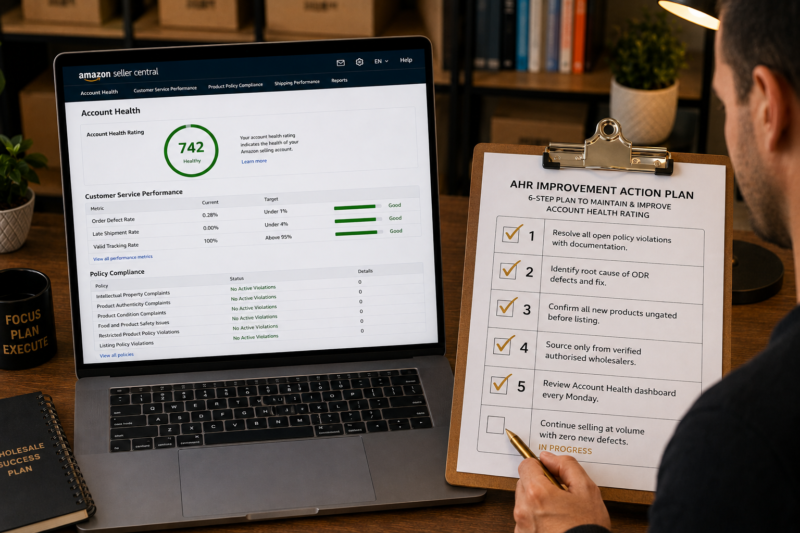
Your AHR Score Improvement Action Plan
| Action | Priority | Done |
|---|---|---|
| Resolve every open policy violation — with documentation | Immediate — highest impact action | ☐ |
| Identify root cause of any ODR defects — fix sourcing or listing issues | Immediate — prevents further defects | ☐ |
| Confirm all new products are ungated before listing | Ongoing — before every new listing | ☐ |
| Source only from verified authorised wholesalers | Ongoing — every purchase order | ☐ |
| Review Account Health dashboard every Monday | Weekly — non-negotiable routine | ☐ |
| Continue selling at volume with zero new defects or violations | Ongoing — the primary recovery mechanism | ☐ |
| All actions in place — AHR score recovery in progress | ✅ | |
Conclusion — Build Your Score High and Keep It There
A high Account Health Rating score is not just a vanity metric — it is a material protection for your FBA business. It gives you time to respond to new problems before Amazon takes enforcement action and it signals to Amazon’s systems that your account is a reliable long-term seller worth protecting. Building your score to 700 and above and keeping it there through clean sourcing accurate listings and consistent weekly monitoring is one of the most valuable long-term investments you can make in the security of your wholesale FBA business.
Find your next wholesale brand through our Brands Directory. Research every product with Keepa. Confirm every margin with AMZScout. And protect your AHR score using the action plan in this guide.
FIND YOUR NEXT WHOLESALE BRAND — SELL WITH A HIGH AHR SCORE
Browse 5,000+ Verified Wholesale Brands Free
Find verified wholesale trade contacts in the Brandhunterz Brands Directory — source your product apply for your account and sell on Amazon FBA with a consistently high Account Health Rating.
About the Author
This article is written by the team at Brandhunterz Ltd — a UK registered Amazon FBA wholesale sourcing company (Company No: 15342697) registered in England and Wales since 2023. Visit brandhunterz.com to learn more.